Two Overgrips Walk Into a Sweaty Match: Tourna Grip vs. Yonex Super Grap
You are up 5-3 in the first set, serving for it. Your hands are wet — not damp, wet. You toss, you swing, and somewhere between the trophy position and contact the handle rotates half a centimetre in…

You are up 5-3 in the first set, serving for it. Your hands are wet — not damp, wet. You toss, you swing, and somewhere between the trophy position and contact the handle rotates half a centimetre in your palm. The ball lands wide. You look at your grip. It looks fine. You know it isn't.
That half-centimetre is the difference between trusting your serve and managing it. And the solution, for most players, is an overgrip. But not any overgrip. There are two families, and they work in opposite ways. If you pick the wrong one for your hand, you will keep losing that half-centimetre. If you pick the right one, you stop thinking about your grip entirely — which is the whole point.
Two Ways to Be Grippy
The first family is the dry-absorbent grip. It feels papery, thin, almost chalky. It does not feel tacky when you hold it. Its trick is that it soaks up moisture and holds it inside the wrap, so your hand stays dry against the surface. Tourna Grip is the king of this family.
The second family is the tacky-wet grip. It feels sticky when you touch it, even out of the pack. It does not absorb much moisture. Instead, it stays grippy because the surface tack holds against your skin even when both are wet. Yonex Super Grap is the best-known example.
They feel opposite. They behave opposite. And if you have been using one and wondering why your grip keeps slipping, you might simply be in the wrong family.
Tourna Grip: The Sponge
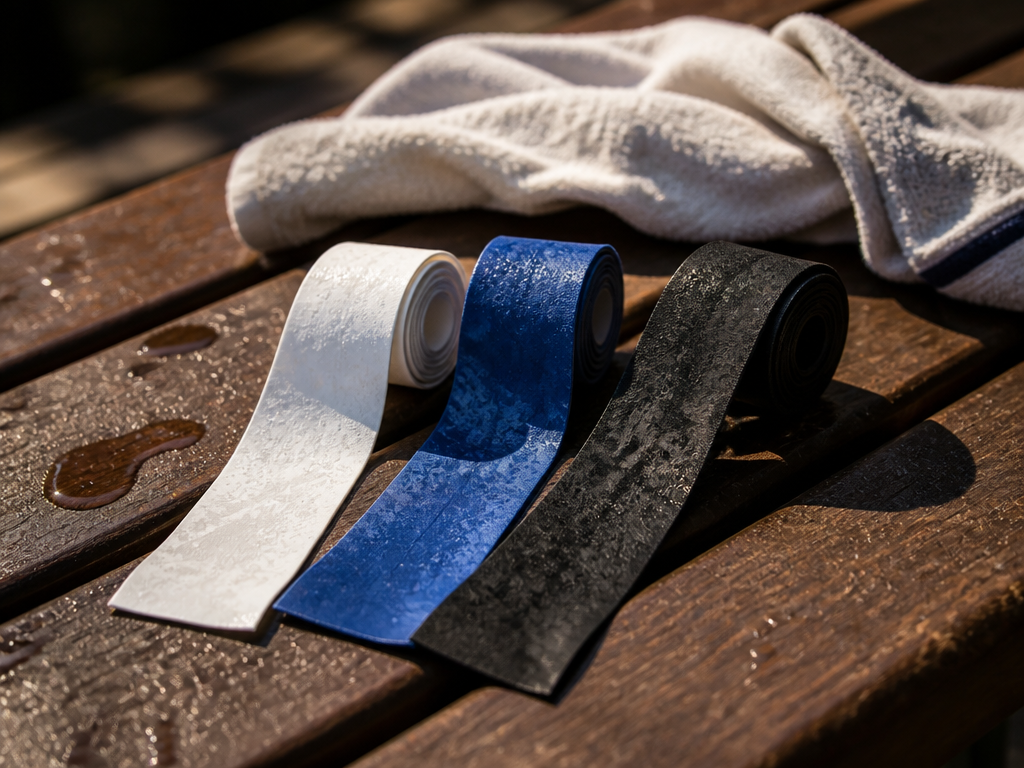
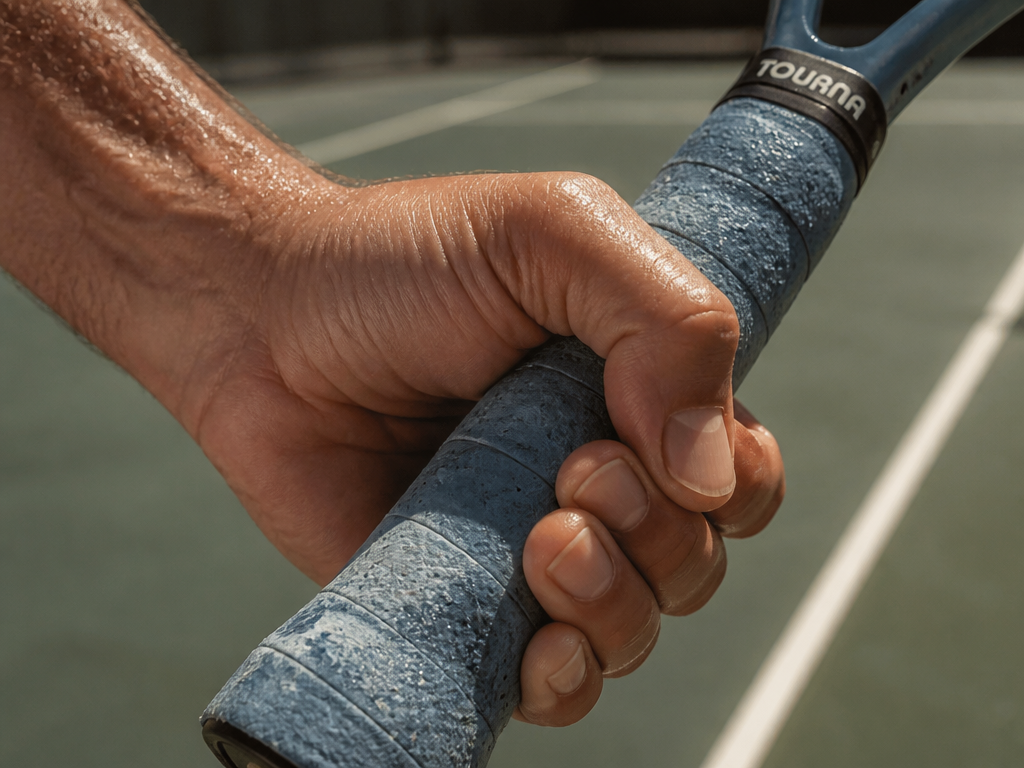
Tourna Grip is the blue-and-white roll that has been on pro racquets since the 1980s. It is thin, it tears easily when you wrap it, and it feels like medical tape. Players who love it say "the more you sweat, the grippier it gets." That is almost true. The more you sweat, the more moisture the grip absorbs, and the drier your hand stays on the surface. The grip itself gets wet inside, but your palm feels dry.
I used Tourna for seven years because I believed what everyone believes: that it is the best grip for sweaty hands. And it is, in the sense that it does not go slick. But here is what nobody told me: Tourna loses its texture after about two hours of match play. The papery surface wears smooth where your thumb wraps over the index finger. By the middle of the second set, you are gripping a slightly damp, slightly smooth surface that no longer grabs your skin the way it did fresh.
You can change it every match, and many pros do. But changing an overgrip between sets on a public court with sweaty hands is not fun. The adhesive strip on Tourna is narrow. The tape is fragile. If you rush, you ruin it.
Honest negatives: short lifespan, fragile installation, collects dust and court grit, and if you have dry hands you will hate it — it feels like nothing.
Yonex Super Grap: The Sticker
I switched to Super Grap two years ago because I was tired of changing grips between matches. I expected to hate it. A tacky grip on sweaty hands sounded like a physics mistake.
The first time I hit with it, the sensation was disorienting. The grip is thicker than Tourna — noticeably cushioned. It has a rubbery, almost squishy feel. And it is aggressively tacky. When you put your hand on it, your palm sticks. When you adjust your grip between shots, you feel the skin pull.
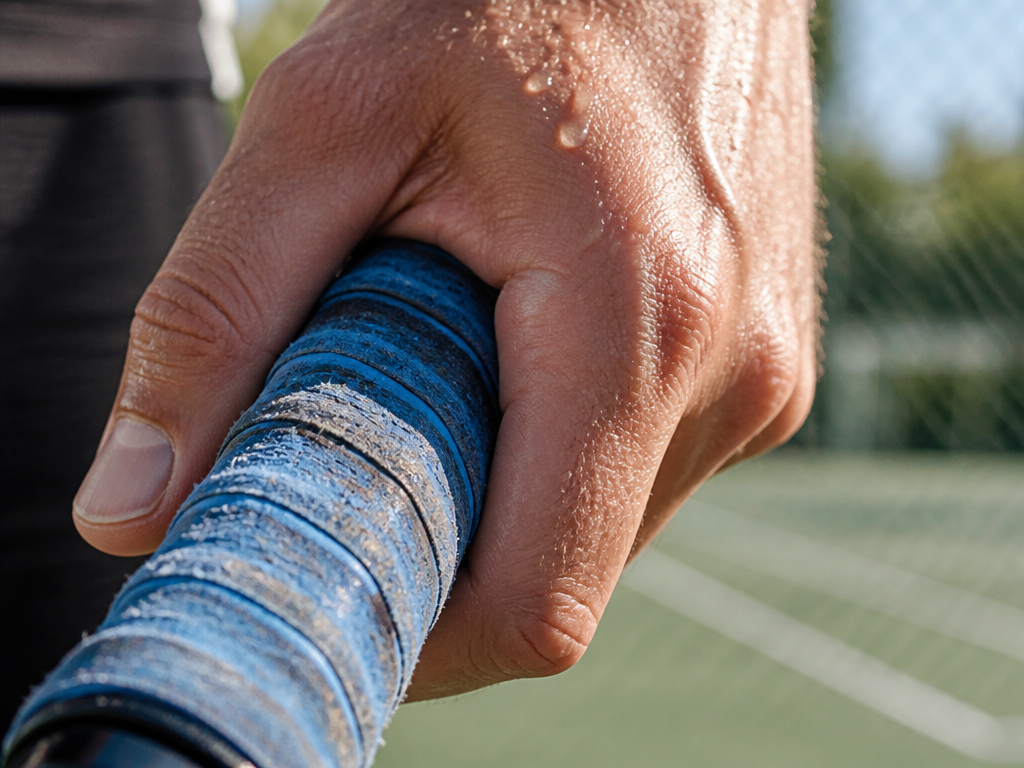
In dry conditions, Super Grap is almost too sticky. You have to consciously loosen your fingers between points because the grip does not let your hand slide naturally. But in humid match conditions — the kind where your palm is wet before the first changeover — something interesting happens. The tack activates. The moisture does not kill the stickiness; it seems to make it more consistent. Your hand stays planted on the grip through the entire swing.
The first time I served an entire match without adjusting my grip once, I looked at the handle and realised I had not thought about it. That is the win.
Honest negatives: it wears differently — the tack fades gradually over 6-8 hours rather than dying suddenly, the thickness changes the balance of a head-light racquet, and if you hate a cushioned feel you will hate this.
Head to Head
| Criterion | Tourna Grip | Yonex Super Grap |
|---|---|---|
| Sweat handling | Absorbs moisture into the wrap | Tack holds against wet skin |
| Lifespan in match play | 1.5–2 hours before surface goes smooth | 6–8 hours before tack fades |
| Feel | Thin, close to the bevels | Cushioned, masks bevel feel |
| Installation ease | Fragile, tears easily, narrow adhesive strip | Easy, stretches slightly, wide strip |
| Cost per hour (approx) | Low per grip, high per hour (you change often) | Higher per grip, lower per hour (it lasts) |
| Dust pickup | High — picks up everything | Low to moderate |
How I'd Actually Decide
You have to know what kind of sweater you are.
If your hands drip between points — if you wipe them on your shorts, your towel, the court — you are a heavy sweater. For you, Tourna is still the right choice, but only if you are willing to change it every match. If you are not, your second set will be played on a worn-out surface.
If your hands are moderately sweaty — damp but not dripping — you should try Super Grap. The tack will hold through a full match and into the next one. You will lose some bevel feel, which matters if you play with extreme western grips where you need to feel the edge. But you will gain a consistent contact surface that does not change halfway through a set.
If you play in dusty conditions — red clay, Har-Tru, hard courts with loose surface grit — Tourna will turn into sandpaper within games. Super Grap picks up less dirt and is easier to wipe clean between points.
Who This Is For
Super Grap is for the player who wants to install a grip and forget about it for a week of practice and matches. It is for the player who wins more points when they stop adjusting their grip.
Tourna is for the player who needs to feel the bevels, who changes grips often anyway, and who plays in conditions so humid that no tack could possibly hold. It is for the player who trusts the ritual of fresh wrap before a match.
Who This Isn't For
Neither of these is for players with naturally dry hands. If your palms stay dry through a two-hour match, you can use any synthetic grip — or a leather grip with no overgrip — and get better feel than either of these offers.
Neither is for the player who wants a grip that feels the same in January as in July. All overgrips are humidity-sensitive. The question is which direction they break.
The Unsettled Question
Here is what I still do not know, and neither does anyone who tests these things seriously: does the moisture that Tourna absorbs actually change the weight and balance of the handle over the course of a match? A wet Tourna grip is heavier than a dry one. By how much, and does that matter when you are hitting a forehand at the start versus the end of a set? And on the other side — does the tack of Super Grap degrade faster in high humidity, or does moisture reactivate it? I have seen evidence for both claims, from players I trust.
The science on grip performance under real match conditions is mostly absent. Manufacturers test in labs. Players test on court. The two datasets do not overlap cleanly. You have to run your own experiment.
Here is how: buy one roll of each. Play a match with Tourna. Change it. Play the same match a week later with Super Grap. Do not switch mid-match. Pay attention to when you stop thinking about your hand. That is your answer.
The half-centimetre that cost you the serve at 5-3 is not a technique problem. It is a contact problem between your skin and the handle. Fix the contact, and your technique — which was always good enough — gets to show up.