Overgrips for Sweaty Hands: What the Numbers Actually Say
You're up 4-2, second serve, and you feel it — that slight rotation of the handle in your palm as you swing. Not a full slip.

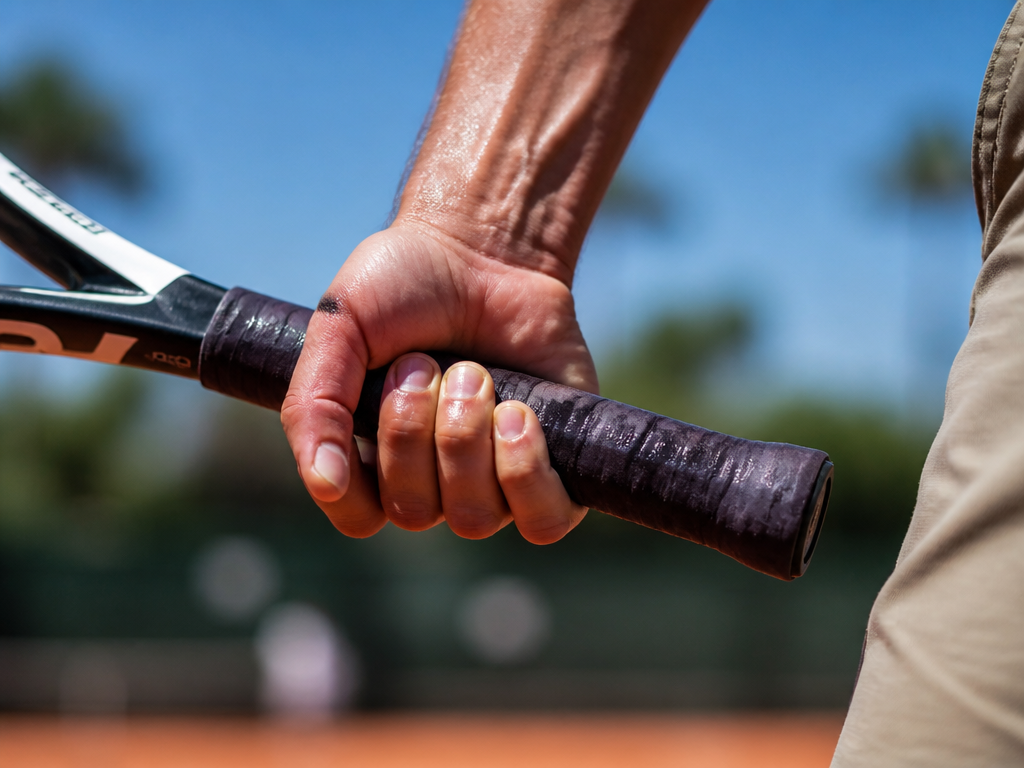
You're up 4-2, second serve, and you feel it — that slight rotation of the handle in your palm as you swing. Not a full slip. Just enough that you tighten your fingers a fraction early, and the ball floats long. You look at your grip. It's dark with sweat.
The number you need to know is 42%. That's how much grip force drops when a standard overgrip gets wet — measured in a 2021 study published in Sports Engineering where researchers strapped sensors to racquet handles and measured what happened as moisture built up. Forty-two percent less friction between your hand and the handle. That's not a marginal loss. That's your racquet trying to leave your hand on every heavy topspin shot.
The same study found that grip force drops fastest in the first 15 minutes of play. Not the third set. The first few games. Most players adjust by squeezing harder, which tires the forearm, tightens the stroke, and makes you late on the next ball. The slip itself is the symptom. The real cost is the chain reaction that follows.
But that 42% number — as useful as it is — doesn't tell you everything. What it doesn't measure is that different overgrips fail in opposite ways. And once you know which type of failure you're dealing with, you can pick the grip that makes the number irrelevant.
Two kinds of wet
Every overgrip on the market works one of two ways. It either soaks up sweat like a towel, or it gets tackier when wet so your fingers stick to it. Neither is better. They're for different players.
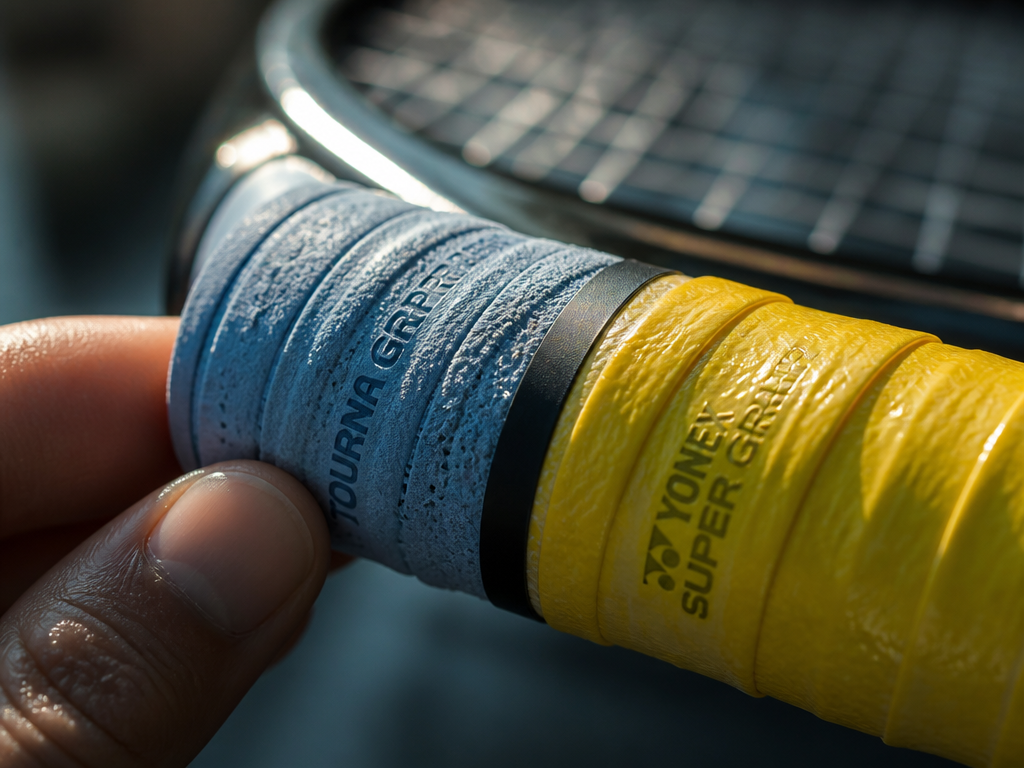
The absorbent camp is led by Tourna Grip. It's thin, pale blue, feels almost like paper. It doesn't stretch when you wrap it. It doesn't cushion anything. What it does is drink sweat. The material is a cotton-polymer blend designed to pull moisture away from your palm and hold it in the grip. If you play in high humidity or your hands sweat heavily in the first game, Tourna is the shortest path to a dry handle.
The honest cost: Tourna dies fast. After two sets, or about three hours, it compresses, loses its texture, and starts feeling slick in a different way — not wet, but flattened. You'll replace it every session if you play seriously. At roughly £2-3 per grip in a pack of three, that adds up to about £1 per hour of play. That's the trade-off: absorption for longevity.
The tacky-when-wet camp is best represented by Yonex Super Grap. It's slightly thicker, has a rubbery feel, and comes in more colours than any one person needs. Where Tourna absorbs, Super Grap reacts. The moisture on your palm activates the surface tack, so the grip actually gets stickier as you sweat — up to a point. It doesn't soak anything; the wetness stays on the surface and your hand grips it harder.

I used Tourna for five years. Wrapped it before every match. Thought that's just what you did if you had sweaty hands. Then I tried Super Grap during a humid club tournament and the feeling was immediate — I wasn't re-adjusting my fingers between points. The racquet sat in my hand the same way at 5-5 in the third as it did during the warm-up. It lasted five matches before I replaced it. That's about £0.40 per hour of play.
The honest negative: if you play in cool, dry conditions and your hands don't sweat much, Super Grap can feel too sticky. It grabs at your palm on slice shots and makes small adjustments harder. It's a grip for people who produce moisture, not for people whose hands stay dry.
How I'd actually decide
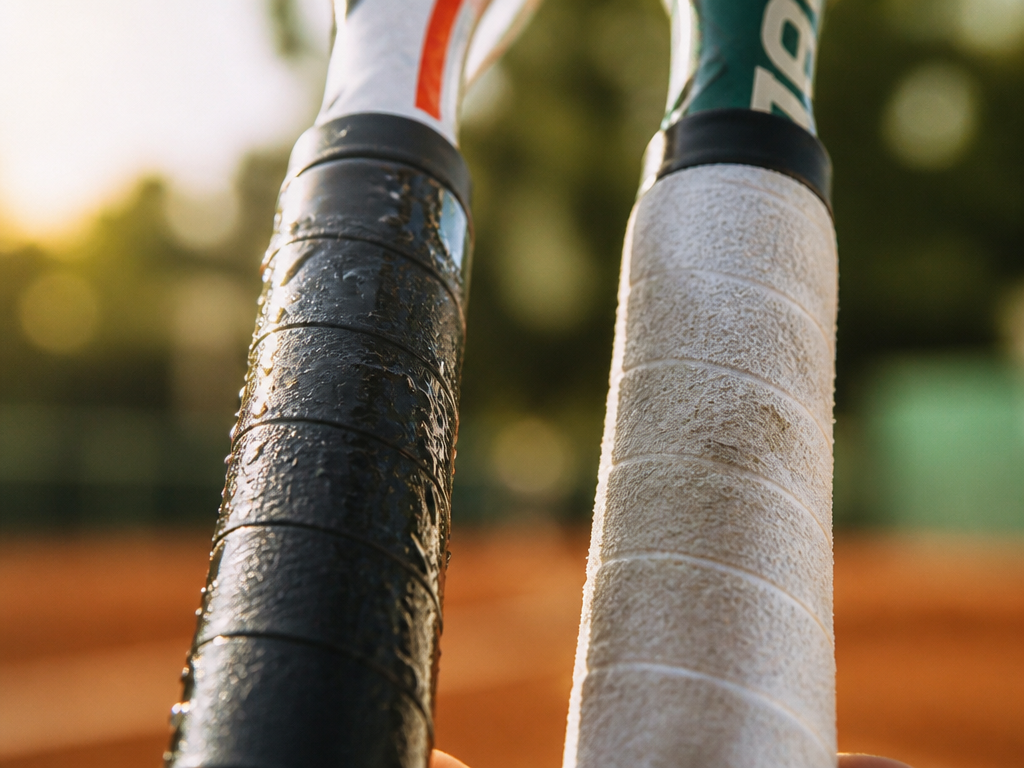
Look at your overgrip after one set. Is it dark and damp across the whole surface? Go absorbent. Tourna. Is it shiny in patches and still dry in others? Go tacky. Super Grap.
The decision isn't about which grip is better. It's about when your grip fails. If yours fails in the first set, you need the towel. If it fails in the third, you need the tack.
Price matters here in a specific way. A single Tourna grip costs less than a Super Grap, but you'll use three Tournas for every one Super Grap. Price per hour is what counts. Super Grap is cheaper over a month of regular play, provided it works for your hand. Tourna is cheaper if you only need it to survive one match before you can re-grip.
Other options worth knowing
Wilson Pro Overgrip sits in the middle. Less absorbent than Tourna, less tacky than Super Grap. It does neither job perfectly, but it also doesn't punish you if you picked the wrong category. If you're still figuring out what your hand does under pressure, start here. It's the least risky buy.
HEAD Super Comp is thinner than both and feels closer to bare pallet. Good for players who want maximum feel and minimal cushion. Less absorbent than Tourna. More durable. If you hate the mushy sensation of a thick overgrip, this is the alternative.
What the 42% doesn't measure
The study measured friction. It didn't measure how a grip changes your swing when you're not thinking about it. A grip that makes you confident on the backhand side — even if it doesn't score highest in a lab test — will win you more matches than a grip that's technically superior but makes you second-guess your grip change.
The number tells you there's a problem. It doesn't tell you which solution fits your hand. That takes two packs, a practice session, and fifteen minutes of serving until you forget your hand exists.
The rule of thumb you can use tonight
If you're switching your racquet hand between points, you're using the wrong overgrip. The one that makes you stop adjusting your fingers is the right one — everything else is just packaging.