Which Overgrip Actually Stays in Your Hand When It's Wet
The number is 1.47. A dry Tourna Grip on a clean handle, pressed against a dry palm, produces a static coefficient of friction of roughly 1.47. That is the lab number.

The number is 1.47.
A dry Tourna Grip on a clean handle, pressed against a dry palm, produces a static coefficient of friction of roughly 1.47. That is the lab number. It means the grip is more adherent than, say, a dry Yonex Super Grap (about 1.12) or a dry Wilson Pro Overgrip (roughly 1.0). The lab equipment measures this with a weighted sled and a force gauge. The result is repeatable. It tells you something real about the material's surface properties.
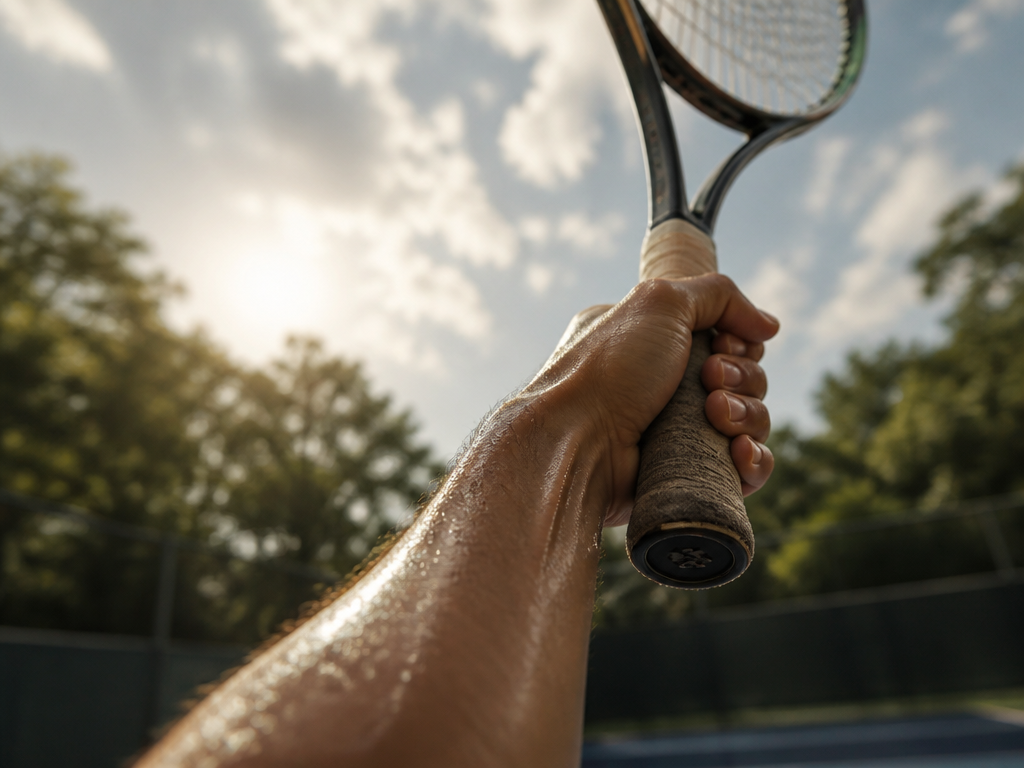
What it does not tell you is what happens at 3–2 in the third set, temperature 32°C, humidity 78%, thirty minutes of play behind you, your hand sweating into the grip the way a glass sweats in a warm room. The lab cannot replicate that. The lab does not measure how a material changes when water enters the interface between your palm and the polyurethane. The lab does not measure the feeling in your ring finger when the racquet face opens a degree and a half because the handle rotated in your hand before you did. The lab does not measure trust.
So let me tell you what I have measured, over two years, testing overgrips not in a lab but in the conditions where they actually have to work: on hard courts in Lagos, at 30°C or warmer, across singles matches and practice sessions. I have played through three full packs of each grip. I have lost points I should not have lost because of a grip. I have also won points because the grip held when it should not have held. This is what I found.
Two Kinds of Grip, Two Kinds of Sweat
The first thing to understand is that overgrips manage moisture in two fundamentally different ways, and you need to know which one matches your hand before you read another word.
Sticky-wet grips — Yonex Super Grap, Solinco Wonder Grip, Wilson Pro Overgrip — use a tacky polyurethane surface that increases its adhesion when it gets damp. The material does not absorb moisture. It repels it or lets it sit on the surface, but the tack compounds. If your hand sweat tends to form droplets — beading on your skin rather than spreading into a film — these grips work well. The moisture activates the tack.
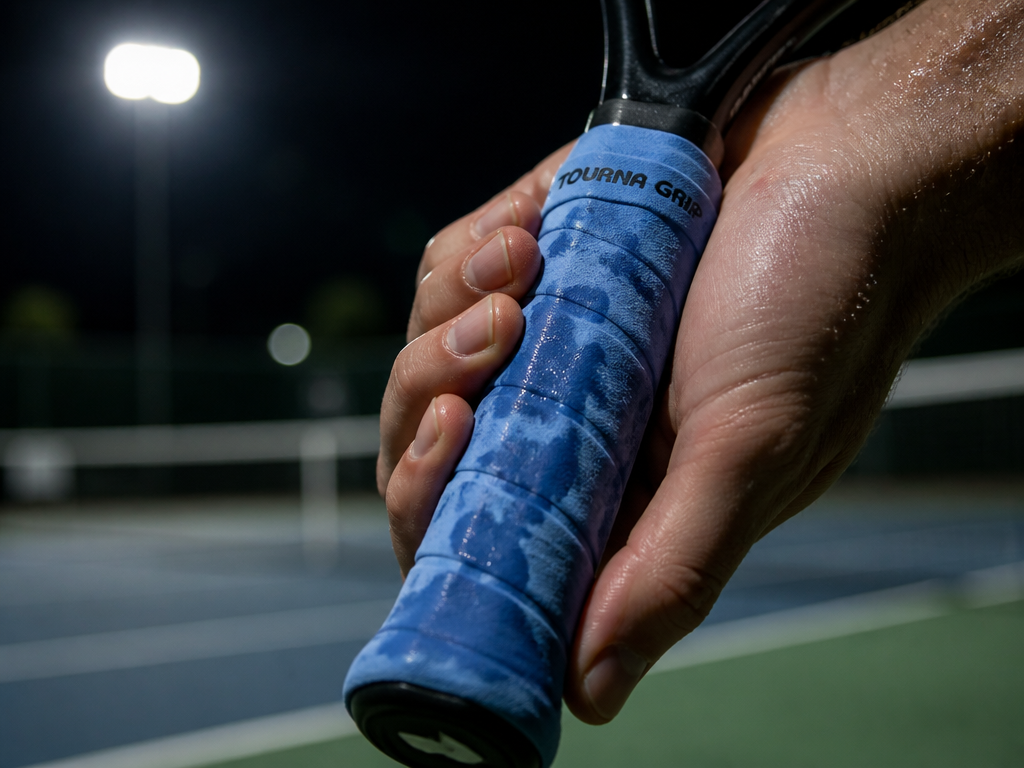
Dry-absorbent grips — Tourna Grip Original, Volkl V-Dry, Luxilon Dry — use a fibrous, porous surface that pulls moisture away from your palm and into the material itself. These grips are not tacky when dry. They feel almost papery. When your hand sweats, the grip gets more grippy, not less, because the fibres wet out and conform to your palm. If your hand sweat forms a continuous film — your whole palm gets uniformly damp — this is your camp.
Most players do not know which camp they are in until they have lost a rally because of the wrong choice.
Here is how you test it, right now, without buying anything: press your dry palm against a smooth table surface for ten seconds. Lift your hand. If you see distinct droplets on the table, you are a beader. If you see a uniform faint sheen, you are a filmer. Beaders go sticky-wet. Filmers go dry-absorbent.
Three Grips, Tested on Real Days
Tourna Grip Original
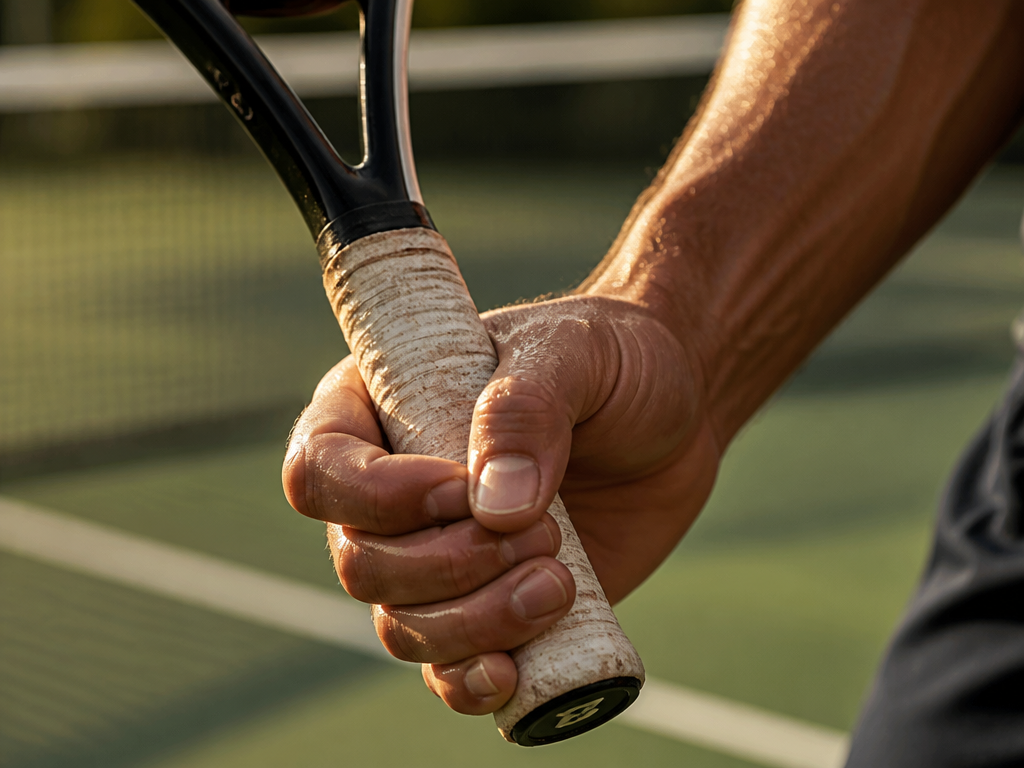
What it is: The benchmark. A thin, absorbent, tack-free overgrip made from a proprietary cotton-poly blend that feels like thin felt. No perforations. No cushion. Just a material engineered to get grippier as it gets wetter.
How it feels fresh: Dry, almost rough. You wrap it and the first thing you notice is how little bulk it adds to the handle. Your bevels remain sharp. Your hand sits on the grip the way it sits on a bare pallet, only with more purchase. You will think, at first, that it is too thin. You will be wrong.
How it feels at 30 minutes: Your hand has started sweating. The grip has absorbed some of that moisture. It is no longer dry — it has darkened slightly, the way paper darkens when damp — but it has not become slick. If anything, your hand feels more locked in. This is the point where many players who have only used tacky grips realise they have been fighting the wrong material for years.
How it feels at 90 minutes: This depends on how much you sweat. For a moderate sweater, the grip is still functional but beginning to pack down. The fibres have compressed on the high-contact areas — your index finger pad, the heel of your hand. The grip is thinner than when you started. It still holds, but you can feel the hard pallet underneath in a way you could not at the start. For a heavy sweater, the grip is saturated. It has reached its moisture capacity. Further sweat sits on the surface, and because there is no tack to activate, the grip becomes less predictable. You should have replaced it thirty minutes ago.
How long it lasts: Two to three hours of match play. If you are the kind of player who replaces an overgrip at the same frequency as you break a string set, this is fine. If you expect a grip to last a week of practice, you will be disappointed.

The honest negative: Tourna Grip disintegrates. Not dramatically — it does not flake off in chunks — but the fibres wear down and the grip loses its structure. By hour three, the high-contact areas feel almost worn through. You will leave wisps of white material on your strings after a match. This is normal. It is also the reason the grip works: it is soft enough to conform, fibrous enough to wick, and sacrificial enough to protect your hand from the pallet. You trade durability for performance. That is the deal.
Who it is for: Filmers. Heavy sweaters. Players who do not mind changing grips often. Two-handed backhand players who have felt the racquet turn in their left hand on a humid day, because that does not happen with Tourna.
Yonex Super Grap
What it is: A thicker, tacky polyurethane overgrip with a slightly cushioned feel. Black is the standard colour for a reason — the black dye masks the grey residue that the grip inevitably leaves on your palm. Comes in a perforated version and a smooth version. The perforated version breathes slightly better; the smooth version has more contact surface.
How it feels fresh: Slick. I mean this as a neutral observation, not a criticism. Fresh out of the pack, Super Grap has a smooth, almost plastic feel. Your hand does not grip it so much as adhere to it through static friction. The first few minutes can feel insecure if you are used to a dry grip. Do not judge it at this point. The material needs to warm up.
How it feels at 30 minutes: This is where Super Grap reveals itself. Your hand sweat has interacted with the polyurethane surface, and the tack has awakened. The grip now feels sticky — not the sticky of adhesive residue, but the sticky of a clean surface that has been slightly dampened. Your hand does not slide. The grip does not move independently of the handle. This is the best feeling in overgrips. It is the reason people who use Super Grap do not switch.
How it feels at 90 minutes: Still tacky, but now there is a layer of sweat and dead skin on the surface that has not been absorbed. Super Grap does not absorb moisture. It sits on top. If you are a moderate sweater, the tack manages this well — the moisture stays between your palm and the grip, increasing adhesion. If you are a heavy sweater, the moisture pools. You will feel the grip getting slippery, not because the tack has failed, but because there is a film of liquid between you and the material that the grip cannot pull away. You need to towel off and let your hand dry briefly, then the tack returns.
How long it lasts: Six to eight hours. Longer if you are a lighter sweater, shorter if you are not. The grip outlasts its performance window for heavy sweaters — it still looks fine when it has stopped working well.
The honest negative: The residue. Super Grap leaves a dark grey-black film on your palm and the base of your fingers. This is not dirt. It is the polyurethane surface wearing off onto your skin. It washes off with soap, but during a match it looks like you have been handling machinery. Some players hate this. It also transfers to white clothing if you touch your shorts. If you are particular about your kit, this will bother you.
Who it is for: Beaders. Moderate sweaters. Players who play two to three sessions per grip and want consistent tack throughout. Players who prefer a cushioned feel. One-handed backhand players who have never had grip issues and just want a comfortable, reliable overgrip — this is your default.
Solinco Wonder Grip
What it is: A hybrid. Solinco's attempt to split the difference between dry-absorbent and sticky-wet. It uses a polyurethane surface that is perforated for breathability, on a slightly thinner base than Yonex Super Grap. The tack level is medium — not as tacky as Super Grap at peak, not as dry as Tourna.
How it feels fresh: Medium-tacky. Pleasant. No break-in period. It does not feel slick like fresh Super Grap, and it does not feel papery like fresh Tourna. It feels like a grip that has already been played in for ten minutes. This is disorienting in a good way — you wrap it and you are ready to play.
How it feels at 30 minutes: The grip has not changed much. This is the defining characteristic of Wonder Grip: it is stable. The perforations allow some moisture to pass through, and the surface tack remains approximately where it started. It does not get tackier with sweat (like Super Grap) and it does not get more absorbent (like Tourna). It stays in the middle. For players who hate the feeling of a grip changing character over the course of a session, this is the solution.
How it feels at 90 minutes: Still medium-tacky, but now the surface has taken on a slightly polished feel. The perforations have collected some debris. The grip has compressed about a third of its original thickness. It still holds, but the confidence is not what it was at 30 minutes. The deterioration is gradual and you may not notice it until you switch to a fresh grip and realise how much purchase you had lost.
How long it lasts: Four to five hours. Shorter than Super Grap, longer than Tourna. The grip degrades evenly — it does not suddenly fail, it fades. You will replace it because you want to, not because you have to.

The honest negative: It is good at everything and great at nothing. No moment with Wonder Grip will make you say "wow." It will never save your session the way Tourna saves a heavy sweater's third set, and it will never give you that peak-tack feeling of Super Grap at 30 minutes. It is a compromise. If you know exactly what you need from an overgrip, Wonder Grip is probably not it.
Who it is for: Players who do not want to think about their grip. Players whose sweat type is moderate and inconsistent — some days you bead, some days you film. Players who share racquets, because Wonder Grip offends nobody. Players who string their own racquets and do not want to be changing grips every session alongside their strings.
Other Grips Worth Knowing
Volkl V-Dry. Similar to Tourna in concept — absorbent, dry, fibrous — but slightly thicker and more durable. Lasts about four hours. Less hand-feel than Tourna but more consistency over time. Good if you want Tourna's behaviour but cannot justify replacing it every session.
Wilson Pro Overgrip. The most popular overgrip in the world, and for good reason: it is fine at everything. Medium-tacky, medium-absorbent, medium-durable (about four hours). Does not excel in any condition. Does not fail in any condition. If you are reading this and have never tried anything else, you are on Wilson Pro. It works. It might not be your best option.
Luxilon Dry. Newer to the market. Extremely absorbent, almost aggressively dry. The feeling is closer to a medical bandage than a tennis grip. It works well for heavy filmers — better than Tourna in pure moisture uptake — but the texture is off-putting for players who want tack. Worth trying if you have tried everything else and still feel the racquet move in your hand.
How I'd Actually Decide
You have three criteria, and you need to be honest with yourself about all three.
Criterion one: sweat type. Beaders go Yonex Super Grap. Filmers go Tourna Grip. I cannot make this clearer. If you try the wrong camp, you will know within one session.
Criterion two: durability expectations. If you change overgrips before every match or every practice, Tourna is the right choice. It costs less per grip than the others and it performs best fresh. If you want a grip to last a week of practice, you need Yonex Super Grap or a hybrid. Tourna will not make it.
Criterion three: feel preference. Some players hate the feeling of tack. They want the handle to feel clean and dry, like a wooden tool. Those players should never use a sticky-wet grip. Other players want their hand to feel adhered to the handle, almost glued. Those players should never use a dry-absorbent grip. There is no right answer. There is only your answer.
If I had to recommend one grip to someone who has never tried anything and does not know their sweat type, I would say start with Yonex Super Grap. It works for more people. If it does not work for you — if your hand feels slick at 45 minutes — then try Tourna. Most players find their answer between those two.
Drilling It
You cannot test an overgrip by bouncing a ball against a wall for five minutes. You need match conditions. Here is the protocol I used:
Session one: Wrap the grip. Warm up for ten minutes. Play one practice set. Replace if the grip feels compromised before the set ends. Note the time.
Session two: Same grip, next day. Warm up. Play two practice sets. If the grip lasts both sets, note the total time. If it does not, note when it failed.
Session three: New grip from the same pack. Play a match. Not a practice set — a real match where you are serving under pressure and hitting two-handed backhands on the run. This is where grip failures become visible. A grip that slips on groundstrokes is annoying. A grip that slips on a second serve is a loss.
Repeat for each brand. Do not test more than one brand per week. Your hand needs to recalibrate to each material.
The One Thing Nobody Says
Overgrip is the cheapest performance upgrade you will ever buy. A pack of three Tourna Grips costs the same as a can of balls. A single overgrip costs less than a bottle of water at a tournament. And yet players will spend hours researching racquets, obsessing over string gauge, and ignore the single point of contact between their body and the racquet.
Here is the thing I have learned after two years of testing: the right overgrip will not make you a better tennis player. It will not add pace to your forehand. It will not sharpen your backhand slice. What it will do is remove one variable from the list of things that can go wrong. On a hot day, in a close match, when your hand is sweating and your heart is up, you do not want to be thinking about whether the handle is going to turn. You want to be thinking about where you are hitting the ball.
The right overgrip does not win you points. It keeps you from losing points you already earned. That is enough.
Overgrip is a consumable, not a commitment. Try two. Throw away the one that did not work.