Racquet Review: When Your Control Frame Hits a Ceiling — Blade vs Pro Staff vs the Spinelike Alternative
You know the feeling. Your forehand lands, and it lands short. Not by a lot — maybe a metre and a half inside the baseline — but the opponent steps in, takes it on the rise, and now you're defending.

You know the feeling. Your forehand lands, and it lands short. Not by a lot — maybe a metre and a half inside the baseline — but the opponent steps in, takes it on the rise, and now you're defending. You check the racquet. It's a Blade, or a Pro Staff, something you chose years ago because you wanted to feel the ball, because you hated the hollow ping of a stiff frame, because control mattered more than raw speed.
It still matters. But the rally ball has a ceiling, and you've started to wonder if the racquet is the limit.
Let me be honest from the top: this is not a review that tells you to throw away your control frame. I'm still not convinced most players should. But if you're an advanced club or competitive player who knows where the ball is going and just wishes it got there faster — with more shape, more weight, more of that heavy ball that makes an opponent hesitate — there is a small class of racquets worth your attention. They sit in a narrow slot between the classic control frames and the pure spin/power rockets. They don't ask you to give up feel. They ask you to adjust your expectations about what "control" actually means.
What Most People Do
I see two patterns. Both cost the player something real.
Pattern One: The Lead Tape Spiral
You've been adding weight. First at 3 and 9, because the internet told you that increases stability. Then a little at 12 for plough-through. Then handle weight to balance it. Before long your Blade is swinging at 340 and you can't get it around on quick exchanges. You tell yourself you'll adapt, but three weeks later your serve is still missing by the same margin and your arm is tired before the second set.
The problem is not that lead tape doesn't work. The problem is that a control frame's design limits how much you can push it before it becomes sluggish rather than powerful. The Blade 98 is a 21mm constant-beam racquet with a 63 RA flex. Adding mass increases plough-through but it doesn't change the beam's ability to store and release energy on heavy contact. You can make a Blade heavier. You cannot make it launch the ball the way a 23mm tapered beam does. At some point you're just fighting the chassis.
Pattern Two: The Spin-Power Jump
This is the player who walks on court one day with a Pure Aero 98 or a Babolat Strike and decides they'll "learn to control it." They are not the same player three months later. Their groundstrokes are shorter because they're afraid of overhitting. Their timing is off because the launch angle is different. They keep shanking the ball wide on the forehand side because they're used to closing the face late, and with a stiffer, more powerful frame, late means long.
I've done this myself. I spent a season in a Pure Aero 98 and I can tell you exactly what happens: you start aiming for smaller targets to compensate for the extra power, and then you miss those targets because the racquet is doing something your hand didn't ask for. It's not a bad frame. It's a bad frame for someone whose stroke is built around a 63 RA flex and a thin beam.
The evidence against both patterns is simple: neither approach preserves what you already have. One dulls it with weight. The other replaces it with a different game entirely.
What the Evidence Suggests
There is a spec profile that sits between these two. I've arrived at it through my own testing, through conversations with stringers who work with college players, and through tracking what happens when a Blade or Pro Staff player switches and actually sticks with the change. The profile looks like this:
- Flex rating: 62-65 RA. Not the low 60s of a prestige, not the high 70s of a pure power frame. You want the frame to bend enough to keep the ball on the strings, but not so much that it robs you of pace on centred hits.
- Swing weight: 325-332 unstrung, or high 320s to low 330s strung. This is the key number. Below 320 and you won't get the mass behind the ball to push through a heavy rally. Above 335 and you're back in lead-tape territory — playable, but demanding.
- Beam width: 22-24mm tapered. A constant 21mm beam like the Blade will always limit how much energy the frame can return. A 26mm beam like a Pure Drive gives too much free power on off-centre hits. The middle ground is a tapered beam that thickens toward the tip — this lets the racquet flex in the throat for feel and stiffen in the head for pop.
- String pattern: 16x19, but not open. You want a 16x19 that's tight enough to keep the launch angle predictable. Some 16x19 patterns in this category are actually denser in the centre than the Blade's 18x20. The Defyer P100 is a good example — it's a 16x19 but the string spacing is tighter than you'd expect, so you get spin access without the erratic launch that some open patterns produce.

Three frames fit this profile well. I've tested all three extensively. Here's what each does for the player coming from a control frame.
Wilson Defyer P100
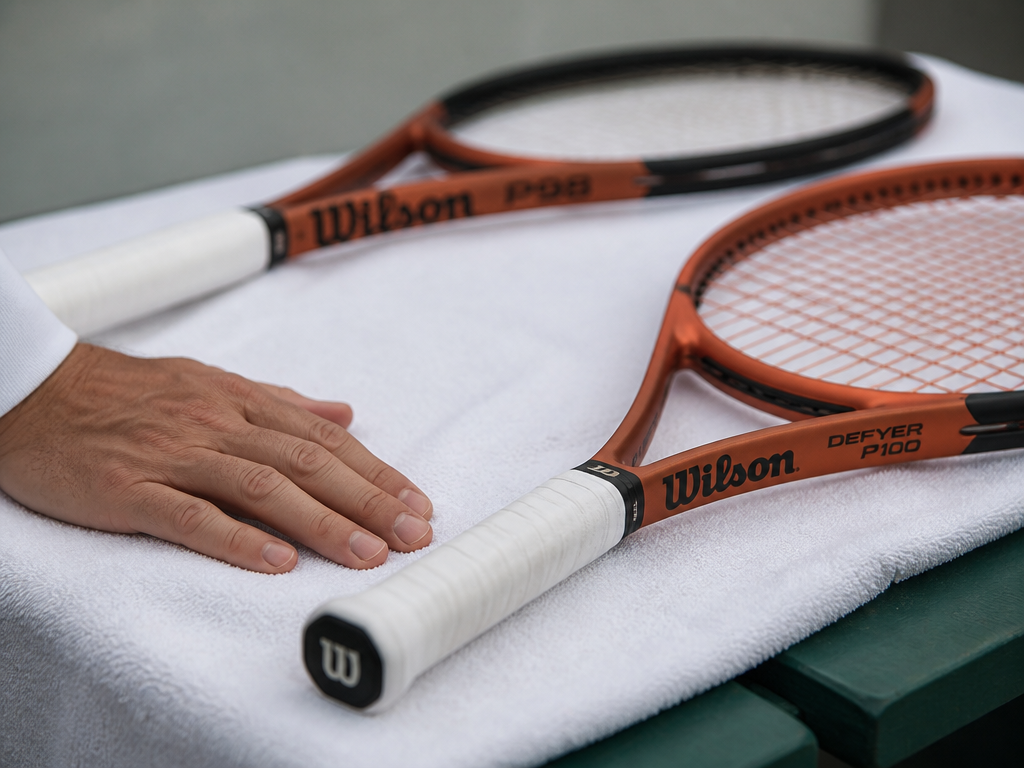
This is the one I've spent the most time with, so I'll start here. The Defyer is Wilson's answer to the player who found the Blade too demanding and the Ultra too stiff. It's a 100 square inch head, 22-24mm tapered beam, 64 RA, with a swing weight around 327 unstrung depending on the batch.
What it does well: It gives you the Blade's plushness at contact — that quiet, deep thud that tells you the ball stayed on the strings — but the ball comes off with about 8-10% more velocity on a centred hit. The difference is most noticeable on the backhand side, where the slightly thicker beam helps you get depth without muscling the ball. Slice stays low because the 16x19 pattern isn't overly open. On serve, the P100 gives you free pace on flat serves without the launch angle spike that makes you miss long by a metre.
What it costs you: The grip shape is Wilson's old rectangular profile — thinner from front to back. If you've been using a Head or Yonex with a more rounded handle, the Defyer will feel strange in your hand for the first few sessions. I had to build up the grip with an extra overgrip to get the bevel feel I wanted. Also, the P100 is not a racquet you can just buy and play. It benefits from a small amount of lead at 12 — five grams, no more — to bring the swing weight to about 332 and stabilise the head on heavy cross-court exchanges. Out of the box, it can twist slightly on off-centre forehands against a heavy ball.
Honest negative: The Defyer doesn't have that explosive trampoline feel you get from a Babolat Aero. If you want a racquet that does the work for you on defence, this isn't it. The P100 rewards clean contact. On defensive slices or stretched forehands where you don't get the sweet spot, the ball comes off predictably — meaning not much happens.
Yonex Percept 100
The Percept is Yonex's replacement for the VCORE Pro line, and it's the closest thing to a modern Blade that Yonex has made. Same 100 head, same 22-24mm beam, 64 RA. The difference is in the isometric head shape, which gives you a slightly larger sweet spot in the upper hoop.
What it does well: The Percept forgives mishits better than the Defyer. If you catch the ball high in the stringbed — which happens more than we like to admit — the Percept returns a playable ball rather than a dead floater. It's also more stable out of the box. Yonex's stiffness distribution means the frame resists twisting even at 320 swing weight. For a player who doesn't want to add lead, the Percept is the straight-out-of-the-box winner of these three.
What it costs you: The Percept doesn't communicate the ball's location on the stringbed as clearly as the Defyer. It's not a numb feel — Yonex's Vibration Dampening Mesh is genuinely good — but if you're used to the Blade's almost surgical feedback, the Percept will feel slightly muted. You'll feel the ball, but you won't always know exactly where on the strings it hit. For competitive players who rely on that feedback to adjust mid-point, that matters.
Honest negative: The Percept's launch angle is lower than the Defyer's. If you came from an 18x20 Blade and you're used to driving through the ball flat, this will feel natural. If you're coming from a 16x19 Blade and you want more easy spin, the Percept will make you work for it. You can open the string pattern with a lower tension or a softer string, but out of the box, the Percept does not reward spin-heavy strokes as much as the Defyer does.
Head Boom Pro
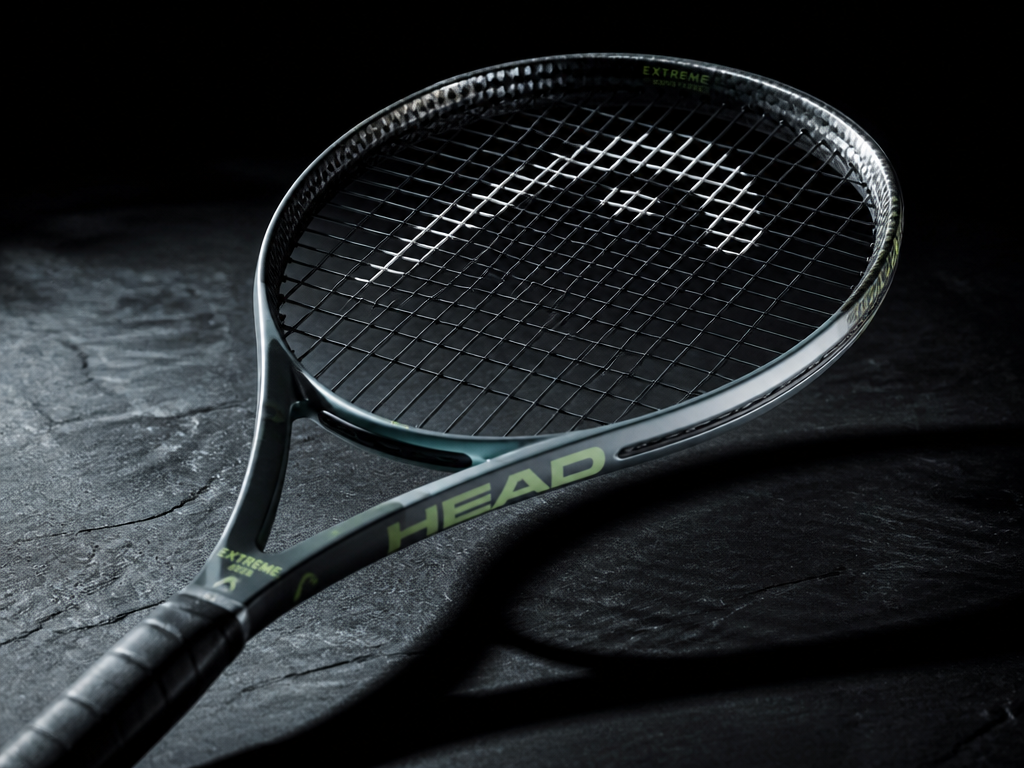
The Boom Pro is the wild card here. It's 100 square inches, 23mm constant beam, 63 RA. Head markets it as a comfort-plus-power frame, but the pro version is actually quite controlled. The beam is constant rather than tapered, which means the flex is more uniform through the hoop.
What it does well: Spin access. The Boom Pro has an open 16x19 pattern that lets you shape the ball aggressively without the frame fighting you. If your game relies on heavy topspin to create time, especially on the forehand side, the Boom Pro will give you more RPM than the Defyer or Percept with the same swing. It's also the most comfortable of the three. Head's Auxetic construction absorbs shock well, and players with any history of elbow sensitivity will feel the difference immediately.

What it costs you: Directional control on flat shots. The same open pattern that helps spin makes it harder to hit a flat approach or a straight drive down the line. The ball wants to curve. If you're a player who hits flat first and spin second — a classic Pro Staff player, for example — the Boom Pro will force you to adjust your target. You'll start aiming inside the line and finding the line instead. That's workable, but it's work.
Honest negative: The Boom Pro's feel at contact is polarising. It's not dead, but it's not plush either. There's a quick, almost crisp response that some players describe as "tinny" compared to the Defyer's thud or the Blade's buttery feedback. Head has reduced this with the Boom 2024 update, but if you value feel above all else, demo this one before you buy.
What I Actually Do
I keep a Pro Staff 97 v13 in my bag for doubles. The feel on volleys and half-volleys is still unmatched for me. I've had that racquet for three years and I know where every milligram of lead is.
For singles, I switched to the Defyer P100 about eight months ago, and I haven't looked back. My setup: 332 swing weight strung (five grams at 12, one gram at 3 and 9), a head leather grip to keep the balance manageable, and a multi/poly hybrid at 24/22 kg. The multi in the crosses gives me a bit of extra pocketing on the forehand side, which compensates for the slightly stiffer beam. The poly in the mains keeps the launch angle honest.
I chose the Defyer over the Percept because I wanted the feel feedback. I'm a player who adjusts mid-point based on where I felt the ball hit the strings — I'll close the face a degree earlier if I felt contact drift toward the throat — and the Defyer tells me that more clearly. The Percept is a better racquet for someone who doesn't want to think about that, and I mean that as a compliment. It's more forgiving, more stable, and easier to play with from the first hit.
I chose the Defyer over the Boom Pro because I hit more flat balls than I like to admit. On the forehand side I tend to drive through the ball rather than brush it, and the Defyer's tighter 16x19 keeps my line drives under control. The Boom Pro would give me more spin, but it would also punish my flatter stroke on days when the timing is off.
Who This Is For / Who It Isn't
This is for you if: You play at least three times a week. You have a consistent stroke production — meaning your miss is a pattern, not a surprise. You know your current racquet's swing weight within five points. You've been using the same string and tension for over six months and you can feel when the poly dies. You're comfortable adding weight or at least telling a stringer what you want.
This is not for you if: You change strings every three weeks. You're still figuring out whether you prefer 16x19 or 18x20. You don't know your swing weight and don't care to. You've never demoed a racquet before buying. For those players, the safest move is to stay with whatever control frame you have and spend the money on a lesson. A coach finding a technical reason your rally ball is short — grip too tight, shoulder not rotating, weight transfer stalling — is worth more than any racquet.
Also: if you're happy with your Blade or Pro Staff, stay happy. The difference these racquets make is real, but it's incremental. I'm talking about 8-10% more rally depth and 5-7% more spin on an average contact. That's enough to change a match against someone who steps in on your short ball. It's not enough to change your level overnight.
The Practice Observation
I want to end with something small. After I switched to the Defyer, the first thing I noticed in practice was not the power. It was the shape of my backhand cross-court. With the Pro Staff, that shot had a predictable arc — maybe two and a half metres over the net, landing around the service line. With the Defyer, the same swing produced a lower arc — maybe two metres — with about the same depth. The ball got to the opponent's backhand corner faster without me doing anything different.
I didn't change my swing. I changed the tool. The difference was enough that my practice partner started commenting on it within two sessions. Not because I was hitting harder, but because the ball arrived earlier. That half-second matters in a singles rally.
That's what I mean by the ceiling. It's not about power. It's about the ball arriving at a time that makes the opponent uncomfortable. If your current frame can't do that anymore, one of these three might. Demo the Percept first if you don't want to add weight. Demo the Defyer if you want the feel and are willing to spend an evening with lead tape and a scale. Demo the Boom Pro if spin is your primary weapon.
And if none of them work, keep your Blade. You didn't lose anything by looking.