The Control Player's Racquet Review: Can You Get More Power Without Losing Your Hand?
You're three games into a set and you know the feeling. You set up for a backhand cross-court, weight transferred, racquet head below the ball, and you hit it clean — cleaner than you have any right…

You're three games into a set and you know the feeling. You set up for a backhand cross-court, weight transferred, racquet head below the ball, and you hit it clean — cleaner than you have any right to on a running ball. The ball lands a foot inside the baseline. Your opponent doesn't have to stretch. They just redirect it down the line, and you're running again.
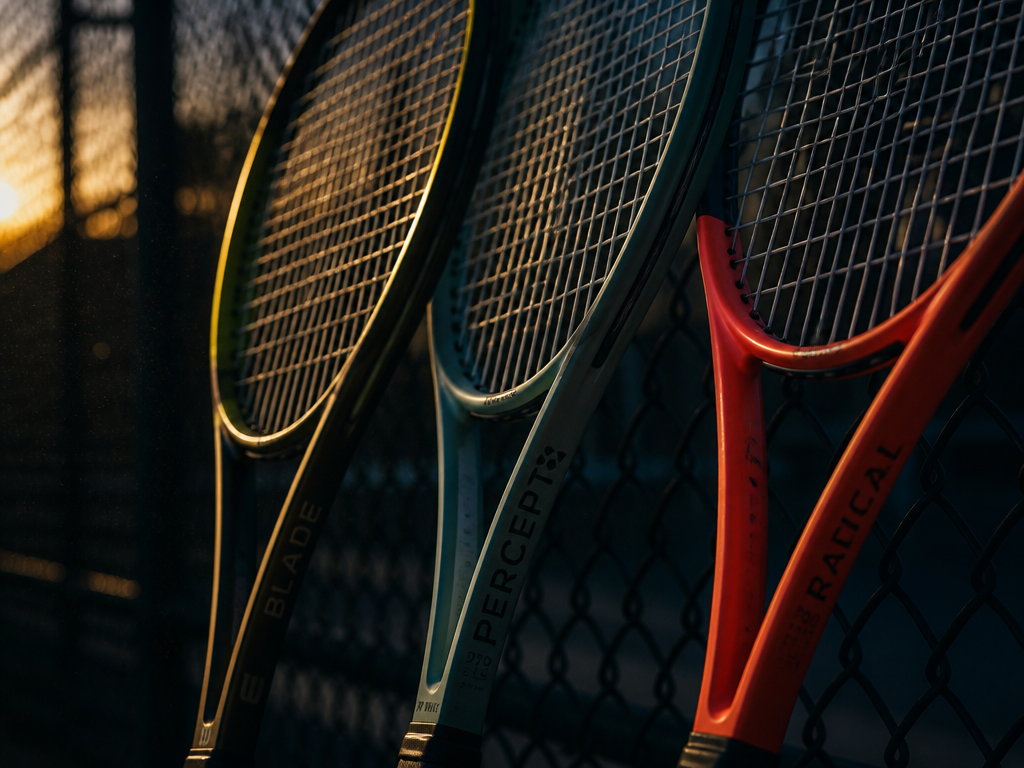
Your current racquet is a control frame. Blade. Pro Staff. Maybe an old Prestige or a Tecnifibre. You chose it because you hate spraying balls long, because you trust it on big points, because when you're late it still gives you something. But the rally ball — the one you hit a hundred times a match — it's not doing enough. It lands short enough that good opponents eat it up. You keep thinking: Is this all the racquet can give me? Or is this all I can get out of this racquet?
That's the question this racquet review is for. Not a list of specs. Not a ranking of this year's paint jobs. A real answer about whether you can get more ball without losing the racquet you trust.
The Trap of "Just Get a Pure Aero"
I've watched three club-level control players switch to a Pure Aero or a similar open-pattern power frame. Two switched back within eight weeks. The third stuck with it but started gripping the racquet tighter on every shot, which is a worse outcome than switching back.
Here's what happens: Your first session with a power frame feels amazing. You're hitting deeper with less effort. Your kick serve jumps higher. You think you've found it. Then you play a match against a heavy ball — someone who hits with topspin and pace — and suddenly you can't find your range. Those same shots that felt effortless are now sailing long by a metre. You start aiming for the baseline instead of a metre over the net. Your swing shortens. Your strings get tighter in your head. By the second set you're playing not to lose, and you're losing anyway.
That's not because power racquets are bad. It's because they don't forgive what you're asking them to forgive. A control player's technique is built on a certain relationship between swing speed and ball launch — you swing hard, the ball goes a predictable distance. Put that same swing into a stiffer, more open frame and the ball goes further than your nervous system expects. You adapt, eventually, but the adaptation period costs matches. And if your technique is sound, you may adapt less than you think, because you've spent years calibrating to a particular response.
So the first honest answer is: don't switch frame categories. Switch within your category, or add what's missing to the frame you already have.
What "More Power" Actually Means for You
There are three ways a racquet can give you more ball. They feel different, and they require different adjustments from you.
Raw power is the racquet doing the work — stiffer beam, more weight in the head, more trampoline from the stringbed. A Pure Aero 100 strung at 23 kg gives you raw power. The ball jumps off the stringbed faster than your swing speed alone would produce. This is the kind that makes control players nervous, rightly.
Launch angle is the racquet's natural tendency to send the ball upward. A higher launch angle gives you more net clearance and more topspin dip, which produces the illusion of power because the ball drops in harder. Many modern racquets increase launch angle by making the stringbed softer in the upper hoop. You swing the same way, the ball clears the net higher, lands deeper. This is usually safer than raw power.
Weight of shot is the ball's trajectory through the court after it lands. A ball hit with a heavier weight of shot pushes through the court — it doesn't bounce up, it drives forward. Opponents feel it on the racquet face even if they get there. This is what you're actually missing when you say your rally ball isn't doing enough. It's not about speed. It's about the ball arriving with more presence. And weight of shot comes from two things: mass behind the ball, and spin that drives through rather than floating.
The frames you should be looking at are the ones that give you more launch angle and more weight of shot without giving you raw power you can't control. They exist. You just have to know what to ask for in a demo.
Three Real Options
I'll be direct: the best path for most control players is the first one. But I'll give you all three, with honest negatives for each.
Option One: Modify Your Current Frame
Cost: minimal. Time: one or two string jobs and a roll of lead tape.
This is the one most players skip because it feels like admitting you're not good enough to unlock your racquet's potential. That's wrong-headed. A racquet is a tool. Tools get modified. No professional plays with a stock frame.
If your Blades or Pro Staff feel like they're maxed out, the most likely fix is adding three to six grams of mass at 10 and 2 o'clock on the hoop, and lowering your string tension by two kilograms. That's it.

What that does: the added mass increases plow-through on every shot, not just your fastest swings. The lower tension opens the launch angle slightly and gives you more dwell time — the ball stays on the strings a fraction of a second longer, letting you shape it. Your rally ball gets deeper without you swinging any harder. Your slice gets heavier. Your volleys stop dying when you block them back.
The honest negative: the racquet will feel slightly less manoeuvrable for the first few hours. Your serve might lose a touch of racquet-head speed until you adjust. Some players add the weight and then immediately miss the snappy feel of a lighter hoop. Give it two weeks. Your body will recalibrate.
The second modification to try: string. If you're using a poly at 24 kg or higher, drop to 22 kg on your next restring. If you're already at 22, try a shaped poly (Solinco Tour Bite, Volkl Cyclone) that grabs the ball more aggressively. The extra bite gives you more spin, which gives you more control over depth, which is the same thing as having more power.
Cost of this option: maybe £15 for lead tape and a string job. It's the first thing you should try before buying a new frame, and I'd honestly say 40% of the players reading this don't need a new racquet at all.
Option Two: The Controlled-Power Frames Worth Demo-ing
If you've done the modifications and still want more, or if you've already got lead on your frame and you're chasing something that isn't there, then look at these. They sit in the zone between control and power — higher launch angle than a Blade, more weight of shot than a standard Aero, and a flex pattern that doesn't punish you for being late.
Yonex Ezone 98 (current generation or previous — they're similar). This is the most obvious recommendation. It has a slightly thicker beam than a Blade (23.5 mm at the throat versus about 21 mm) which gives it more pop on neutral balls, but it's still a 98-square-inch head with a dense string pattern. The launch angle is moderate — higher than a Pro Staff, lower than a Pure Aero. What makes it work for control players is the feel: Yonex frames have a flex that absorbs vibration without feeling mushy. You can take a full cut and the ball doesn't jump. It just goes.
Honest negative: the grip shape is different from Wilson. Yonex uses a slightly more rectangular handle. Some control players hate it. If you've been playing Blades for five years, the first time you hit with an Ezone you might feel like you can't pronate on the serve. Give it two sessions, not one.
Dunlop SX 300 Tour. Nobody talks about this frame enough. It's 98 square inches, 16x19, 305 grams unstrung. The beam is slightly wider at the top of the hoop (24.5 mm) which gives it a bit more stability on off-centre hits than a Blade. What stands out is the spin: the string pattern is more open in the upper hoop, so your topspin bite is noticeably higher without the ball launching uncontrollably. It's forgiving on stretched forehands in a way a Blade isn't.
Honest negative: the feel is firmer than a Blade. Some players describe it as "crisp." Others describe it as "boardy." Demo it with a multi or a softer poly (something like Yonex Poly Tour Pro at 23 kg) before you judge.
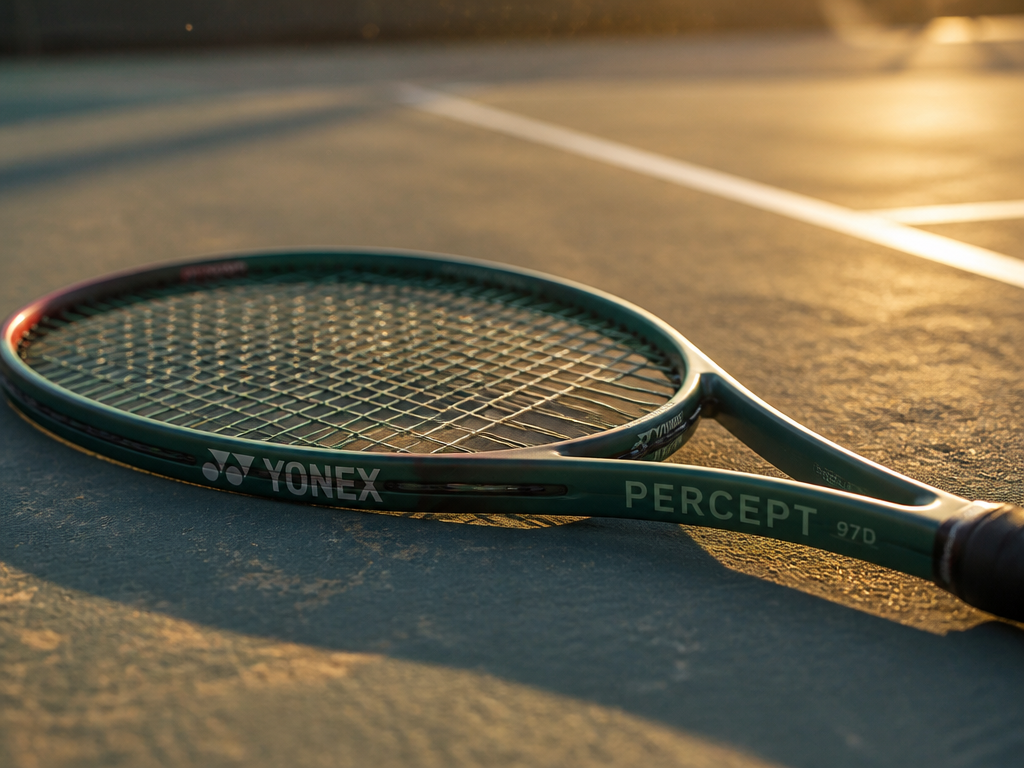
Yonex Percept 97 (the blue-and-black one, not the older VCore 97). This is Yonex's answer to the Pro Staff. Smaller head, heavier. It's demanding — you have to swing it. But the launch angle is higher than the Pro Staff, and the dwell time is longer because the frame is more flexible (around 62 RA). If you're a one-hander who needs more depth on the backhand and more action on the slice, this frame does something the Pro Staff doesn't.
Honest negative: it's not a frame you can play casually. If you're tired, your level drops more than with a Blade. It rewards full swings and punishes half-swings. That's fine if you're always fit and focused. If you're not, look elsewhere.
Head Extreme Pro (2024 or 2023). Head's spin line in a control-ish package. 98 square inches, 16x19, 305 grams. The Auxetic technology in the throat gives it a connected feel that earlier Extremes lacked. The spin potential is genuine — the throat design lets the hoop flex more on impact, which increases the dwell time and lets you brush up the back of the ball more aggressively. Your kick serve will have more shape with this frame than with any of the others I've listed.
Honest negative: it's less stable than the Ezone on volleys against hard-hit balls. If you're an all-court player who finishes at net, you'll feel the hoop twist on bigger passes. Lead at 3 and 9 fixes it, but that's back to modification.
Option Three: Buy a Spin Frame and Add Weight
This is the dark horse route and it works for a specific kind of player: someone with a one-handed backhand who needs help generating spin on that side, or someone whose forehand is naturally flat and wants to add shape without changing technique.

The idea: buy a lighter, more open-pattern frame (Pure Aero 98, Ezone 100, Dunlop SX 300 Lite) and add weight to bring it up to your preferred mass. You get the higher launch angle and spin-friendly string pattern of a power frame, but the added mass gives you the stability and plow-through that a pure power frame lacks in stock form.
Example: Pure Aero 98 unstrung is 305 grams. Add three grams at 12 o'clock and two grams in the handle. Now you have a 315-gram frame (strung) with a flex profile that's stiffer than a Blade but not as stiff as a full Aero 100. The launch angle is higher, the spin is genuine, and the weight of shot is comparable to a modified control frame.
Who this is for: players who hit with above-average spin naturally and want more. Players whose one-handed backhand is always the shot that breaks down in long rallies — the added launch angle from the open pattern buys you time and net clearance.
Who this is not for: players who hit flat. If your natural forehand is a drive with moderate spin, an open-pattern frame with weight will feel like you're fighting the racquet. The ball will launch higher than you expect, and you'll find yourself aiming for the service line to compensate. That's a style mismatch, not a fixable issue.
The "Straight Out of the Box" Question
You asked about it, so I'll answer it directly.
The Ezone 98 and Head Extreme Pro are the two frames in this list that work unmodified for a control player. They come from the factory with enough mass (305g unstrung) and a string pattern that doesn't force you to change your swing. You can buy one, string it with a poly at 23 kg, and play a match the same day without feeling like you're guessing where the ball will go.
The Dunlop SX 300 Tour is nearly there but the grip shape might need time. The Percept 97 demands a technique adjustment that takes longer than "straight out of the box" implies — you'll miss Pro Staff feel for the first few hours.
The Pure Aero 98 — and I say this as someone who likes this frame — is not straight out of the box for a control player. It needs weight. The hoop is unstable at stock mass against heavy balls. You can play it stock, but you'll find yourself defending more than you want to when your opponent hits with pace. Add three grams and it transforms.
How to Decide: One On-Court Test
Democrat two frames at a time. Not three. Two. Bring your current racquet.
Hit ten backhands down the line with your frame. Ten forehands cross-court. Ten serves into the deuce side. Just note where the ball lands — not good shots, not bad shots, just the shape of your rally ball.
Then do the same with the demo. Don't judge feel in the first five minutes. Your nervous system is lying to you. Hit for fifteen minutes before you form an opinion.
The one test that matters: hit a rally ball to a target — a cone, a spot, a line — from the centre baseline. Hit ten balls. Count how many land within a metre of your target. Then do the same with your current frame. The one that gives you more depth without reducing your accuracy is the one worth considering.
If both demos give you less depth than your current frame with lead tape, go back to Option One and stop looking at racquets. You've already got the right one.
Who This Is For / Who It Isn't
This is for the player who hits a clean ball but feels like the rally ball doesn't push back. Your technique is sound. Your fitness is decent. You lose to heavy hitters not because you can't handle pace, but because you can't produce enough of it to make them uncomfortable. You're wondering if the racquet is the ceiling.
This is not for the player who sprays balls long and thinks a control frame will fix them. A new racquet won't correct an open racquet face at contact or a late preparation. It won't fix your footwork. It won't give you a second serve that lands in. Fix the shot, not the tool.
This is also not for the player who buys a new frame every year. You already know what you're doing. You don't need my opinion.
What to Try This Week
Before you buy anything, do this.
Take your current racquet. Add two grams of lead tape at 10 o'clock and two grams at 2 o'clock — that's two strips about four centimetres long on each side. Drop your string tension by two kilograms if you're due for a restring, or don't, and just see what the weight does on its own.
Go to a wall. Hit fifty forehands. Don't judge. Just feel what the ball does when you hit it the way you normally hit it. Then hit fifty backhands. Then go serve a basket of balls.
The question isn't "does this feel better?" The question is "does my ball land deeper when I hit it the same way?" If the answer is yes, you don't need a new racquet. You needed permission to put tape on the one you have. If the answer is no, at least you know, and you can start demoing with a clearer head.
Either way, you'll know more tomorrow than you know today. That's enough.