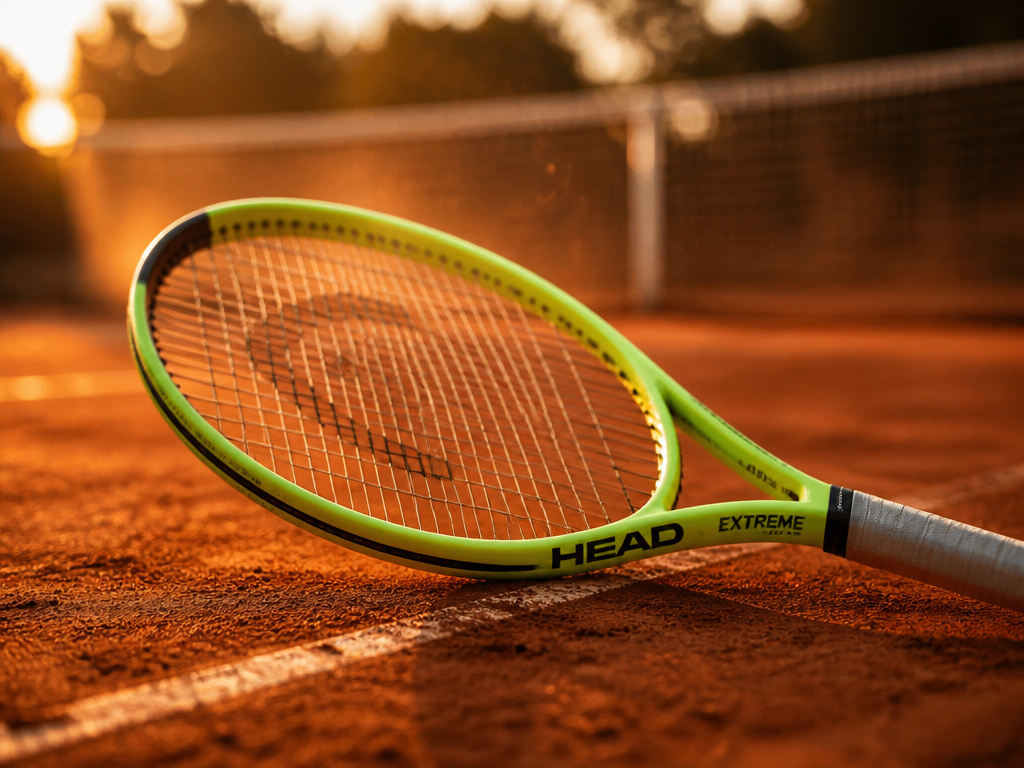
HEAD Extreme 2026 Review – Three Questions You Should Ask Before Buying
The 2024 HEAD Extreme did not work for everyone. If you are reading this, you probably already know why. The frame was stable — nobody questions that.

The 2024 HEAD Extreme did not work for everyone.
If you are reading this, you probably already know why. The frame was stable — nobody questions that. It was spin-friendly, forgiving on off-centre hits, and predictable. But it was also muted in a way that made some players feel like they were hitting with somebody else's racquet. The ball came off the stringbed, landed deep, and you had to look at the court to confirm where because your hand told you very little.
For a one-handed backhand player, that disconnect is a problem. You need the slice to tell you, through the handle, how much bite you got. You need the topspin backhand to speak — not loudly, but clearly.
The HEAD Extreme 2026 arrives with a material change that is supposed to answer that. Hy-Bor — a boron fibre blend laid into the upper hoop — replaces the previous stiffness distribution. The racquet keeps the Graphene 360+ frame underneath, but the layup has shifted. Does it fix the disconnect? Yes and no. Which is why you need to ask the right questions before you buy.
The hybrid layup question
The material story on the 2026 Extreme is straightforward: HEAD added boron fibres to the upper third of the hoop. Boron is stiffer than graphite pound-for-pound, but that is not the point. The point is where the stiffness sits.
In the 2024 Extreme, the frame felt uniformly dampened — stiff overall but quiet, as if the racquet absorbed the vibration before it reached your hand. The 2026 moves that absorption higher into the hoop. You feel more of the hit in the throat and handle, less of the high-frequency rattle in the tip.
On court, this means:
- Off-centre hits near the top of the stringbed no longer go dead. The upper hoop holds its plane better. A ball struck high in the string pattern still launches with predictable depth, rather than dropping short.
- The sound changed. The 2026 rings slightly at contact — a clean, metallic note that the 2024 completely lacked. If you listen for feedback as much as you feel it, this matters.
But here is the honest part: if you hated the 2024 because it felt like hitting with a pillow, the 2026 will feel like hitting with a slightly firmer pillow. The change is real. It is not a complete overhaul of the frame's personality. The Extremes have been heading in this dampened direction since the 360+ generation, and the 2026 does not reverse course. It just adds a layer of clarity that was missing.
The feel question
The 2026 line has four main models: the MP, the Pro, the MP L, and the MP XL. Each answers the feel question differently.
MP — the safe bet
100 square inches, 16x19, 300 grams unstrung. Swing weight sits around 320-325 depending on the unit. This is the frame most players should start with.
The MP has the most accessible launch angle in the line. You can shape the ball early, add spin without muscling it, and the forgiveness is genuine — mis-hits towards the frame edges still produce playable depth. The upper hoop stability from Hy-Bor is most noticeable here: early demos showed fewer dead spots at the 10 and 2 o'clock positions than the 2024.
The trade-off: the MP can feel too direct on flat drives. If you hit through the ball rather than across it, the launch angle can send balls long before you feel the mistake. This is not a control problem — it is a feedback priority. The MP tells you about spin and depth. It is less clear about net clearance.
Best for: The 3.5-4.5 player who wants spin, forgiveness, and a predictable response. If you have not clicked with a Pure Aero or a Speed MP, this is where to look.
Pro — the demanding option
98 square inches, 18x20, 310 grams unstrung. The Pro is the frame for players who want to feel everything.
The 18x20 pattern lowers the launch angle significantly. Balls come out flatter, with less free spin. You have to produce your own rotation through racquet head speed and contact point. The Hy-Bor benefit is clearer here because the smaller head concentrates the contact zone — off-centre hits in the Pro punish you more than in the MP, and the boron helps that punishment hurt less.
The Pro is the best-feeling Extreme for the one-handed backhand. The dense pattern gives you precise control on slice depth, and the extra weight soaks up heavy balls without twisting. But you need to be fit. A 310-gram unstrung frame with an 18x20 pattern and a swing weight approaching 330 will feel sluggish in the third set if your footwork drops off.
Best for: The 4.5+ hitter who values feel over spin and has the technique to generate their own pace. Not for players still developing their stroke mechanics — the forgiveness is not there.
MP L — the weight watcher
285 grams unstrung, same head size and pattern as the MP. The Hy-Bor is present, but the lighter layup means the upper hoop stability is less pronounced. The frame flexes more on impact, which can feel nice on soft shots but unpredictable on hard-hit balls.
This model exists for players transitioning from lighter racquets, juniors moving up, or competitive players who want Extreme geometry without the static weight. It is a good frame. It is not the frame you buy hoping to improve.
Best for: The player who knows they need a sub-300-gram racquet and wants Extreme spin characteristics.
MP XL — the standout
The surprise of the line.
The MP XL is the 100-square-inch 16x19 pattern extended by half an inch to 27.5 inches. Unstrung weight is 305 grams. The extra length adds leverage, which changes the feel profile dramatically.
Here is why the XL works: the half-inch extension pulls the sweet spot slightly higher in the stringbed. Combined with the Hy-Bor upper hoop, you get a contact zone that feels connected in a way the standard MP does not. The ball stays on the strings longer — not by much, but enough that you can feel the shape of the shot before it leaves. The launch angle is slightly higher than the MP, but the control is better because the racquet gives you more time to direct the ball.
The serve is where the XL separates itself. The extra half-inch and the 305-gram weight combine to produce racket head speed that feels effortless. Flat serves down the T, kickers wide — the XL rewards the motion without demanding extra effort.
The cost: manoeuvrability at net. The extended length makes volley reactions slower, and the swing weight (around 330) can feel heavy on quick exchanges. If you play doubles primarily, the MP is the better choice.
Best for: The singles player who serves big and wants the feel connection the 2024 lacked. The one-handed backhand player who slices and drives with equal priority. This is the model that tempts you to switch permanently — the challenge is transitioning back.
Who this is for / who it isn't
Buy the 2026 Extreme if:
- You liked the 2024 but wanted more feedback from the upper hoop.
- You are a 4.0+ one-handed backhand player looking for a spin-friendly frame that still slices with authority.
- You serve big and want a racquet that feels solid on contact without deadening the response.
- You have never clicked with Babolat Pure Aero feel and want an alternative in the spin-friendly category.
Do not buy the 2026 Extreme if:
- You want a racquet that feels buttery on every shot. The Extreme line is not plush — it is crisp and dampened, even with the Hy-Bor update.
- You are a 3.0-3.5 player looking for an all-around improvement. The Extreme rewards spin generation and aggressive swing paths. If your strokes are still developing, a more forgiving frame like the HEAD Instinct or Speed will serve you better.
- You already own a 2024 Extreme and are happy with it. The update is real but not transformative enough to justify the cost unless the muted feel genuinely bothers you.
How I would actually decide
Two demos, same day.
Take the MP and the MP XL out for forty-five minutes each. Warm up together, then do this:
-
Hit ten slice backhands crosscourt with each frame. Watch where the ball lands and listen to the sound at contact. The MP will feel quieter. The XL will give you more audible feedback. Your slice depth will tell you which racquet communicates better.
-
Serve ten wide, ten T with each. The XL will feel faster through the air. The MP will feel easier to control. If the XL serves are landing consistently deeper without extra effort, that is the sign.
-
Play out a mini-set to four games with each. Do not overthink it. By the end of four games, you will know which racquet you trust on the third ball. Try this: on whatever you demo, start the string tension two pounds lower than whatever the shop recommends. The Extreme pattern is dense enough to hold the ball, and the extra millisecond of dwell time from lower tension compensates for the frame's natural dampening. Then hit your first ten slice backhands and notice where the ball lands. That feedback — clean, honest, in your hand — is what the 2026 Extreme gets right that the 2024 did not.