Overgrips for Sweaty Hands: What Actually Works in Match Play
The first time somebody told you to buy Tourna Grip, you probably heard it the way beginners hear "keep your eye on the ball." True enough, but not the whole truth.

The first time somebody told you to buy Tourna Grip, you probably heard it the way beginners hear "keep your eye on the ball." True enough, but not the whole truth. Tourna is the default recommendation for sweaty hands because it works — right up until it doesn't. After years of using it myself, I switched and discovered that the advice cuts about half the story.
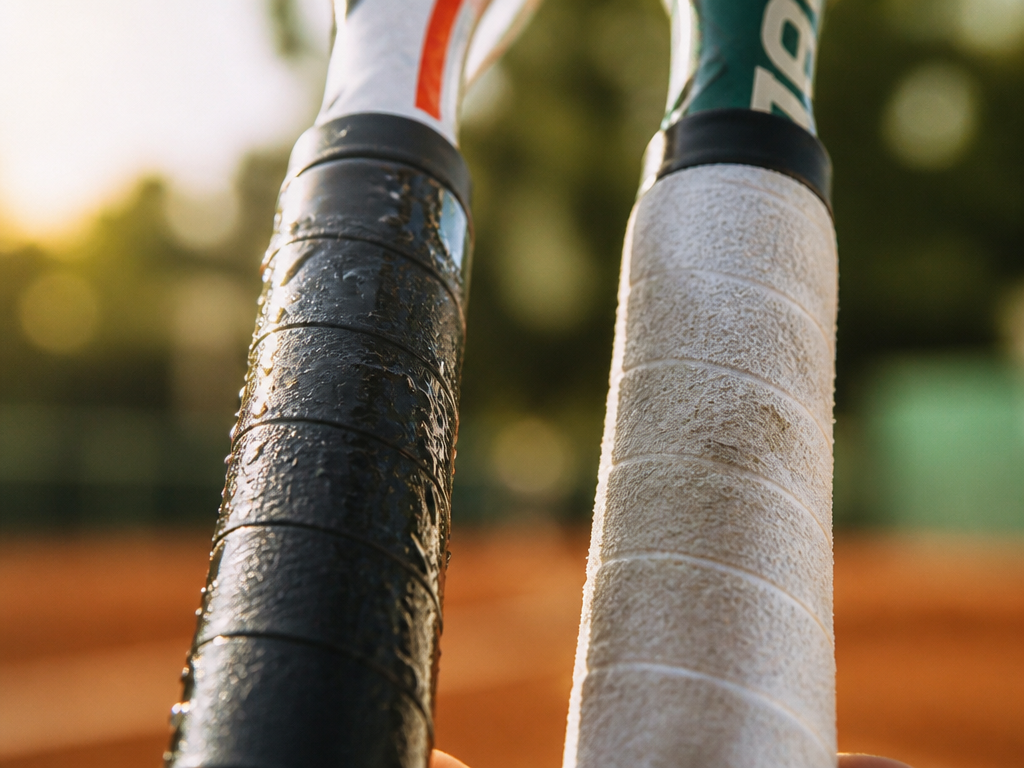
There are two kinds of overgrip for a player who sweats. The first kind stays sticky when wet. You rub it and it grabs your palm like a gecko. The second kind soaks moisture into itself and stays dry to the touch. Both work. They feel completely different, and if you've only tried one camp, you don't know what you're missing.
The two camps
Sticky-when-wet grips are tacky by design. They grip your hand when it's bone-dry, grip it when it's damp, and grip it when you're wringing out a towel between changeovers. The trade-off: they attract lint and dead skin, they wear out fast, and when they finally go slick they go slick hard.
Absorbent-and-dry grips feel papery or cloth-like when new. They pull sweat off your palm into the grip material itself. Your hand stays dry. The trade-off: they can feel dead or slippery if your hands are cold, and once the material is saturated — two matches, maybe three — the grip becomes a wet sponge you can't revive.
Here is what I've found after playing through both camps in actual match conditions, not the hitting session where you change grips right after.
Tourna Grip — the original dry grip
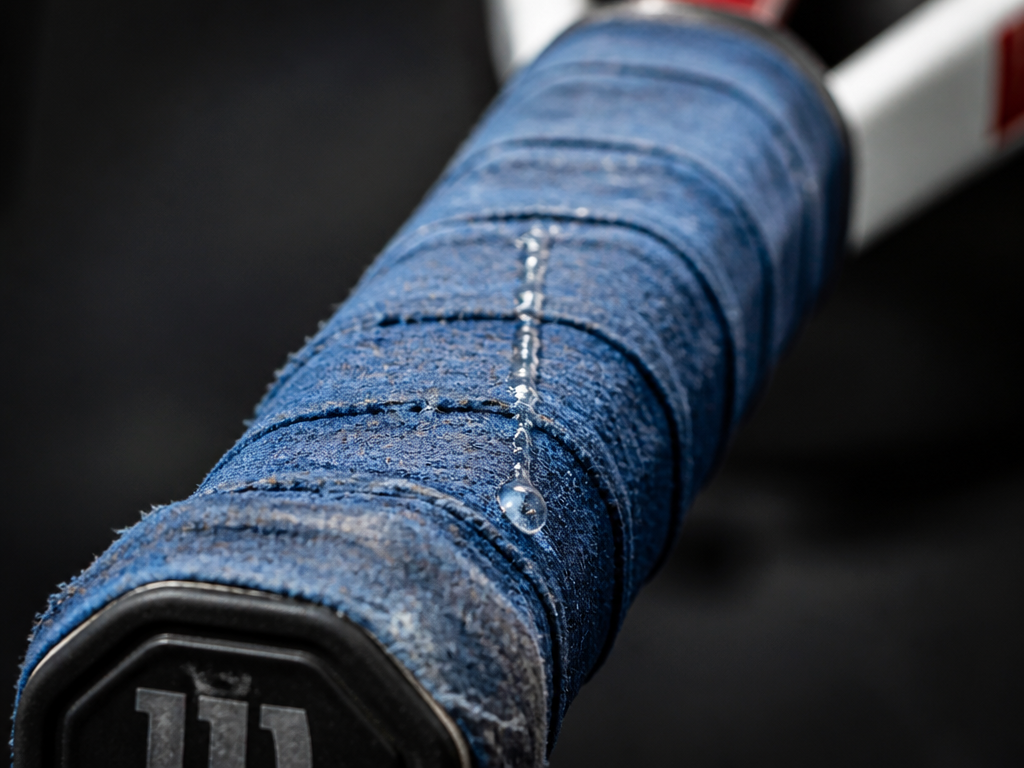
Tourna is the thin, cloth-feeling blue grip you've seen on every college player's racquet. It is not tacky. It is absorbent. Unwrap it, and it feels almost papery. Pull it tight and the perforations let air through so the moisture evaporates between points.
What it does well: your hand stays dry for roughly two hours. The grip works best when you sweat early and keep sweating. What it does poorly: it has almost no cushion, so if you grip hard, you feel every vibration. And once it's done — once the perforations flatten and the material stops drinking — it turns into a slippery film. It lasts about two to three singles matches before you need to rewrap.
Tourna is a fine starting point. It is not the ending point.
Yonex Super Grap — the sticky alternative
After years on Tourna I tried Super Grap and felt the difference on the first serve. It is tacky out of the pack. Not sticky like tape — tacky like a new eraser. Play with dry hands and it grabs. Play with sweaty hands and the tackiness holds, though the feel changes. Your hand does not slide, but you do not feel dry either. You feel damp, then tacky, then damp again.
Super Grap has more cushion than Tourna. If you have ever had elbow tenderness from gripping too hard, that extra millimetre matters. It also lasts longer — four to five matches before the tacky layer wears off. The only real downside is the lint. The grip attracts fibres from the ball fuzz and from your bag. After two matches it starts looking grubby, and some people rewrap for cosmetic reasons when the grip still has life.
That is the trade-off. Tourna gives you dry feel and short life. Super Grap gives you tacky feel and double the life. Neither is wrong. You just need to know which you want.
Wilson Pro Overgrip — the middle path
Wilson Pro is the most popular overgrip on tour for a reason, but that reason is not "best for sweaty hands." It is a balanced grip — moderate tack, moderate absorbency, moderate durability. If your sweating is mild, it handles a match fine. If your hands get drenched by the first game, you will be squeezing the racquet by the second set.
Pro Overgrip shines for the player whose hands sweat only in long rallies or nervous moments. It gives you a tacky start with enough absorbency to handle a little dampness. It does not excel in either category, but it does not fail in either either. For the 3.5–4.0 player still figuring out their grip preference, it is a safe place to start. You just won't end there.
Head Xtra Soft — for the death grip player
If you strangle the racquet — and you probably do, especially on serve — Head Xtra Soft is worth your time. It is noticeably thicker than the others, with a plush feel that absorbs shock. The tack is gentle, not aggressive. It stays consistent for about three matches, then goes slick fairly fast.
The advantage: you can relax your hand a little. The extra cushion means you do not have to grip as hard to feel in control. That alone reduces sweat, because tension produces heat, and heat produces sweat. It is a small feedback loop, but real.
The disadvantage: the thickness changes the bevel feel. If you like to feel the octagons through the grip, this one blunts them. Some players find they hit more shots long because they cannot feel the face angle as clearly.
Babolat VS Original — the expensive one you might not need
Babolat VS Original is the overgrip you buy when you have tried everything else and still want something better. It is tacky, with more texture than Super Grap. It lasts five to six matches. It stays tacky in humidity. It also costs roughly double what Tourna costs.
It is good. It is not twice as good. The durability is real — you do get more matches — but the performance difference from Super Grap is marginal. You are paying for the last 5–10% of feel. If you have the money and you have ruled out everything else, VS Original is a luxury that works. If you are on a budget, you are not missing much.
How to decide
Here is the honest version of the common advice. If your hands sweat a lot, you have two real options: Tourna Grip (absorbent, dry feel, short life) or Yonex Super Grap (tacky, damp feel, longer life). Everything else is a variation on one of those two. Wilson Pro splits the difference for mild sweaters. Head Xtra Soft cushions for death grippers. Babolat VS Original exists for the person who has tried both camps and wants to buy their way out of the choice.
Try this this week
Buy one roll of Tourna Grip and one roll of Super Grap. String one racquet with each — or, if you only have one, wrap half your handle with Tourna and half with Super Grap, separated by a strip of tape. Play a set with each side and pay attention to your hand after the third game. You will know in twenty minutes which camp you belong to. That knowledge is worth more than any recommendation. The right grip will not make you hit cleaner, but it will stop you from thinking about your hand in the middle of a rally. That is enough.