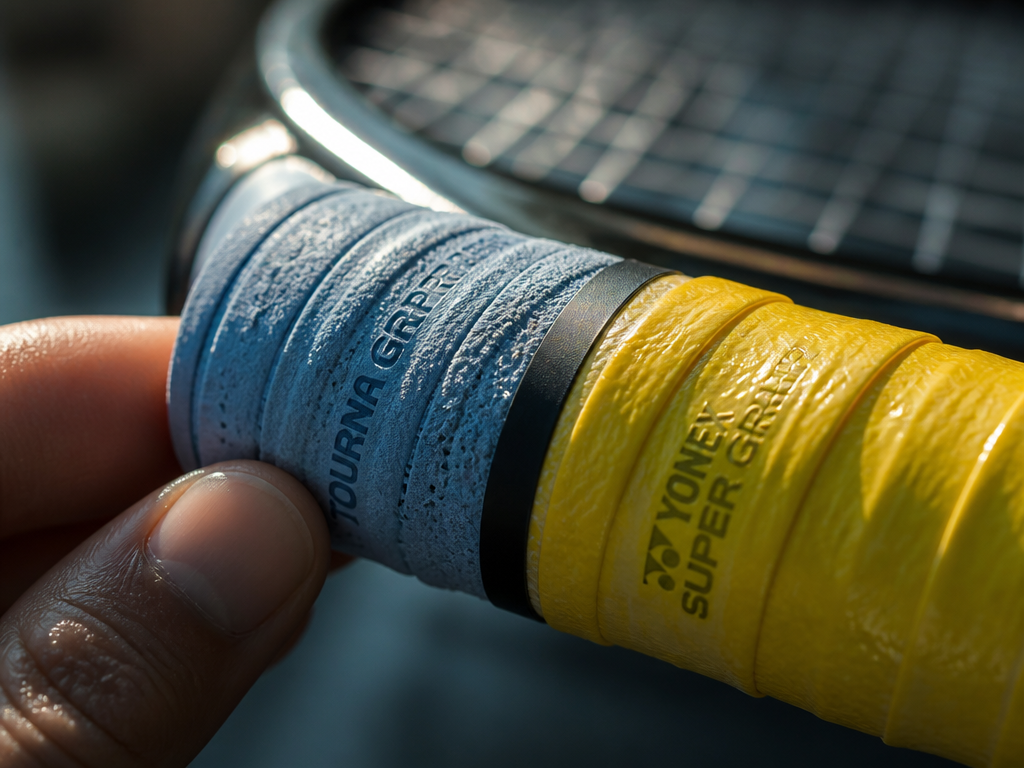
Tacky vs Dry Overgrips: Which One Actually Stops the Slip?
I played two matches last Saturday. Same racquet, same opponent, same courts, same 28-degree heat. The only difference: a white overgrip on one frame and a black one on the other.

I played two matches last Saturday. Same racquet, same opponent, same courts, same 28-degree heat. The only difference: a white overgrip on one frame and a black one on the other.
The white one lasted eight games before I started turning the handle between points, checking for the first sign of the head slipping in the hit. The black one lasted four games and was gone by the second set — I finished the match holding tighter than I needed to, hitting the frame on backhands I normally make, because I didn't trust the handle anymore.
The white one was a dry grip. The black one was tacky.
I'd been using the tacky one for years because that's what the guy at the shop handed me, and because it felt great in the air. But I had never actually measured the difference between the two categories — sticky when wet versus absorbent when wet — in live play. So I did. And the results changed which grip I put on before a match.
This is what I found.
Two Ways to Stop a Slip
Every overgrip on the market does the same job: it sits between your hand and the racquet's base grip and tries to stop the handle from moving when you swing. But the mechanism is completely different depending on which type you buy.
Tacky grips use a sticky, gel-like surface that grabs your skin through friction. They feel almost rubbery when new. Think of the way a new pencil eraser feels against your finger — that's tack. The grip clings to your palm, and as long as both surfaces are dry, it works brilliantly. Introduce moisture, and the tack turns slick.
Dry grips use an absorbent, cloth-like surface that wicks moisture away from your hand. They feel papery or fabric-like when new. They don't grab your skin; they drink the sweat so your palm can stay dry against the grip. Introduce moisture, and the grip actually works better — the fibres expand, the contact improves, and the thing that ruins a tacky grip (sweat) is the thing that activates a dry one.
That's the whole physics of it. There's no third category that does both. Every grip trades one property for the other. The question is not which one is better. The question is which sweat profile you have.
Tacky Grips: What They Do, What They Cost
The representative of this category, for most club players, is the Wilson Pro Overgrip — often called Super Grap, though the official name shifted over the years. It's the most popular overgrip in the world for a reason.
What it feels like new: You wrap this and you notice it immediately. The surface is almost velvety-sticky. Your hand sticks to it without you needing to squeeze. For the first two to three hours of play, you can hold the racquet with remarkably light grip pressure and still feel locked in. That light grip pressure is a real benefit — it reduces forearm fatigue and lets you swing freely on groundstrokes.
What happens when you sweat: The tack breaks down in contact with moisture. Not gradually — there's a threshold. You'll feel fine for four or five games, and then suddenly, between one changeover and the next, the grip goes from locked-in to sliding. This usually happens around the twenty-minute mark of active play in warm conditions, faster if you have naturally damp hands.
How long it lasts: Three to five hours of court time. After that the tack is gone and the surface feels like smooth plastic. You can extend the life by not pressing hard during wrapping (tight wrapping preserves the material) and by letting the racquet air-dry after play instead of shoving it in a bag. But three to five hours is the honest window. If you play twice a week, that's one grip per week, maybe two in summer.
Price: Around 50 to 70 rand per grip in singles, cheaper in bulk. The cost is low enough that the usual advice — change it every three sessions — is genuinely affordable.
The honest negative: You cannot reactivate tack. Once the surface breaks down from moisture, there's no drying it out and getting the feel back. A dried tacky grip feels worse than a fresh dry grip, because the surface is now just dead rubber with no texture. You have to replace it. If you sweat heavily, you will replace it every match. That's not a value judgment; it's a cost.
Other options in this category:

- Yonex Super Grap — very similar to Wilson, slightly thinner, slightly longer lasting in my testing. The feel is a touch less sticky but the durability makes up for it. I get an extra session out of a Yonex compared to a Wilson.
- Babolat VS Original — the tackiest of the three by feel. It grabs hold of your hand like it's trying to keep you from dropping the racquet. The trade-off is that it wears out fastest. Two sessions, maybe three, and it's done.
- Head Prestige Pro — a little thicker than the others, which means more cushion, less feel. The tack lasts about the same as Wilson. Good if you like a plush handle.
Dry Grips: What They Do, What They Cost
The representative here is the Tourna Grip — the original blue absorbent overgrip that's been on the market since the 1970s. It looks and feels nothing like a tacky grip.
What it feels like new: Rough. Papery. Some players describe it as feeling like medical tape, which is accurate — the material is a cotton-polymer blend designed to absorb moisture, not to stick. When you first pick up a racquet wrapped in Tourna, it feels dry and slightly abrasive against your palm. There is zero initial grip; you have to hold the racquet. This freaks out players who are used to tack.
What happens when you sweat: This is where the category earns its money. As your hand moistens, the grip fibres absorb the moisture and expand slightly, creating more contact surface against your palm. The more you sweat, the more the grip conforms to your hand. The grip does not get slippery. It gets more secure. I've played through three sets in 32-degree humidity with a Tourna grip and never felt the handle shift once. By the third set, the grip was damp throughout, and it still held.
How long it lasts: One match. Maybe two if you're playing in a dry climate and don't sweat much. Tourna grips are famously short-lived because the absorbent material compresses and loses its structure after about three hours. The grip will still be on the racquet, but the texture flattens out, the absorbency drops, and you start feeling the base grip through it. This is the price of the moisture-wicking performance. You cannot have both absorption and durability; the material has to be soft enough to drink sweat, which means it breaks down fast.
Price: 40 to 60 rand per grip, often sold in multi-packs of ten or thirty. The per-grip cost is lower than tacky grips, but you use more of them. A heavy sweater using Tourna will go through ten grips in the time a dry-handed player uses three Wilson grips.
The honest negative: You have to replace it more often than you think you should. And the initial feel — rough, dry, no tack — is genuinely unpleasant if you've been using something sticky. The first time you switch to a dry grip, you will question your decision on the first practice swing. Give it two weeks. If your hands sweat, you will not go back.
Other options in this category:
- Tourna Grip Original (blue) — the standard. Medium thickness, maximum absorption. The most trustworthy option for heavy sweaters.
- Tourna Tac — a hybrid that tries to add a slight tack to the absorbent base. It's not a true dry grip anymore; it's a middle ground that doesn't fully satisfy either camp. I don't recommend it. If you want tack, buy tack. If you want dry, buy the original.
- Gamma Supreme — billed as a "tacky" grip but behaves more like a dry one in practice. It has a soft, absorbent feel with a hint of grip. It's less effective at wicking than Tourna but more comfortable out of the packet. Good for moderate sweaters who find Tourna too rough.
The Test That Changed My Mind
The Saturday experiment I mentioned at the top: I played two matches back to back against the same opponent, using the same racquet model (Yonex VCore 98), same string (Hyper-G at 22 kg), same tension. The only difference was the overgrip.
Match 1 (tacky grip — Wilson Pro): The first four games were perfect. The racquet felt connected to my hand. I hit a clean backhand down the line in game two that I normally don't go for. By game six, I noticed I was adjusting the grip between points. By game eight, I was consciously wiping my palm on my shorts before every serve. I lost the first set 6-4, and I was gripping the handle too hard on every forehand, late on contact, dumping balls into the net. The grip was still on the racquet but it had lost its hold. I finished the match hitting defensive rally balls because I couldn't trust the handle.

Match 2 (dry grip — Tourna Original): The first two games felt strange. The grip was rough. I was aware of it in my hand. I thought about taking it off between sets. By game four, my hand had started sweating normally (it was hot), and the grip responded. The rough texture softened. The handle felt (and I don't use this word lightly) planted. I played the rest of the match without once thinking about my grip. I won 6-3, 6-2. Was the grip solely responsible? No. I was fresher in the second match, my opponent may have tired, there are a dozen variables. But I was also not tightening my hand on every swing, and that let me use the wrist snap and racquet head speed that had disappeared in the first match.
I switched my match racquet to Tourna that evening. I've been using it for three months. I go through more grips than I used to, but I have not had a grip slip in a match since.
How to Actually Decide
Stop reading the marketing. Start reading your own hand.
Choose tacky if: - Your hands stay dry during play. You don't find yourself wiping your palm on your shorts between points. - You like the feeling of the racquet being "stuck" to your hand without squeezing. - You play in a cool or dry climate (indoor courts, autumn, high altitude). - You don't want to replace your grip every session. - You prize initial feel over long-match security.
Choose dry if: - Your hands sweat. Not just on hot days — every day. You've lost a grip mid-swing at least once in the last month. - You play in humid conditions (coastal cities, summer, night tennis in warm climates). - You've tried tacky grips and found they stop working after twenty minutes. - You're willing to replace grips more often in exchange for zero slippage. - You play matches long enough that sweat builds up over an hour or two.
If you genuinely don't know which camp you're in, do what I did: wrap one racquet with a tacky grip and one with a dry grip. Play a set with each. Don't decide in the first ten minutes. Let the sweat accumulate. The answer will be obvious by the end of the first set.
Who This Is For / Who It Isn't
This is for the player who has lost a match because of a slip — not because of a bad shot, but because the racquet turned in the hand at contact and the ball went nowhere useful. That's a specific kind of frustration, and it has a specific fix. If you have never had that feeling, you can use any grip and be fine. The decision matters less to you.
This is also for the player who has been using the same grip for years because it's what they started with, not because they tested alternatives. Most players fall into this category. I did. The guy at the counter handed me a Super Grap when I bought my first real racquet, and I bought them for six years afterward without thinking. The grip industry depends on that inertia. Break it. Spend 300 rand on a variety pack of different grips, try them all, and settle on the one that actually solves your problem, not the one that feels best in the shop.
This is not for the player who changes grips every match regardless. You already know what you need. This is also not for the high-performance junior whose parents buy grips by the carton — you're fine, keep going.
What I Still Don't Know
I didn't test every grip on the market. I didn't test the effect of humidity gradients — whether a tacky grip performs differently in Durban than in Johannesburg, or how altitude affects the absorption rate of a dry grip. I didn't test how string texture (rough polys versus smooth multifilaments) feeds vibration into the grip and changes your perception of tackiness over time. I didn't test whether wrapping technique — overlapping percentage, direction, tension — changes the effective life of the grip by enough to matter.
Those are separate questions. They deserve a separate investigation.
What I do know: the right overgrip costs almost nothing relative to the quality of tennis it can unlock. If you have been playing with a slipping handle, you don't need a new racquet, a new string, a lesson, or a stronger wrist. You need a different surface between your hand and the handle. That's a two-hundred-rand fix for a problem that has probably cost you sets you should have won.
Go buy a three-pack of the opposite type to whatever you're using now. Wrap one racquet. Play a match. See what happens.
The answer will be in your hand by the first changeover.