Yoruba Indigenous Religion in Church and Mosque: What Survived
The praise session at a Pentecostal church in Ìbàdàn opens the way a party opens. A gángan — the small talking drum held under the arm — answers the song leader line for line, bending its pitch to…

The praise session at a Pentecostal church in Ìbàdàn opens the way a party opens. A gángan — the small talking drum held under the arm — answers the song leader line for line, bending its pitch to follow the Yoruba words. A woman in a lace gèlè dances in the aisle, shoulders doing most of the work. A cousin visiting from Atlanta leans over and asks the question this piece is about: is that Yoruba indigenous religion in the room, wearing a Christian name?
The short answer is that the relationship is real and it is not disguise. Christianity and Islam among the Yoruba were learned in Yoruba — in the language, in the music, in a very old set of assumptions about how a person addresses power — and that grammar stayed put when the theology changed. What carried over is mostly form. Where content carried over, the people involved usually know it did, and have argued about it for a century.
Three questions hiding inside one
The question gets muddled because it is really three.
Are Yoruba Christians and Muslims secretly worshipping òrìṣà? Almost always, no. A Cherubim and Seraphim congregation in Lagos is not running a hidden shrine. The Aládùúrà churches — the name means "owners of prayer" — were in fact the most explicit rejecters of òrìṣà worship in Yoruba Christian history, more so than the mission churches they broke from.
Did indigenous Yoruba forms shape how church and mosque are done here? Demonstrably yes, and not subtly. You can hear it from the street.
Is the boundary between the two always clean, for every person, on every occasion? No. This is where the honest answer becomes "it depends" — on the family, the town, the lineage, and what has gone wrong that year. A man can be a committed Muslim and still stand in the crowd at his town's egúngún festival because his father's compound has an obligation to it. Whether that makes him a participant or a spectator is a question his neighbours themselves argue about.
What the tradition actually is
Before comparing anything, it helps to be specific about the thing being compared. Yoruba traditional religion — practitioners increasingly call it Ìṣẹ̀ṣe, from a phrase meaning the source or the original practice — centres on Olódùmarè, also called Olórun, the supreme being, who is distant and is not petitioned directly in daily life. Between people and Olódùmarè stand the òrìṣà, several hundred of them, and they are local: Ṣàngó is anchored in Ọ̀yọ́ and its royal history, Ọ̀ṣun in Òṣogbo and its river, Ògún wherever iron and the road are. Versions of their stories differ from town to town, and Yoruba tellers say so openly rather than treating variation as a defect.
Alongside the òrìṣà sits Ifá, a divination system associated with Ọ̀rúnmìlà, in which a trained diviner — a babaláwo — works with a vast memorised corpus of verses organised under signs called odù. It is practised today, in Nigeria and Benin and across the Atlantic. The Ọ̀ṣun-Òṣogbo festival draws crowds every August; Ọ̀ṣun State has marked an Ìṣẹ̀ṣe day in the same month. In Cuba this world continues as Lucumí, in Brazil as Candomblé, in Trinidad as Orisha worship — continuations with their own histories, not damaged copies of a Nigerian original.
Side by side
| Ìṣẹ̀ṣe (Yoruba indigenous practice) | Aládùúrà and Pentecostal churches | Yoruba Muslim practice (Ìmàle) | |
|---|---|---|---|
| People and region | Yorubaland: southwestern Nigeria, Benin, Togo; and diaspora continuations | Founded in Yorubaland from 1918 onward; now global | Present in Yorubaland since at least the 18th century, strongest early in Ìlọrin and Ọ̀yọ́ |
| Name used for God | Olódùmarè, Olórun | Ọlọ́run — the same word | Ọlọ́run alongside Allah |
| What it sounds like | Dùndún and bàtá drum families; call-and-response; praise poetry | Talking drums, shékèrè, dancing in the aisle, call-and-response | Wéré and sákárà traditions, Ramadan wake-up singing, chanted praise |
| How praise is built | Oríkì: stacked attributions naming what the subject has done and where they come from | Long stacked praise names for God, structurally identical to oríkì | Chanted praise of God and the Prophet in Yoruba, in the same stacked form |
| Who leads | Priests and diviners trained within a lineage; initiation required | Prophets, pastors, founders — authority often from a calling, not a lineage | Àlùfáà, imams, Qur'anic scholars |
| What is asked for | Children, health, protection, resolution — brought through an òrìṣà or through divination | Children, health, protection, resolution — brought directly to God through prayer | Children, health, protection, resolution — brought directly to God through prayer |
Read the bottom row and the top row together and the picture gets clearer. The needs are continuous. The route is what changed.
The layer under the music
The deeper continuity is linguistic, and it was built deliberately.

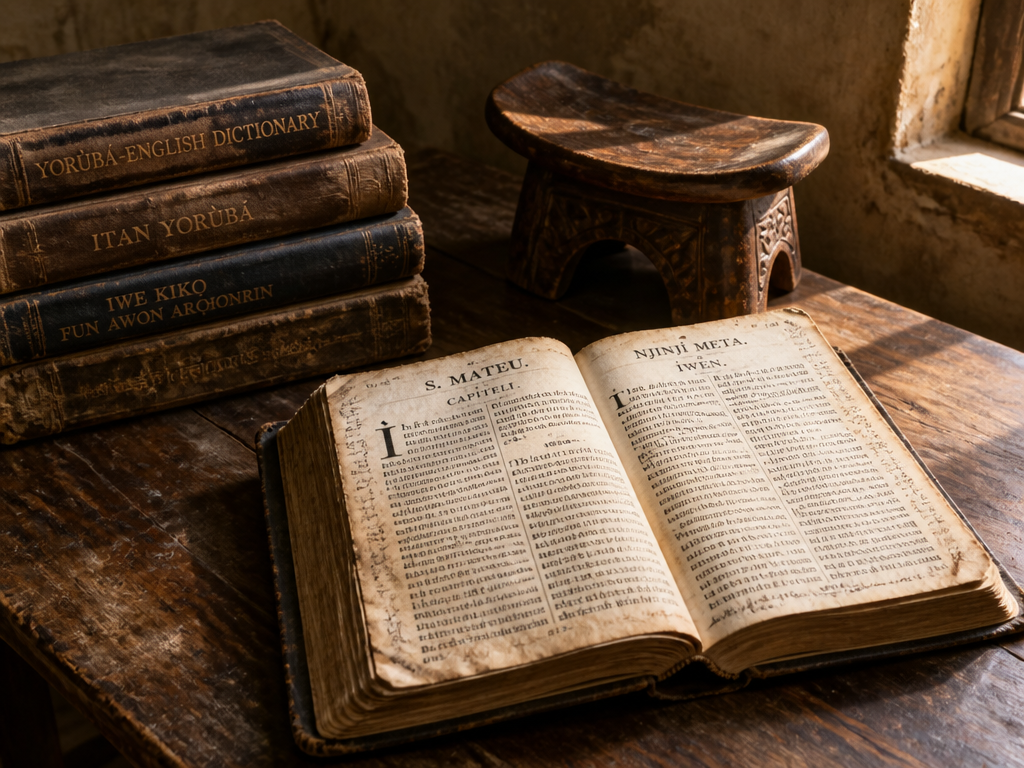
When Samuel Àjàyí Crowther — a Yoruba man taken as a boy in the slave trade, freed, and later the first African Anglican bishop — led the translation of the Bible into Yoruba in the nineteenth century, he had to choose Yoruba words for Christian concepts. For God he chose Ọlọ́run, a name already in use for the owner of the sky. Yoruba Qur'anic teaching made a similar move. The result is that a Yoruba Christian, a Yoruba Muslim, and an Ìṣẹ̀ṣe devotee can all say Ọlọ́run and each mean something coherent to themselves.
One choice went badly. For Satan, the translators used Èṣù. Èṣù in Yoruba thought is not evil; he is the one who carries messages between the human world and the òrìṣà, who tests people, who enforces the rule that nothing moves without acknowledgement. Making him the devil folded a messenger into a monster, and that error is now four generations deep in Yoruba-language hymns, sermons and everyday speech. It is worth correcting not out of grievance but because it is simply inaccurate, and because it still shapes how diaspora readers first meet the name.
Then there is oríkì. Karin Barber's work on oríkì describes it as a general Yoruba resource — you can praise a town, a lineage, a river, a person, a king. So when a church praise leader piles up attributions for God for four minutes without repeating himself, he is using an indigenous poetic engine. Some scholars go further and say they can hear specific òrìṣà epithets embedded in Christian and Muslim chants. That reading is contested, and reasonably so: if the praise form was always general, an epithet appearing in both places may show a shared toolkit rather than a smuggled deity. This is one of the places the honest answer is that it depends on the line, and on who is listening.
Where scholars disagree
Bolaji Idowu, in Olódùmarè: God in Yoruba Belief (1962), argued that Yoruba religion was essentially monotheistic all along, with the òrìṣà as intermediaries under one God. Critics have said he read Christian categories backwards into the tradition, and that the tidy hierarchy is partly his own.
J. D. Y. Peel, in Religious Encounter and the Making of the Yoruba (2000), argued something sharper: that "Yoruba religion" as a single describable system was itself partly produced by the missionary encounter, because it took outsiders asking systematising questions to make a patchwork of town practices look like one religion. Wande Abimbola, working from inside Ifá, has spent a career arguing for the intellectual seriousness of the odù corpus on its own terms.
These positions are not reconcilable by splitting the difference, and this piece will not pretend otherwise.
Where the connection ends
Rhythm travelled. The system did not.
Ifá is not present in the church or the mosque in any form. Its authority rests on a memorised corpus and on initiation within a lineage — you cannot pick it up by ear the way you can pick up a drum pattern. The same is true of egúngún, where masquerades bring ancestors into the town at festival time under lineage custody. Ẹbọ, the offering that divination may prescribe, is a category Yoruba Christianity and Islam both reject outright and knowingly.
And the theology diverges at the root. Ìṣẹ̀ṣe distributes the sacred across many named powers with local addresses. Christianity and Islam do not. A shared drum does not close that gap, and treating Yoruba Christians or Muslims as unknowing carriers of an older faith takes away from them exactly what the tradition itself values most: knowing what you are doing and whose it is.
Names and terms
- Ìṣẹ̀ṣe (ee-SHEH-sheh) — the Yoruba term for indigenous practice, used by practitioners today.
- Òrìṣà — the named powers between people and Olódùmarè.
- Oríkì — praise poetry that names a subject by attribution and origin.
- Aládùúrà — "owners of prayer"; Yoruba-founded churches, from 1918 onward.
- Ìmàle — the Yoruba word for Muslim.
- Babaláwo — a trained Ifá diviner.
- Gángan, dùndún, bàtá — Yoruba drum families; the first two bend pitch to imitate speech.
What this piece did not answer
It did not settle how much of the continuity was deliberate. Choosing Ọlọ́run for God was a decision on record; a drum pattern arriving in a church in the 1930s usually was not, and the archive for that is thin.
It also did not cover the reverse traffic — how a century of Christian and Muslim presence changed Ìṣẹ̀ṣe itself, which it plainly did. For that, Peel is the place to start, and Abimbola for Ifá from the inside. For the sound, the honest next step is not a book: it is a Sunday morning in Ìbàdàn or a Ramadan pre-dawn in Ìlọrin, listening to what the drum is saying under the words.
The Yoruba have a line for this: ilé la ti ń kó ẹ̀ṣọ́ rè òde — it is at home that we learn the manners we take outside.