Yoruba Indigenous Religion in Church and Mosque: What Carried Over
The service ran two hours and ten minutes, and I spent most of it with a notebook on my knee, counting. Eleven congregational songs.

The service ran two hours and ten minutes, and I spent most of it with a notebook on my knee, counting.
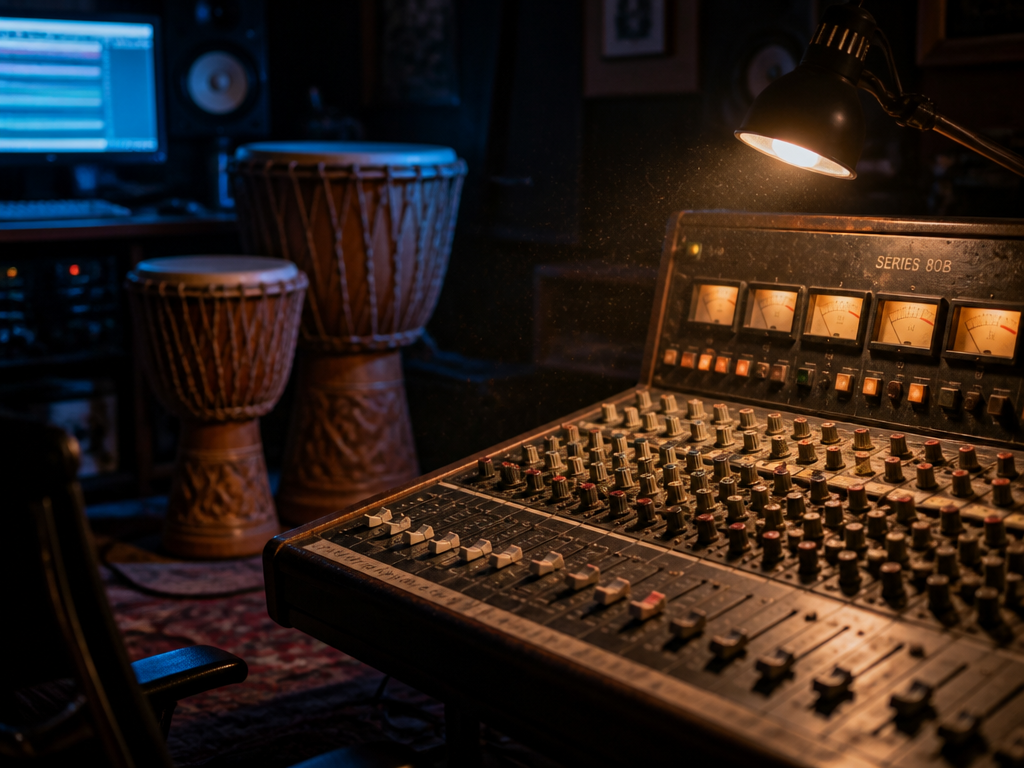
Eleven congregational songs. Three drums on the platform, none of them mentioned in the hymnal: a dùndún, the hourglass drum whose tension ropes are squeezed under the arm so the pitch bends like a spoken sentence; a smaller gángan from the same family; and a sẹ̀kẹ̀rẹ̀, a gourd netted with beads that hisses on the offbeat. Of the eleven songs, seven were built the same way — not verse and chorus, but a rising stack of names and attributes for the one being addressed. That stacking is a form with a name. It is called oríkì, and Yoruba indigenous religion has used it to address the powers for far longer than there have been church buildings in Ìbàdàn. Nobody named an òrìṣà that morning. Nobody needed to. The room was already praying in a grammar the older tradition wrote.
I want to be careful about what a count like that proves. Seven of eleven is not evidence that Yoruba Christians are secret òrìṣà worshippers, and anyone who tells you so is selling something. It is evidence of something less scandalous and more interesting: that when two world religions were preached in Yorùbá, they were preached into a language that already had a full vocabulary for God, destiny, praise, and the dead — and that vocabulary did not step aside.
The relationship, in one sentence
Here is the whole argument compressed, because it is easy to blur: Yoruba indigenous religion, Yoruba Christianity and Yoruba Islam are not three branches of one trunk, and not three strangers; the indigenous tradition supplied the language, the music and the working ideas about personhood into which the two newer faiths were preached, so what they share is idiom and imagination, not creed.
The people in question are Yorùbá speakers of southwestern Nigeria, the Republic of Benin and Togo, together with their descendants in Cuba, Brazil, Trinidad and the United States. The order of arrival matters. Islam reached Yorùbá towns overland through trans-Saharan and Hausa trade networks and was established among Ọ̀yọ́ court and merchant families well before the nineteenth century; Ilọrin became an emirate in the 1820s. Christian missions arrived later, from the 1840s, at Badagry and Abẹ́òkúta — and crucially, they arrived largely in Yorùbá mouths. Many of the first evangelists were recaptives: Yorùbá people freed from slave ships, settled in Sierra Leone, converted there, and returned home speaking their mother tongue. Samuel Àjàyí Crowther, the Ẹ̀gbá boy who became the first African Anglican bishop, translated the Bible into Yorùbá himself.
So the encounter was never a foreign text meeting a silent people. It was a translation problem, solved in Yorùbá, by Yorùbá speakers, using words that already meant something.
Ìṣẹ̀ṣe: the tradition the others were translated into
Practitioners today often call it Ìṣẹ̀ṣe — roughly, the source-practice, the way of the beginning. It is not a church and has no founder or central authority; it is a body of ìtàn (narratives), oríkì (praise poetry), divination knowledge, festival calendars and lineage obligations that varies by town, compound and teacher. Ilé-Ifẹ̀ tells a story one way; Ọ̀yọ́ another; a family in Òṣogbo will have its own emphasis. Versions differ, and the tradition itself says so.
At the widest frame is Olódùmarè, also called Ọlọ́run, owner of the sky — remote, not petitioned casually, not represented in images. Beneath and closer are the òrìṣà: Ọbàtálá, who shapes bodies; Ògún, of iron and the road; Ṣàngó, of thunder and the Ọ̀yọ́ kingship; Ọ̀ṣun, of the river at Òṣogbo; Ọya, of the wind and the Niger; Èṣù, who carries messages and keeps the exchange honest. Ifá, the divination system associated with Ọ̀rúnmìlà, is consulted through a corpus of verses memorised over years by a babaláwo; Wándé Abímbọ́lá spent a career showing how large and how technically demanding that corpus is.
Two ideas from that system travel further than any deity's name. The first is orí — the inner head, the portion of destiny a person chooses before birth, which can be strengthened or obstructed but is fundamentally yours. The second is àṣẹ, the power that makes a word take effect; a thing said with àṣẹ happens.
Hold those two next to a Sunday sermon about God's plan for your life, spoken over a congregation that answers every promise with a word meaning let it be so, and you can see why translation was not difficult here. The concepts had somewhere to land.
The layer you can hear
The drums are the part anyone can verify without knowing a word of Yorùbá.
The first mission churches banned them. Nineteenth-century CMS and Wesleyan congregations sang translated English hymns to a harmonium, and the dùndún was classed with heathenism. What broke that was not a foreign import but a Yorùbá revival. From the 1920s the Aládùrà churches — the name means owners of prayer — put Yorùbá music, Yorùbá prayer forms and Yorùbá healing expectations back into Christian worship. The Cherubim and Seraphim movement began in Lagos in 1925 around Moses Orímoládé Tùnọlàṣe and Christianah Abíọ́dún Akínsọ́wọ̀n; Josiah Òṣìtẹ́lú founded the Church of the Lord (Aládùrà) at Ògèrè in 1930; the same decade produced the revival around Joseph Ayọ̀ Babalọlá that became the Christ Apostolic Church. Today the drums are unremarkable in almost every Yorùbá church, including the Pentecostal megachurches that would describe themselves as furthest from tradition. Gospel recordings borrow the rhythmic architecture of apala and fújì openly, as a style choice, not a confession.

The Muslim side of this is less discussed and just as visible. Qur'anic recitation carries its own musical discipline, imported and guarded. But around Yorùbá Muslim life there grew an entire praise-song economy with local roots: wéré, also called ajísáàrì, the pre-dawn music that woke neighbourhoods for the Ramadan meal in Lagos; sákárà, built on a round clay-framed drum and the gòjé fiddle; apala, which Haruna Ishọlá took to the whole country; wáká, led by women and carried furthest by Sàlàwá Abẹ̀ní; and fújì, which Sikiru Ayìndé Barrister developed directly out of wéré and which has been the sound of Yorùbá Muslim celebration for fifty years.
None of that came from Arabia. It came from the same praise-singing conventions that were used to greet a king, honour a lineage, or salute an òrìṣà — the singer naming you, naming your father, naming your town, until the room knows who you are. The occasion changed. The craft did not.
The layer you have to know the words to hear
Now the part that takes translation.
Every Yorùbá Christian who prays says Ọlọ́run. Every Yorùbá Muslim who prays in Yorùbá says Ọlọ́hun, the same word in a Muslim register, alongside Allāhu. That word is not a mission coinage. It is the indigenous name for the owner of the sky, and Crowther put it in the Bible because it was the only word that would carry the meaning. The most common Yorùbá epithet for God in a church chorus, Ọba àìkú — the king who does not die — is likewise older than the chorus.
Crowther's translation also produced the single most consequential error in the record. Needing a Yorùbá word for the devil, the translators used Èṣù. In the tradition, Èṣù is not evil. He is the messenger who carries offerings between people and the òrìṣà, the keeper of the crossroads, the one who enforces reciprocity and who will humiliate you for arrogance or for skipping your obligations. He is unpredictable, and he is the reason nothing gets delivered if the protocol is ignored. Rendering that figure as Satan taught generations of Yorùbá Christians — and then, through missionary writing, the wider world — to read a moral system's enforcement mechanism as its villain. It is a translation decision, made once, in the 1800s, and it is still doing damage.
The names are the other tell. Yorùbá personal names are sentences, and many of them are theophoric: Ifáyẹmí (Ifá suits me), Fáṣọlá (Ifá makes honour), Ògúndípọ̀, Ọ̀ṣundáre, Ṣàngóbùnmi. People carrying those names today are churchwardens and alhajis. Some families substituted Olú- and Olúwa- forms a generation or two back — Olúwafẹ́mi where a grandfather was Ifáfẹ́mi — which is itself a record of the change, kept in the same grammar. And the naming ceremony, ìsọmọlórúkọ, held on the seventh, eighth or ninth day depending on lineage and child, still opens with the household tasting water, salt, honey, palm oil and kola in front of the baby, in Christian and Muslim homes alike, before anyone opens a Bible or a Qur'an.
Diaspora readers meet the fragments first. Àṣẹ at the end of a poem or a track. Ọ̀ṣun in a video's river imagery. Ògún invoked in a rap verse. Those are not empty borrowings, but they are the small change of a much larger system — one that crossed the Atlantic whole, not in pieces, and is practised in Cuba as Lucumí, in Brazil as Candomblé Ketu, in Trinidad as Orisha worship. Those are continuations with their own initiates, their own drum languages and their own authority. They are not diluted copies of anything.
Side by side
| Ìṣẹ̀ṣe (the indigenous tradition) | Yorùbá Christianity | Yorùbá Islam | |
|---|---|---|---|
| People and region | Yorùbá towns of Nigeria, Benin, Togo; diaspora lineages in Cuba, Brazil, Trinidad | Same towns, from the 1840s; carried inland largely by Yorùbá recaptives | Same towns, established earlier via Hausa and trans-Saharan trade; Ilọrin from the 1820s |
| Word used for God | Olódùmarè, Ọlọ́run | Ọlọ́run, Ọba àìkú | Ọlọ́hun, Allāhu |
| Who mediates | Babaláwo, ọlọ́rìṣà, family elders, egúngún masquerades | Prophets and visioners in Aládùrà churches; pastors | Imams, Qur'anic teachers (àlùfáà) |
| Praise form | Oríkì — stacked names and attributes | Praise choruses using the same stacking | Praise-singing at ceremonies, patrons and the Prophet, same stacking |
| Instruments | Dùndún, gángan, bàtá, sẹ̀kẹ̀rẹ̀, àgídìgbo | The same drums, standard since the Aládùrà churches | The same drums in wéré, apala, sákárà, wáká, fújì |
| Destiny | Orí and ìpín, chosen before birth | God's plan, preached into the same expectation | Qadar, preached into the same expectation |
| How it travelled | Lineage, initiation, festival, apprenticeship | Mission schools, translation, revival | Trade, scholarship, clerical households |

Where scholars disagree
They disagree seriously, and pretending otherwise would be dishonest.
J.D.Y. Peel argued across two major books — Religious Encounter and the Making of the Yoruba and later Christianity, Islam, and Oriṣa Religion — that these three should be studied as one interacting field, and that what we now call Yorùbá traditional religion was partly given its shape as a single object by the encounter itself. Before missionaries needed something to compare Christianity to, nobody in Ọ̀yọ́ was inventorying a religion.
Bọ́lájí Idòwú, in Olódùmarè: God in Yoruba Belief, argued that the tradition was at bottom monotheistic, with the òrìṣà as ministers of one God. Later scholars have pushed back hard, reading that as a Yorùbá Christian theologian defending his ancestors in the terms his critics respected — winning the argument by accepting its frame.
And the Aládùrà churches largely reject the continuity reading of their own practice. Ask about the white garments and you will be pointed to Revelation, not to Ọbàtálá; ask about blessed water and you will be pointed to the Jordan, not to Ọ̀ṣun. That is a serious position held by serious people, and it is not obviously wrong: two traditions can arrive at white cloth and moving water independently. What the continuity argument has going for it is not any single symbol but the density of the overlap — drum, praise-form, name-grammar, prophecy, healing expectation, all at once, in one language.
Where the connection ends
A good comparison ends with the differences, and here they are sharp.
Sacrifice. The reciprocal economy of ẹbọ — offering made, obligation discharged, outcome negotiated — is the operating core of the indigenous tradition, and it is precisely what church and mosque reject. The drum crossed over. The transaction did not.
Exclusivity. Ìṣẹ̀ṣe accommodates plurality easily; a household can honour several òrìṣà and consult across lineages. Christianity and Islam both make exclusive claims. This is a structural difference, not a defect on anyone's side, and it is the reason the shared vocabulary sits inside two frames that will not merge.
Trained specialist knowledge. Nothing in Yorùbá church or mosque life corresponds to a babaláwo's decade of memorising odù verses, or to the initiation that makes someone an ọlọ́rìṣà. That knowledge belongs to lineages and initiates, and it is not transferable by observation.
Two mistakes sit on either side of all this. The first is to say that Yorùbá Christians and Muslims are unknowingly worshipping òrìṣà. They are not. They are devout people making religious choices in the only language they have, which happens to be a language their ancestors built for religious speech. The second mistake is to treat Yoruba indigenous religion as a residue that survives only smuggled inside other people's services. It does not. It has its own practitioners, its own festival calendar, its own priests and its own visible public life — the Ọ̀ṣun-Òṣogbo festival fills a sacred grove on the river every August, and the number of Yorùbá people who identify openly with Ìṣẹ̀ṣe has been rising, not falling, on both sides of the Atlantic.
Names and terms
- Ìṣẹ̀ṣe (ee-SHEH-sheh) — the Yorùbá name practitioners use for their own tradition.
- Olódùmarè / Ọlọ́run — the supreme being; the second name is now used by everyone praying in Yorùbá.
- Òrìṣà — the powers with names, stories and shrines: Ọbàtálá, Ògún, Ṣàngó, Ọ̀ṣun, Ọya, Èṣù.
- Èṣù — messenger and keeper of the crossroads; rendered as the devil in the Yorùbá Bible, which he is not.
- Ifá — the divination system; a babaláwo is the trained diviner who works it.
- Orí — the inner head; a person's chosen portion of destiny.
- Àṣẹ (AH-sheh) — the power that makes a word take effect.
- Oríkì — praise poetry that names a person, lineage, town or òrìṣà by stacked attributes.
- Aládùrà — "owners of prayer"; the Yorùbá-founded churches from the 1920s onward.
- Dùndún / gángan / bàtá / sẹ̀kẹ̀rẹ̀ — the drum family, its smaller pressure drum, the drums associated with Ṣàngó and egúngún, and the beaded gourd rattle.
Back to the count
I kept the wrong number that morning.
Seven of eleven measures a style, and styles are borrowed constantly and mean less than they look like they mean. The number that actually held was one. One word — Ọlọ́run — said by the pastor, said by the congregation, and said an hour later by the man selling recharge cards outside who told me he was Muslim and used the same word without pausing over it. Three religions in one street, disagreeing about nearly everything that can be disagreed about, and reaching for a single name that none of them brought with them.
That is what survived formal conversion: not a hidden shrine behind the pulpit, but the language itself, still doing the work it was built for. Ilé ni à ń wò kí á tó sọ ọmọ lórúkọ — we look at the house before we name the child, as the Yorùbá proverb has it. The house was already standing when the new names arrived.