Yoruba Indigenous Religion in Church and Mosque: The 1% Gap
Around four in the morning during Ramadan, in the older quarters of Ìbàdàn and Ilọrin, a small band walks the street playing people awake for the pre-dawn meal. The music is called wéré, or ajísáàrì.

Around four in the morning during Ramadan, in the older quarters of Ìbàdàn and Ilọrin, a small band walks the street playing people awake for the pre-dawn meal. The music is called wéré, or ajísáàrì. The drums are Yoruba drums. The praise-singing runs in the call-and-response shape a Yoruba ear has known since long before the first mosque went up in the town. Nobody on that street would describe what they are hearing as Yoruba indigenous religion. They would describe it as Ramadan, and they would be right.
Both things are true at once. That is the whole difficulty, and it is also why the numbers we have about religion in southwestern Nigeria are so much thinner than they look.
The number
When the Pew Research Center surveyed nineteen sub-Saharan African countries in 2010 for its study Tolerance and Tension: Islam and Christianity in Sub-Saharan Africa, the Nigerian sample divided almost evenly between Muslims and Christians. Adherents of African traditional religion — the category that would hold Ìṣẹ̀ṣe, the Yoruba name for their own inherited practice — came in at roughly one percent.
One percent. A rounding error, in a survey of a country where the Yoruba alone number in the tens of millions.
That figure is not an outlier. Other survey programmes working in Nigeria land in the same neighbourhood, usually somewhere between a fraction of a percent and two percent. And there is no official number to check them against: Nigeria's national census has not asked about religion since 1963. The 1991 and 2006 counts left both religion and ethnicity off the form, on the reasoning that the answers were too politically combustible to collect. So the survey figure is, in practice, the figure. When a newspaper or a policy paper says traditional religion has all but disappeared from Yorubaland, this is the number underneath the sentence.
It is worth taking seriously. It is also worth understanding exactly what it counted.
What the number actually measured
It measured a self-report of exclusive affiliation, given aloud to a stranger with a clipboard.
Each of those three things narrows what can come back. Start with the exclusivity. The question form — what is your religion? — assumes a person holds one, the way a person holds one passport. That assumption is not neutral. It arrived in Yorubaland with Christian missions in the nineteenth century and with the expansion of Islam from the north and the coast, and it is a genuine feature of both faiths: to become Muslim or Christian is, in the theology of each, to leave certain things behind. But Yoruba indigenous religion never asked for that kind of membership. There was no conversion ceremony into it and no register of adherents. A person served the òrìṣà their lineage served, consulted a babaláwo when a decision was heavy, and had no occasion to describe any of it as an affiliation, because there was nothing on offer to affiliate against.
So the question arrives already sorted. It offers three doors, two of which have congregations behind them and one of which does not.
Then there is the aloud part. In Lagos, Ògbómọ̀ṣọ́, Abẹ́òkúta, saying I am a traditionalist to an unknown interviewer is not a costless statement. A century and a half of mission schooling and Pentecostal preaching has attached real stigma to it — the word idolatry did a great deal of work — and the stigma is not only rhetorical. It touches hiring, marriage negotiations, standing in a town. Survey researchers have a name for the resulting distortion, social desirability bias, and it is at its strongest precisely where an honest answer costs something.
And then there is the categorical vocabulary itself. When surveys go looking for traditional belief, they tend to ask about witchcraft, about sacrifice to ancestors, about the protective power of charms and sacred objects. Those are serviceable categories, and they turn up real information. But they are also, in origin, the missionary's list — the inventory of things a convert was told to renounce. A question set built from that list will find whatever survived the renunciation and miss everything that was never on it.
What it does not measure
The same 2010 study makes the point on its own. Ask Nigerians who they are and traditional religion vanishes. Ask them what they believe and what they do, and it does not. Across the countries surveyed, substantial minorities of both Christians and Muslims affirmed belief in ancestral spirits, in the protective power of sacred objects, in traditional healers; in several of those countries the figures ran to a quarter of the population or more. Pew's own analysts wrote up the coexistence as a finding rather than a contradiction.
Still, even those questions are aimed at beliefs a person can be asked to confess or deny. They cannot reach the layer underneath — the one made of music, grammar, praise-form, and the name a child is given. That layer does not register as belief at all. It registers as being Yoruba.
This is where the counting runs out, and where you have to start looking and listening instead.
What you can see: the drum and the moving body

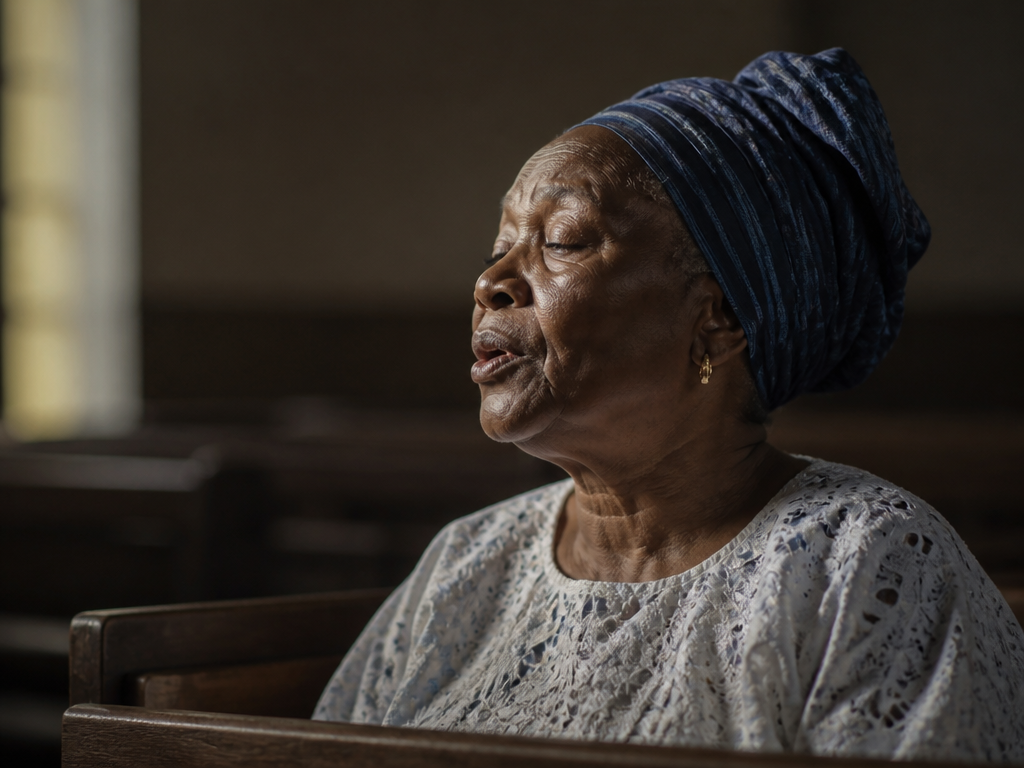
Go into a Christ Apostolic Church service in Ilesa, or a Cherubim and Seraphim congregation in Lagos, or any of the large Pentecostal auditoriums along the Lagos–Ìbàdàn expressway, and the praise-and-worship set is carried by Yoruba drums. The gángan and the larger dùndún — the hourglass drums whose pitch bends under the drummer's arm to shadow the tones of Yoruba speech — sit at the front of the sound alongside keyboard and guitar. The congregation dances, and the dancing is not incidental to the worship; it is how the worship is done.
The Aládùúrà churches, whose name means the owners of prayer, made this the norm early. Cherubim and Seraphim was founded in 1925 around Moses Orimolade Tunolase and Christianah Abiodun Akinsowon; Joseph Ayo Babalola's 1930 revival at Oke-Oye in Ilesa gave rise to Christ Apostolic Church; Josiah Olunowo Ositelu founded the Church of the Lord (Aladura) the same year. These were Yoruba-founded churches with Yoruba-speaking congregations, and they built a Christian liturgy that used the resources a Yoruba town already had: drumming, dreams, prophecy, visions, healing, and prayer conducted at volume and at length.
Congregations differ on how far this goes. The bàtá drums, whose association with Ṣàngó is too legible to ignore, are kept at arm's length in some churches and welcomed in others. Versions of the argument differ from parish to parish, and it is a live argument, not a settled one.
The Muslim side of the same street has its own version. The wéré bands of Ramadan grew, through the twentieth century, into fújì — Sikiru Ayinde Barrister's genre, built out of a devotional street music. Sákárà and àpàlà, the older Yoruba Muslim styles that gave the world Haruna Ishola, run on the sákárà drum and the àgídìgbo, and their song structure is Yoruba praise-poetry structure, applied to Islamic subjects. None of this is smuggled in. Yoruba Muslims built it deliberately, as Muslims, out of the materials to hand.
What you can hear: the name of God
The deeper layer is linguistic, and it goes back to the translation desk.
When Samuel Ajayi Crowther — Yoruba, taken as a boy on a slave ship, freed by a British naval squadron, later the first African Anglican bishop — led the translation of the Bible into Yoruba in the nineteenth century, he needed a word for God. He used Ọlọ́run. It was not a coinage. Ọlọ́run, the owner of the sky, was already a name for the high god of Yoruba cosmology, the one also called Olódùmarè. Every Yoruba Christian who has prayed since has prayed to a name that was in use before the mission arrived. Yoruba Muslims, similarly, say Ọlọ́hun as readily as they say Allāh.
The same holds for Ẹlẹ́dàá, the creator, and for the stacked, escalating praise-names that fill a Yoruba church service. That stacking is the shape of oríkì, Yoruba praise poetry: a subject is not described, it is addressed by an accumulating chain of attributes, each one a small compressed story. The òrìṣà were praised in oríkì. God, in a Yoruba church, is praised in oríkì. The theology changed; the form of address did not.
And then there are names. A great many Yoruba Christians and Muslims carry names built on òrìṣà: Ògúnṣínà, Ọ̀ṣundáre, Ṣàngóbùnmi, Fálọlá and Fáyẹmí and Awótúndé, all rooted in Ifá. Some families keep them without comment. Others substitute — Ifábùnmi becomes Olúbùnmi, Ṣàngóbíyì becomes Olúbíyì, the òrìṣà element swapped for Olú, the Lord. That substitution is itself evidence: you only bother to change a name that still means something.
Side by side
| Aládùúrà and Pentecostal churches | Yoruba Muslim practice | Ìṣẹ̀ṣe shrines and lineages | |
|---|---|---|---|
| People and region | Yoruba-majority southwest Nigeria; large diaspora congregations | Yoruba Muslims of Ilorin, Ìbàdàn, Lagos, Ẹ̀pẹ́, Ìwó | Yoruba towns across Nigeria, Benin, Togo; lineage-based |
| What is carried over | Drumming, dance, oríkì-form praise, prophecy and dream interpretation, Ọlọ́run as God's name | Praise-song structure, Yoruba drums, Ọlọ́hun, naming conventions | The whole system, in continuous practice |
| Music | Gángan and dùndún in praise sets; bàtá contested | Wéré, sákárà, àpàlà, and their descendant fújì | Bàtá, dùndún, and shrine-specific ensembles |
| How the future is approached | Prophecy, visions, dreams read by a prophet | Prayer, and in some quarters consultation of Islamic divinatory practice | Ifá divination by a babaláwo, reading the odù |
| What is explicitly rejected | The òrìṣà as addressees; ẹbọ; initiation | Shirk — associating any partner with God | Nothing borrowed is disowned, but lineage authority is required |
Ìṣẹ̀ṣe is not a survival
One more thing the one percent hides: Yoruba traditional religion is not a residue detectable only inside other faiths. It is practised, openly, now.
The Ọ̀ṣun-Òṣogbo festival fills Osogbo every August, drawing the town's Muslims and Christians along with devotees of Ọ̀ṣun, the river òrìṣà whose grove on the edge of the town was inscribed as a UNESCO World Heritage site in 2005 — restored across the second half of the twentieth century in large part through the work of the artist Susanne Wenger, known in Osogbo as Àdùnní Olóòrìṣà. Osun State designated 20 August as Ọjọ́ Ìṣẹ̀ṣe, a public holiday, in 2014. Babaláwo take clients today, in cities, including clients who will be in church on Sunday.
A survey that reports one percent is not describing that. It is describing how people answer a question.
Where the connection ends

The temptation, having seen all this, is to conclude that the churches and mosques of Yorubaland are the old religion wearing new clothes. That conclusion is wrong, and it is disrespectful to everyone involved.
The addressee changed, and that is the whole of religion. A gángan drum in a church is a Yoruba instrument being used to praise the Christian God. The people playing it are not praising Ṣàngó by other means and would be insulted by the suggestion. Continuity of form is not continuity of worship.
Ẹbọ did not come along. Sacrifice — offering, made in a specified way by a specified person for a specified purpose — is the practical centre of the òrìṣà tradition, and it is precisely what conversion required a person to abandon. It is not present in church or mosque in any form, however transformed.
Initiation and lineage do not transfer. A babaláwo becomes one through years of apprenticeship and initiation within a lineage, learning the corpus of the 256 odù, the verses attached to the Ifá signs. Nothing in a Pentecostal or Aládùúrà church confers that, and nothing in the church claims to.
Traditionalists reject the flattening too. Ìṣẹ̀ṣe practitioners have their own stake in the distinction, and it is not a warm one: they are watching their inheritance described as a set of aesthetics in someone else's building. To say it is all the same underneath is to hand the tradition's substance away and call it a compliment.
Where the scholars actually disagree
They disagree about what any of this proves.
The historian J.D.Y. Peel argued, in Religious Encounter and the Making of the Yoruba, that Christianity and Yoruba ethnic identity were not two things that met but two things made together in the nineteenth century — that the very category Yoruba, as a shared people rather than a set of towns, was substantially produced in the mission encounter, by Yoruba Christians like Crowther. On that reading, the continuities are not the old religion persisting inside the new one. They are what happens when a people build a religion in their own language.
Others, including many Nigerian scholars of religion, object to the standard term syncretism on the grounds that it presumes a pure original that was later diluted, and that no such original ever sat still. Yoruba practice absorbed and reshaped things for centuries before any missionary arrived.
The diaspora sharpens the question rather than settling it. In Bahia and in Cuba, Candomblé and Lucumí kept the òrìṣà openly, pairing them for a long time with Catholic saints — Ṣàngó with Santa Bárbara, Ọ̀ṣun with Our Lady of Charity, Ògún with a warrior saint. Scholars still argue over whether that pairing was protective camouflage under a hostile church or genuine theological work by people thinking in two registers at once. What is not in doubt is that these are living continuations, not degraded copies, and that they carry material the Nigerian homeland lost in places and has in some cases relearned from them.
Names and terms
- Ìṣẹ̀ṣe — the Yoruba term for their own inherited religious practice; the word insiders use.
- Òrìṣà — the powers or deities served within that tradition, each with its own domain, praise poetry, and lineages.
- Olódùmarè / Ọlọ́run — the Yoruba high god; Ọlọ́run is now also the standard Yoruba word for God among Christians.
- Ọlọ́hun — a Yoruba name for God used by Yoruba Muslims.
- Oríkì — Yoruba praise poetry, built by stacking attributive names.
- Babaláwo — an Ifá diviner, trained and initiated within a lineage.
- Odù — the 256 signs of Ifá divination, each carrying a body of verses.
- Ẹbọ — offering or sacrifice, prescribed through divination.
- Aládùúrà — literally the owners of prayer; the Yoruba-founded prophetic churches of the 1920s and 30s.
- Wéré / ajísáàrì — the Ramadan pre-dawn waking music of Yoruba Muslim towns.
- Gángan, dùndún, bàtá, sákárà — Yoruba drums; the first two are talking drums that follow the tones of speech.
The question nobody has found a way to ask
Here is what remains genuinely unsettled, and it is a measurement problem before it is a theological one.
Every instrument we have for counting religion was built for religions that count. Affiliation, membership, conversion, attendance: these are the metrics of traditions organised around exclusive belonging, and they work reasonably well on those traditions. Applied to a practice that never asked whether you were in or out, they return a one percent that means almost nothing and gets quoted as though it meant everything. But the alternative measures are not obviously better. Counting drums and names and grammatical forms will overcount, because a Yoruba Christian singing oríkì to God is doing something real and Christian, not something residually pagan. Nobody has yet designed an instrument that sits between those two errors.
So it stays open. And it stays open in different ways in Ilesa and in Ilorin and in Bahia, which the tradition itself would have predicted. Bí a ti ń ṣe níbí, kò rí bẹ́ẹ̀ níbẹ̀, the Yoruba say — the way it is done here is not the way it is done there. Which leaves the question the surveys keep walking past: when a religion was never a membership, what exactly would it look like for it to have ended, and how would anyone know?