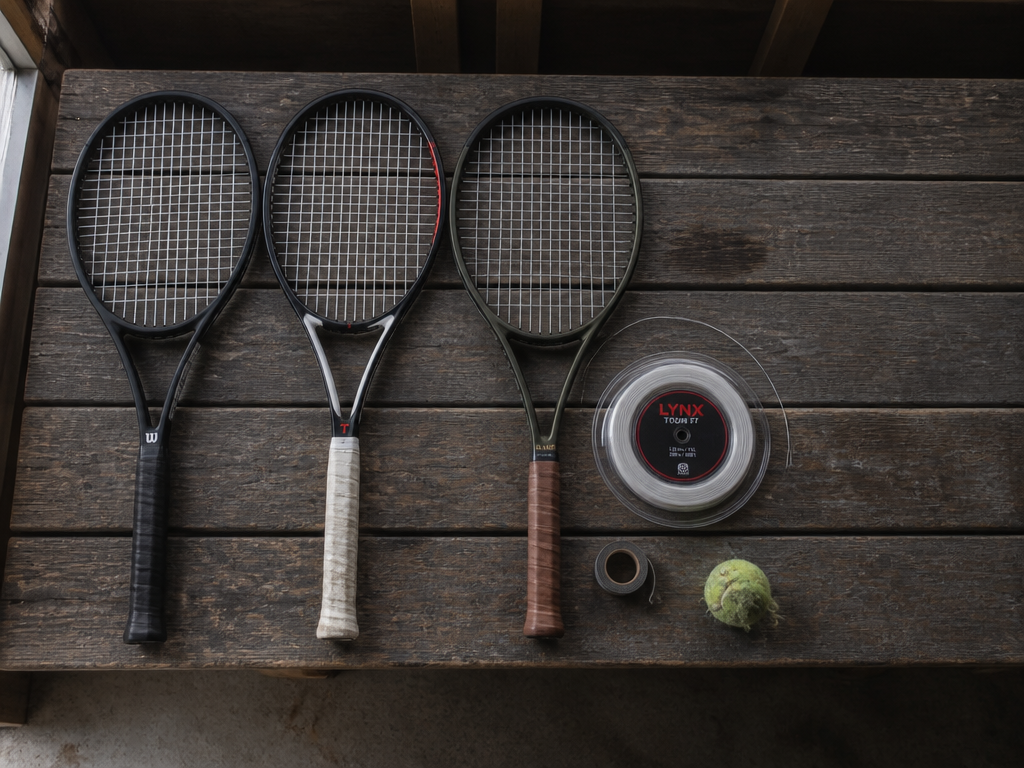
Blade Alternative: The Racquet Review That Asks What You Actually Want More Of
Here's a racquet review for a specific kind of player. If you're holding a Blade or a Pro Staff and wondering whether there's something that gives you more rally ball depth without turning the frame…

Here's a racquet review for a specific kind of player. If you're holding a Blade or a Pro Staff and wondering whether there's something that gives you more rally ball depth without turning the frame into a rocket launcher, this is for you.
The myth you've heard: You have to choose. You can have control, or you can have spin and power. If you want the second group, you pick up an Aero-style stick with an open pattern and a stiff beam, and you accept that your drop shots will wander and your half-volleys will fly.
The evidence that says otherwise: Look at what some players are actually doing. College players adding lead at 12 and 2 to a 16x19 Blade. Club competitors switching from a Pro Staff to a Head Speed MP and finding the ball heavier, not wilder. Tour-level guys who paint their racquets differently but whose actual frames tell a more nuanced story — thinner beams, tighter patterns, higher static weights. The market now has a whole category of frames that sit between the classic control stick and the pure spin monster. They don't have a name the way "tweener" does, but you know them when you hit with one: familiar on the first ball, more forgiving on the second, and capable of a higher ceiling when you load into the shot.
How it works — the mechanism.
Three things change when you move from a tight-pattern control racquet to something in the Blade alternative zone, and they change in ways you can feel in the first ten balls.
String pattern. A 16x19 string bed grabs the ball longer and releases it with more trajectory than an 18x20. The trade: the launch angle is less predictable on off-centre hits. The fix: a controlled string — something like a round polyester at mid tension, not a shaped string that amplifies the variability.
Flex profile. Many frames in this space (Tecnifibre TF40, Yonex VCore Pro — now called the Percept — Head Speed Pro) use a flex that's stiff enough to hold the hoop open on a hard hit but soft enough that you don't lose the sensation of the ball sitting on the strings. A Blade is around 65 RA. These frames sit around 62-64 RA. That difference of two to three points is the difference between "I feel the ball compress" and "I feel the ball disappear into the bed and come back."
Beam width and weight distribution. Most Blade alternatives use a slightly thicker beam (22-23mm) compared to the Blade's 20.5mm. That extra thickness adds a bit of plough-through on defensive shots — the racquet doesn't get pushed around as much when you're stretching. But the bigger variable is where the weight lives. A Pro Staff's weight is concentrated in the handle. A Blade alternative often has more weight in the hoop. That shifts the sweet spot up and forward. The ball comes off with more perceived weight, but you feel the racquet more on off-centre hits if you haven't developed the timing to meet the ball out front.
Drill it.
Take your current racquet and hit ten crosscourt forehands, focusing on depth. Then hit ten with a friend's 16x19 control frame — something like a Speed MP or a TF40 315. Don't try to generate extra spin. Just hit your normal ball. The difference you're looking for isn't "more spin." It's "the same swing produced a deeper ball with a higher net clearance." That's the mechanism in action: the string bed and the flex profile are doing work your arm used to have to do.

Honest takeaway.
There is no Blade alternative that gives you everything. Here's what each option costs.
A 16x19 Blade gives you the most familiar feel with a slightly higher launch angle. It costs you nothing you haven't already felt in a demo — just a string adjustment (go up 2-3 pounds to keep the launch under control). It's the safest move for a Blade loyalist.
A Yonex Percept 97 (formerly VCore Pro) gives you a softer flex and a rounder head shape that produces a more consistent string bed response across the hitting surface. It costs you some crispness on volleys — the frame is quieter, deader on touch shots — and it swings heavier than the spec sheet suggests because the weight is distributed into the hoop.
A Head Speed MP or Speed Pro gives you the most forgiveness of any option in this space. The beam is slightly tapered, so you get a bit of free power on defensive swings without losing control on full cuts. The cost: the feel is more dampened than a Blade. Some players describe it as a "foam" sensation. If you need to feel the ball compress and leave, this might not be for you.
A Tecnifibre TF40 305 or 315 gives you the best combination of flex and stability in this category. It's the closest to a Blade feel while offering more free depth on a neutral swing. The cost: it's demanding. You need to prepare early and hit the centre consistently. If your technique breaks down in the third set, this frame won't save you.
Who this is for: The player whose current control frame feels like it's maxed out — you're swinging as hard as you can and the ball still lands shallow, or you're adding so much spin that you're muscling the ball to keep it deep. You've got consistent technique and you're ready to let the racquet do some of the work.
Who this isn't for: The player still figuring out their swing. These frames amplify what you bring. If you don't bring clean contact and a full swing, they'll feel stiff, unforgiving, and expensive for what they deliver.
A final note on price. The racquets I've mentioned sit at the same retail tier as the Blade — around $230-$260 USD. There is no budget option here that does the same thing, because the engineering that produces this balance (thin beam, controlled flex, stable hoop) costs the same to manufacture whether it's in a familiar paint job or a new one. Don't buy a cheaper frame hoping to add weight to make it feel like a control stick. That usually produces a dead, polarised feel that's harder to modify than it is to replace.
I haven't addressed the real question, which is which specific racquet you should buy. That depends on your swing path, your string tolerance, and whether you're willing to add weight. Those are separate conversations — one for the court, not the article. Start with the five frames I've named. Demo them in the same session with the same string. Your hand will know before your brain does.