Overgrips for Sweaty Hands: What Actually Works When Your Grip Slips Mid-Shot
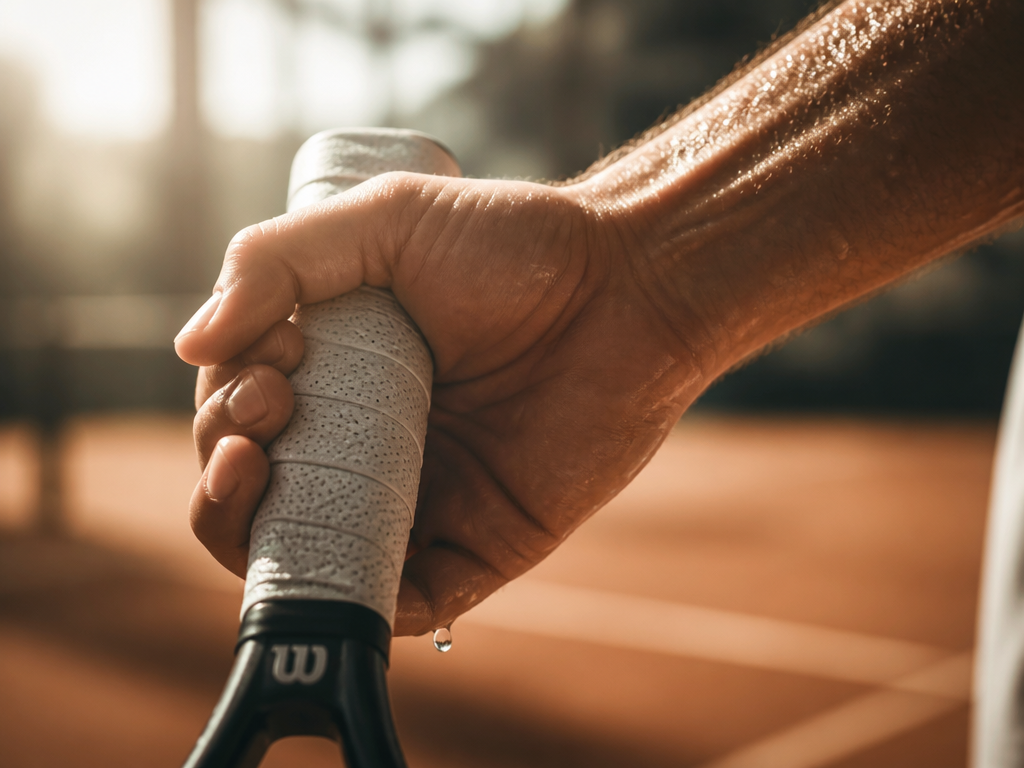
I was up a break at 4-3 in the second set. Deuce court. Second serve out wide, opponent floated a short ball back, and as I stepped in to take it early my right hand rotated inside the grip.

I was up a break at 4-3 in the second set. Deuce court. Second serve out wide, opponent floated a short ball back, and as I stepped in to take it early my right hand rotated inside the grip. The racquet twisted. The ball went into the bottom of the net.
Not a miss-hit. A grip failure.
I walked to the towel, dried my palm, changed my overgrip between games. New one lasted maybe four games. By the time I lost the set 6-4, I had gone through three overgrips and stopped trusting the two-handed backhand entirely. Not because my footwork broke down. Because I could feel the handle turning in my left hand on every heavy shot.
That was the day I stopped assuming all overgrips are basically the same.
Two Species, One Problem
Overgrips for sweaty hands fall into two families, and the difference matters more than brand or colour.
Tacky-when-wet grips get sticker as you sweat. The moisture activates the surface compound. You can feel them grabbing your palm harder the more you play.
Dry-absorbent grips feel papery or suede-like. They wick moisture away from your skin and keep your hand relatively dry. They do not get tackier. They just stay dry.
If you have ever put on a fresh overgrip and thought "this feels too slick, I need more tack," you are a tacky-when-wet person. If you have ever finished a set and found the grip still dry but the surface worn smooth, you are an absorbent person. Most players do not know which camp they belong to because they have only ever tried one or two brands.
I have now spent six weeks playing matches and practice sets with five of the most common options. Here is what I found.
Tourna Grip (Original Blue)
Tourna is the default for a reason. It is thin, dry, absorbent, and feels almost like a paper towel wrapped around your handle. The original blue has no tack at all. You wrap it, you play, and when it gets wet it stays functional — but it does not get stickier. It just stays dry-ish.
What it does well: It works. The thing that makes Tourna the default is that it reliably absorbs sweat for roughly 90 minutes of match play before it starts matting down. For a two-set recreational match, it gets the job done.
Where it falls short: Durability. Tourna compresses fast. After two hours the surface goes smooth and the absorption drops. You will replace it every match if you are playing seriously. Also, it is thin. If you like a cushioned feel, Tourna will feel like nothing between your hand and the bevels.
Who it is for: Players who sweat heavily and do not mind changing grips often. Players who hate the feeling of a slick surface—Tourna never gets slick because it never gets tacky.
Who it is not for: Anyone who wants their grip to last a week of practice. Anyone who wants a plush, padded feel.
Yonex Super Grap
I used Tourna for about three years. I switched to Super Grap because I got tired of replacing grips every session. Super Grap is the tacky-when-wet type. Out of the package it feels slightly sticky. As your hand heats up and moistens, the stickiness increases. Around the third game of a set, it locks onto your palm.
What it does well: Longevity. A single Super Grap will outlast two Tournas easily. I have played four hard-fought sets on one Super Grap and it was still tacky. It also has a bit of thickness to it — enough to soften the bevels without losing feel.
Where it falls short: If you are the kind of player whose hands sweat but stay relatively cool, Super Grap can feel almost too tacky. Some players describe it as "gummy." On very humid days with no breeze, the tack can build up to the point where adjusting your grip mid-point is slightly harder — the grip holds your hand in place, which is normally good but can feel constricting if you are a big grip-changer.
How to decide: If you have been replacing Tourna every match and wondering if there is something that lasts, there is. It is Super Grap. The trade-off is a different feel — tacky rather than dry — and three to four times the lifespan.
Wilson Pro Overgrip
Wilson's entry sits between the two camps. It has moderate tack and moderate absorbency. It does not excel at either but does not fail at either either.
What it does well: Consistency. Pro Overgrip feels the same on day one as it does at the end of a set. It does not get dramatically tackier or dramatically wetter. For players whose sweat level is moderate — not soaking through a grip in three games, not bone-dry — this is the most predictable option.
Where it falls short: It does not solve the problem for either end of the spectrum. Heavy sweaters will find it inadequate after an hour. Players who just barely sweat will find it fine but unremarkable. It is a C+ in both categories when what you really want is an A in the one that matters to you.
Head Xtra Tack
Head makes a grip that is aggressively tacky. Out of the package it sticks to your palm the way a new rubber grip on a badminton racquet does. Some players love this. Some hate it.
What it does well: It is the closest thing to a "locks in your hand" feeling you can get from an overgrip. If your main complaint is that your hand rotates on the handle during heavy groundstrokes, Xtra Tack will stop that.
Where it falls short: The tack degrades faster than Super Grap. After about two hours of hard play, the surface goes from aggressively sticky to moderately sticky. It does not become unusable — it just becomes less remarkable. Also, the initial tack can be off-putting. I gave it to a friend who tried it for half a game and unwrapped it because he felt like he could not adjust his grip at all.
Volkl V-Dry
Volkl's absorbent grip is less common but worth mentioning because it solves a specific problem: it is a dry-absorbent grip that lasts longer than Tourna.
What it does well: It wicks moisture effectively and holds its texture for about twice as long as Tourna. It is slightly thicker than Tourna but not as plush as Super Grap.
Where it falls short: Availability. You will not find it at most pro shops. You have to order it. The feel is not as familiar as the blue standard, and the surface can feel almost fuzzy when new, which some players find distracting.
Common Grip Faults
| What you feel | Likely cause | What to try |
|---|---|---|
| Grip twists in hand on heavy shots | Wrong overgrip type for your sweat level | Switch from absorbent to tacky, or vice versa |
| Grip feels fine for one set, dead by the second | Overgrip has reached end of life | Replace it — this is normal |
| Grip feels too thick, lose bevel feel | Double-wrapped or too many base grips underneath | Strip to bare handle, one base grip, one overgrip |
| Palm slides but fingers stay dry | Grip absorbs moisture but does not grip the skin | Try a tacky-when-wet type |
| Hand gets sticky, hard to adjust grip | Tack is too aggressive for you | Try an absorbent type instead |
A Two-Category World
I replaced Tourna with Super Grap about four years ago and have not looked back. But I know players who tried Super Grap and hated it, went back to Tourna, and are perfectly happy replacing grips every week. Neither of us is wrong. We just have different hands.
The question is not "which overgrip is best for sweaty hands." The question is: do your hands want a grip that sticks when wet, or a grip that stays dry?
Decide that first. Then pick a brand. The myth is that you need to find the overgrip — the one perfect product that works for everyone. The reality is that there are two kinds of overgrip, you are built for one of them, and the wrong kind will make your grip slip no matter how good the brand.