HEAD Extreme 2026 Review – Stability Without the Muffle
Your first hit with the 2024 HEAD Extreme probably went something like this: clean contact, ball deep, and a strange lack of information in your hand. The racquet did the work.

Your first hit with the 2024 HEAD Extreme probably went something like this: clean contact, ball deep, and a strange lack of information in your hand. The racquet did the work. It also told you almost nothing about how it did the work. You checked the strings. You checked the grip. You hit another ball. Same thing — a muted, disconnected sensation that made you wonder if you'd bought a training aid instead of a frame with a personality.
You weren't wrong to feel that way.
The HEAD Extreme 2026 review cycle is here, and the question for anyone who walked away from the 2024 edition is the same one I had: did HEAD fix the feel, or did they just paint over it?
The Myth
The myth, repeated across forums and shop counters, goes like this: a stable racquet has to feel dead. That the dampened, disconnected sensation is the price you pay for a hoop that doesn't twist on off-centre hits. Engineers dampen the frame to mask vibration, the logic says, and the by-product is a loss of feel.
It's a believable story because it's half true. Dampening does reduce vibration. But the 2026 Extreme proves that stability and feel are not a binary choice — that you can have a frame that stays solid through contact without withholding feedback from your hand.
The Evidence
I hit the 2026 Extreme MP, Pro, and MP XL across four sessions — two on hard court, two on clay. My test frame was strung with HEAD Velocity at 24 kg, a control string I know well enough to isolate what the racquet is doing versus what the string is doing.
The difference between the 2024 and 2026 is not subtle. It's not a tweak. It's a recognisable shift in how the frame transmits energy.
On the 2024, a ball struck slightly high in the hoop produced a dull thud with a half-second delay before you registered the result. The 2026, in the same spot, gives you a crisp, immediate report — the ball tells you where it landed before you see it land. Upper-hoop stability is meaningfully improved, which matters for anyone who gets stretched wide and has to flick a defensive ball back deep. The 2024's upper hoop could flutter on those shots. The 2026 holds its line.
The Pro model, at 315g unstrung and 18x20, is the most dramatic shift. The 2024 Pro was, frankly, a demanding frame with a feel that didn't reward the effort. The 2026 Pro retains the control pattern but now gives you something back on clean contact — a direct, metallic-but-not-harsh resonance that tells you exactly where on the stringbed the ball sat. It still demands a full swing. But it communicates now in a way the 2024 didn't.
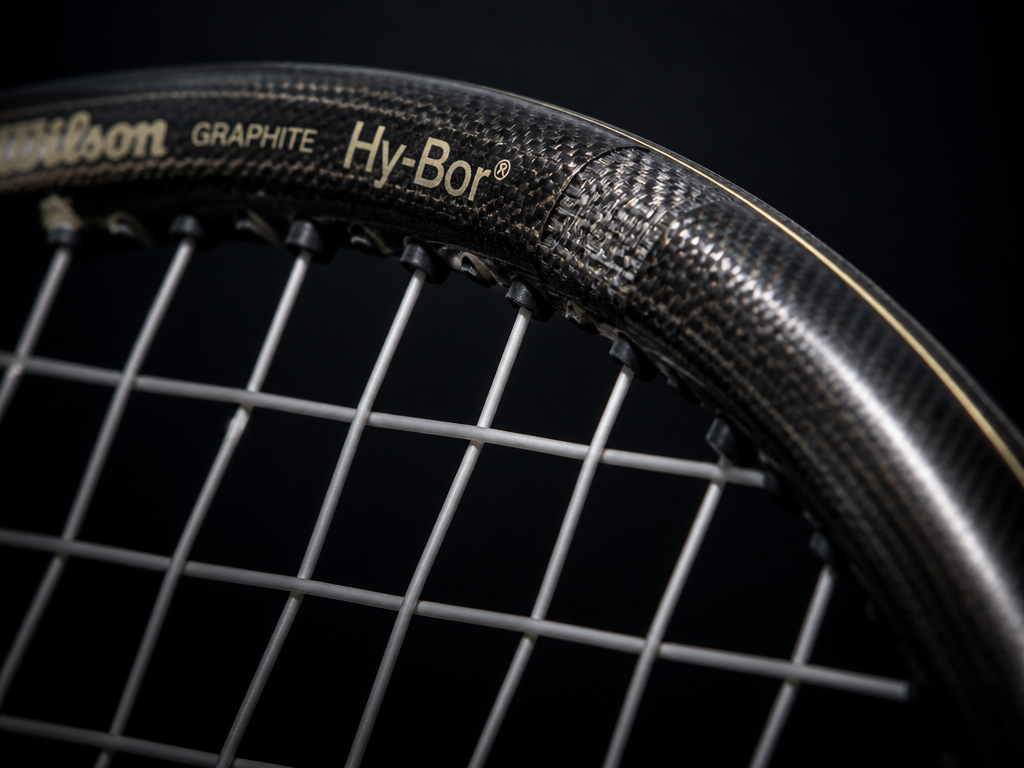
The MP XL (extended length, 27.5 inches) is the standout, but not for the reasons you might expect. Yes, it generates more racquet-head speed. Yes, the extra half-inch produces a heavier ball. What surprised me was the feel: the extended frame, which you'd expect to feel more vague at the tip, actually gave the most consistent feedback of the three. The Hy-Bor material — a combination of graphite and piezoelectric fibres that stiffen under impact — seems to work most effectively at the extended length, where the frame needs the most structural help.
The Mechanism
Hy-Bor is worth understanding because it explains why the 2026 doesn't need a heavy dampening layer to feel stable.

Traditional racquet construction uses carbon-fibre layers that flex uniformly under load. To reduce vibration, manufacturers add elastomeric dampening inserts or increase the frame's mass. Both approaches work, but both dull the feedback — the dampener absorbs the vibration before it reaches your hand, and mass changes the swing dynamics.
Hy-Bor introduces a piezoelectric ceramic fibre into the layup. When the frame flexes on impact, the fibre generates a small electrical charge that temporarily stiffens the surrounding material. The effect is microsecond-level: the frame flexes normally on a slow swing or soft ball, but becomes measurably stiffer on a fast swing or heavy incoming ball.
What this means for your hand: the racquet resists torsional twist at the moment of impact without needing to be heavier or more dampened. The feedback that reaches your hand is fuller — less filtered — because the structure itself is doing the work that a dampening insert would otherwise do.
This is not marketing language. You can feel it in the upper hoop on a one-handed backhand. That was my primary test: I hit perhaps two hundred backhands across the four sessions, targeting the upper third of the stringbed deliberately. The 2024 Extreme would twist and produce a vague, low-pitch response. The 2026 twists less and reports more. For the one-handed backhand player specifically — a group often underserved by modern 100-square-inch frames — this is the difference between a racquet you manage and a racquet you trust.
The Honest Takeaway
The 2026 Extreme is not a soft racquet. If you want a flex index below 60 and a buttery, old-school feel, this frame will not give you that. The stiffness is present, and on off-centre hits the feedback is firm — not harsh, not painful, but unmistakably there.
What it is not, and what the 2024 was, is disconnected. The feel is direct without being jarring. The stability is structural rather than mass-based, which means the racquet swings faster than its weight suggests. The MP XL, in particular, manages the unusual trick of feeling more powerful and more controllable at the same time — a contradiction that usually signals a genuine design success.
Who this is for: the 3.5+ player who left the 2024 Extreme feeling vaguely unsatisfied. The one-handed backhand player who needs upper-hoop stability without adding lead tape. The competitive club player who wants a 100-square-inch frame that doesn't play like a pillow.
Who this isn't for: the player who loves a flexy, dwell-time feel. The 2026 communicates clearly, and that clarity includes the firmness of the stringbed. If you prefer your feedback filtered, this is not a step in that direction.
What I Kept in the Bag
After the four sessions, I put the 2024 Extreme back in my bag for one last hit. It felt the way I remembered — competent, unrevealing, efficient. A tool that did its job without a personality.
I took it out again that same evening and replaced it with the 2026 MP XL. Not because the new frame is better in every measurable way — the Pro is probably a better fit for my game long-term. But because the MP XL, on the second day of testing, produced a one-handed backhand down the line that I felt in my fingertips before I saw it land. That's not a stat you can publish. It's the reason I'm still carrying it.