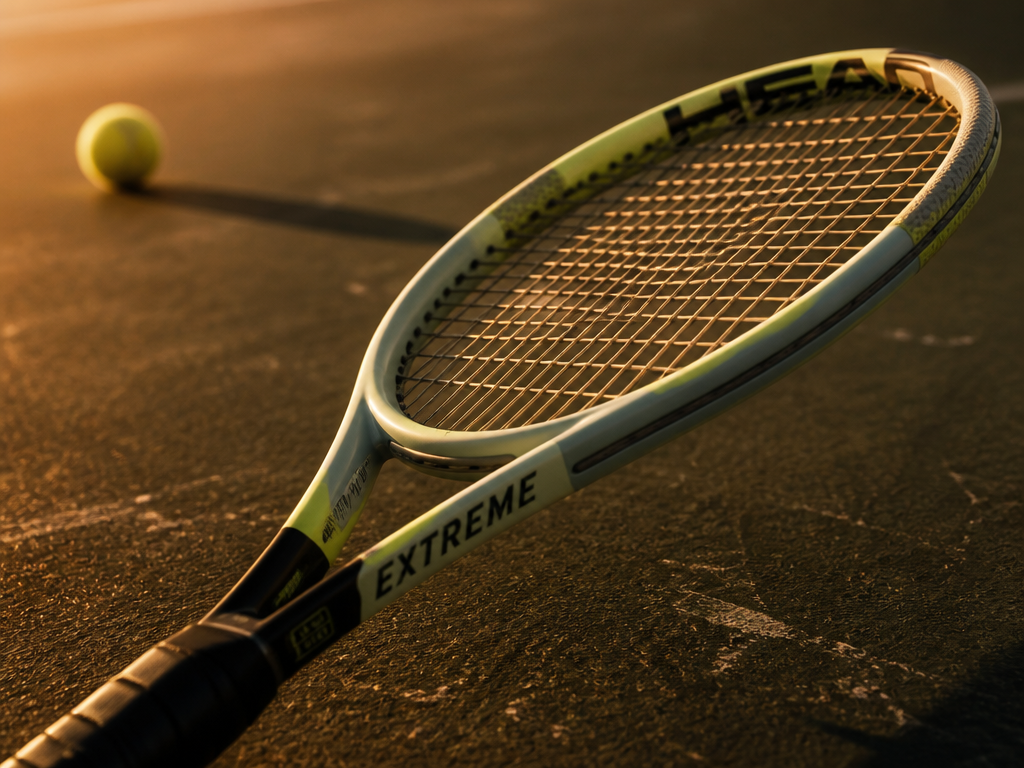
HEAD Extreme 2026 Review: P98 vs P100 – The Pattern That Changes Everything
The HEAD Extreme 2026 review you have read so far has told you the frame is faster through the air, that Hy-Bor stiffens the throat without deadening the hoop, that the cosmetics are polarising and…

The HEAD Extreme 2026 review you have read so far has told you the frame is faster through the air, that Hy-Bor stiffens the throat without deadening the hoop, that the cosmetics are polarising and the MP XL is the surprise of the lineup. All of that is true. But none of it explains the miss you keep making.
You are hitting a backhand slice from the baseline. It floats. It lands short, sits up, and your opponent steps in and drives it past you before your recovery step finishes. You check the tension. You check the bounce height. You tell yourself to stay down longer. None of it works because the problem is not your technique. The problem is the gap between the tenth and eleventh cross string.
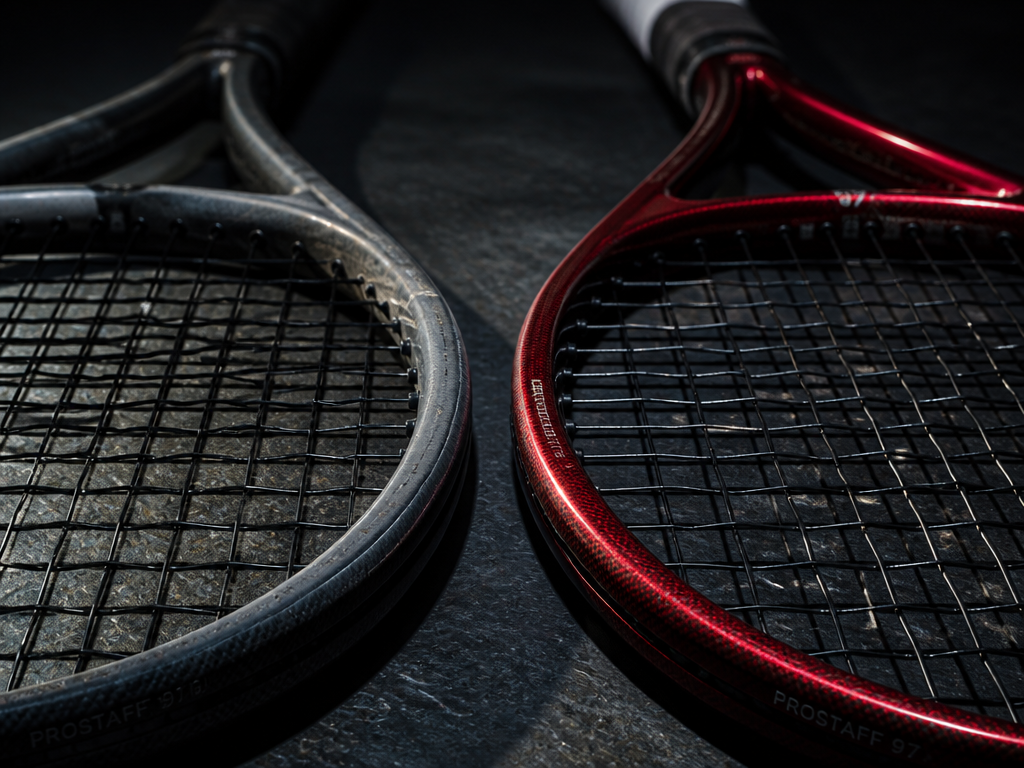
P98 and P100 are not paint jobs or grip sizes. They are the string-spacing codes for two distinct 2026 Extreme models, and they produce two different balls.
Let me show you what happens in causal order, so you can decide which one you should be holding.
What P98 and P100 actually mean
P98 is an 18x19 pattern. P100 is 16x19. HEAD has used density codes before — the old Graphene Touch Speed had a PMP version — but the 2026 Extreme is the first generation where both options arrive at retail simultaneously, not as a limited run.
The difference is not about how many strings break. It is about what happens in the first five milliseconds of contact.
In a P100 (16x19), the crosses are spaced wide enough that the mains have room to snap back laterally before the ball leaves the strings. That snap-back imparts spin via the gear effect — the ball rolls up the stringbed and the strings return to position underneath it, brushing the ball's back surface. You get a higher launch angle and a livelier, springier response at the same swing speed.
In a P98 (18x19), the crosses are tighter. The mains cannot displace as far before contacting the adjacent cross. Snap-back is reduced. The ball sits on the stringbed longer because the spacing is more uniform — less pocketing, more controlled deflection. Launch angle drops by roughly two to three degrees. Trajectory flattens. The ball leaves the strings earlier in the swing arc.
That is the mechanism. Now follow it through a rally.
What happens next
With the P100, your spin-heavy forehand clears the net with more margin. You can aim higher over the tape and trust the topspin to drag the ball down inside the baseline. Slice stays low because the open pattern lets you cut under the ball with less string resistance. The trade-off: on off-centre hits, especially toward the upper hoop, the wider spacing creates a harsher vibration and a more unpredictable launch angle. The ball can flutter. You need to be precise.
With the P98, your flat first serve stays on a tighter line. The 18x19 pattern resists deformation on mis-hits — the ball still goes where the stringbed points. Your one-handed backhand drive benefits more than any other shot because the tighter spacing stabilises the frame against the twisting force of an off-centre contact. If you hit a one-hander, you already know what a 16x19 does to a ball struck low and late toward the tip: it torques the racquet in your hand and sends the ball into the net or the fence. The P98 nearly eliminates that torque.

The one-handed backhand slice, the shot that started this article, changes completely. With the P100, the ball leaves the strings a fraction of a second faster. That earlier release robs you of the sensation of the ball sliding along the strings, which is what gives you directional control. With the P98, the ball stays on the bed long enough for you to feel the edge — you know exactly where the contact point is along the racquet face. The slice stays low because you controlled the angle, not because you guessed the launch.
Who each pattern is for
P100 is for you if: you grew up on 16x19 and found the 2024 Extreme too muted and disconnected. The 2026 P100 restores the liveliness that the previous generation sanded away. You generate your own racquet head speed. You hit with heavy topspin on both wings. You accept that you will mishit one in ten balls toward the upper hoop and you would rather have that one fly long than land short and sit up.
P98 is for you if: you hit a one-handed backhand, you flatten out your two-hander, or you are a 4.0+ player who has realised that 16x19 patterns punish you more than they reward you. The P98 is the version that lets you aim at a half-metre square and trust the frame to hold the line. It is less forgiving on very low balls — the tighter pattern does not help you scoop — but from waist height and above it is the most predictable Extreme HEAD has made since the 2016 Graphene Touch.
This is not for: beginners. Both patterns are demanding in different ways. The P100 asks for consistent contact location. The P98 asks for racquet head speed on spin shots that a developing player does not yet have. If you are below 3.5, the previous generation Extreme MP in 16x19 at a lower tension will teach you more.
Drill it
You need a wall and twenty balls. Stand four metres from the wall. Hit ten forehand drives with the P100 — or whichever model you are considering — and count how many land below waist height on the rebound. Then do the same with the P98. You will feel the launch difference in the first three swings. The P100's ball comes back higher and faster. The P98's ball comes back lower and slower, which means you have to generate your own pace. That is the whole choice in miniature: do you want the frame to add pace, or do you want the frame to hold a line?
The line that matters
Between the 2024 Extreme and the 2026 Extreme, HEAD fixed the biggest complaint: the disconnected, dulled feel that made you wonder if you were holding a frame or a shock absorber. Hy-Bor helps, but the real fix is the pattern choice. They gave you back the option to decide how much string movement you want.
If you value directional certainty over spin amplitude, buy the P98. If you value spin amplitude over directional certainty, buy the P100.
Everything else — the cosmetics, the throat stiffness, the marketing copy — is just decoration around that one decision.