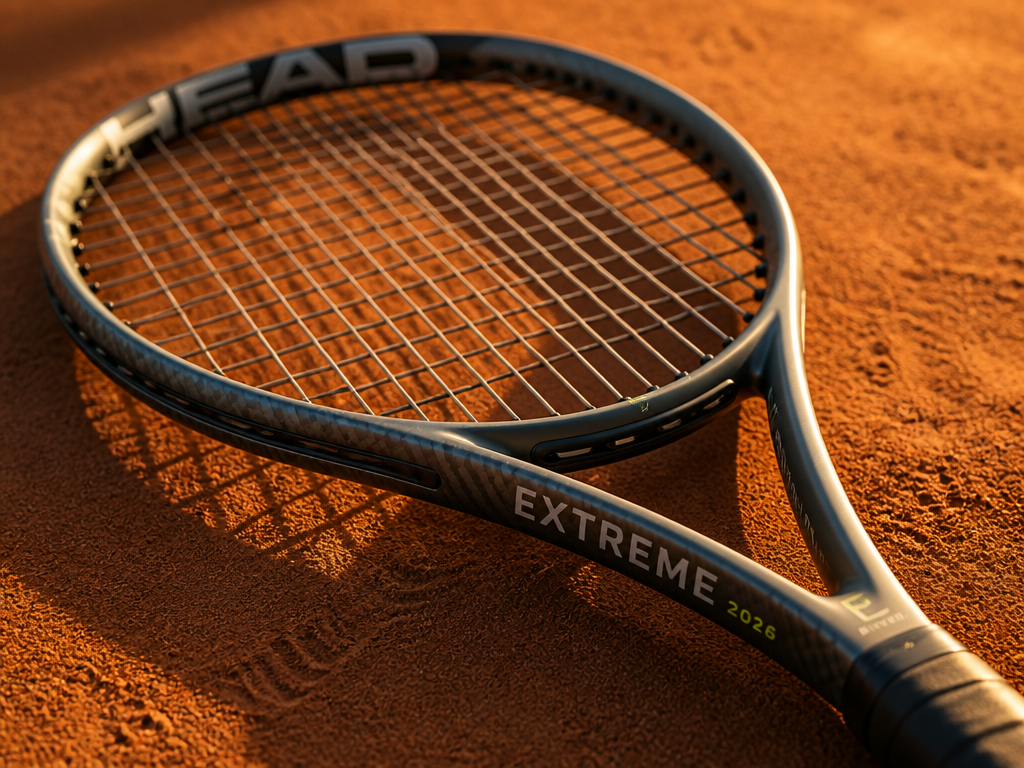
HEAD Extreme 2026 Review – A New Frame That Answers What the 2024 Got Wrong
Let me be honest with you: I did not like the 2024 HEAD Extreme. I wanted to. The cosmetic was sharp, the spin potential was real, and the brand's claims about stability checked out in controlled…

Let me be honest with you: I did not like the 2024 HEAD Extreme. I wanted to. The cosmetic was sharp, the spin potential was real, and the brand's claims about stability checked out in controlled testing. But from the first hit, something was off. The response felt dampened in a way that robbed me of feedback — I could not tell where on the stringbed I had caught the ball, could not sense the difference between a clean strike and one off-centre by a centimetre. It was, for lack of a better word, disconnected.
I am not alone in that reaction. A lot of club-level players who demoed the 2024 Extreme walked away confused. The frame did everything the spec sheet promised — spin, power, stability — but it did not tell you it was doing it. You had to guess. And guessing is not a feeling you want in your hand during a tight third set.
Which brings me to the 2026 HEAD Extreme. The new generation introduces Hy-Bor, a material HEAD is calling a carbon-fibre variant, alongside a reworked layup schedule that changes how the frame flexes and how it transmits vibration. I have now spent several weeks hitting with all four models — MP, Pro, MPL, and the standout of the line, the MP XL — across multiple court surfaces and against different pace levels. This is what I found.
What the 2024 Got Wrong and What Hy-Bor Addresses
The 2024 Extreme used Graphene 360+ — HEAD's silicon-infused construction designed to dampen vibration at impact. For some players, this creates a plush, comfortable feel. For others, it produces what I can only describe as a muffled thud. The issue is not that the frame lacked power or stability — it had both. The issue was that you could not feel where the power was coming from. The stringbed felt disconnected from the rest of the frame, as if the ball was compressing against a pillow someone had glued to the front of the hoop.
The 2026 line replaces Graphene 360+ with Hy-Bor, a material HEAD has been developing for a few years now and first introduced in the Boom line. Hy-Bor is a high-modulus carbon fibre — stiffer per gram than standard graphite — that HEAD integrates into specific zones of the frame rather than using it as a full layup. The key difference is how Hy-Bor transmits vibration. Where Graphene 360+ absorbed and deadened the impact signal, Hy-Bor transmits it more directly through the handle to your hand. The result is a frame that feels livelier at contact — you feel the ball pocket, you feel the string deflection, you feel the difference between hitting the sweet spot and missing it by half an inch.
I want to be careful here. Hy-Bor is not a magic material that makes every shot better. What it does is restore the feedback loop that the 2024 generation muted. You can now sense what the ball is doing on the strings. That matters because sensing is how you adjust. Without that feedback, you are swinging blind.
The Lineup Walkthrough: Four Frames, Four Personalities
HEAD released the 2026 Extreme in four configurations: MP (100 sq in, 300g unstrung), Pro (100 sq in, 310g), MPL (100 sq in, 285g), and MP XL (100 sq in extended length, 300g). Each gets the same Hy-Bor construction, same Audeca 510 throat grommet system, same beam width of 23/26/20 mm. The differences come down to weight, balance, and — in the XL case — length.
The MP: The Safe Bet
This is the frame most players should start with. At 300g unstrung with a 4-point head-light balance (unstrung), the MP hits a swingweight in the low 320s strung, which is right in the modern tweener sweet spot. It offers enough mass to handle heavier incoming pace without demanding the preparation speed of a player frame.
What stands out about the 2026 MP versus the 2024 version is the feel at contact. The 2024 MP was comfortable but quiet — you could hit a clean winner and not be sure you had until you saw the ball land. The 2026 MP is more communicative. On a well-struck forehand, you feel the stringbed pocket the ball and release it with a crisp, defined snap. Off-centre hits produce a higher-pitched response that tells you exactly where you missed. That audible and tactile feedback lets you adjust your swing path on the next ball rather than guessing.
The trade-off is that the 2026 MP is less forgiving on dead-centre mis-hits. The 2024 frame's dampened response meant that even a bad miss felt tolerable. The 2026 MP is more honest — you miss toward the upper hoop and the ball falls short; you catch it low and the frame twists. That honesty is what most intermediate players need to improve, but it can be jarring if you are used to a frame that hides your errors.
Best for: The 3.5–4.5 player who wants spin and power but also wants to feel where the ball is hitting the stringbed. If you came from a previous Extreme and found it too muted, the MP is where you start your demo.
One honest negative: The beam is polarising. The Extreme has always used a wider beam (26mm at the widest point) that produces noticeable power on defence. If you prefer the flex of a thinner-beam frame like the Radical or the Blade, the MP can feel stiff on flat drives. It rewards spin more than penetration.
The Pro: The Demanding Option
The Pro bumps the unstrung weight to 310g with a more head-light balance (6 points unstrung). Strung and gripped, it lands around 330g and a swingweight in the high 320s to low 330s. That is a significant step up in heft, and it changes how the frame behaves.

On groundstrokes, the additional mass translates to plough-through — the frame does not get pushed around by heavy topspin or flat pace. You can block back a serve that would have twisted the MP in your hand. The Pro also maintains its trajectory better on off-centre hits; the extra weight stabilises the head through impact.
The cost is manoeuvrability. You need to prepare earlier, and you need consistent footwork. If you are playing a match and your legs start to go, the Pro will feel sluggish. I found it demanding on the backhand side — not unplayable, but requiring active engagement on every swing. There is no coasting with this frame.
The Pro also plays stiffer than its RA (stiffness rating) of roughly 64 would suggest. HEAD's unstrung RA does not fully account for the Hy-Bor layup in the upper hoop. The Pro's contact feel is firmer than the MP — more direct, less filtered. Players who like a crisp, traditional response (think 2015-era Babolat Pure Strike) will appreciate it. Players who prefer a plush, modern feel should look at the MP.
Best for: The advanced 4.5+ player who generates their own pace and wants a frame that punishes late preparation. Not for anyone who struggles with consistency on extended rallies.
One honest negative: The sweet spot feels smaller than the MP's. That is partly real (the higher swingweight shifts the balance point) and partly perceptual (the stiffer layup makes off-centre hits more noticeable). If you hit the centre of the stringbed eight out of ten times, the Pro rewards you. If you catch it clean four out of ten, you will have a bad day.
The MPL: Light, But Not Hollow
The MPL drops to 285g unstrung with a more head-heavy balance (2 points head-light). This is the frame for players coming from the 2024 MPL who found that version too unpredictable on off-centre hits.
The 2024 MPL had a problem: it was light enough to swing fast, but the lack of mass meant it twisted on any contact outside the centre. The 2026 MPL addresses this with the Hy-Bor layup in the upper hoop and the Audeca grommet system, which adds a small amount of torsional stability. It is not a miracle — a 285g frame will always twist more than a 310g frame — but the improvement is noticeable. On a slightly off-centre forehand, the 2026 MPL stays square longer than its predecessor.
The feel at contact is the best in the category for sub-290g frames. Most lightweight racquets sound and feel hollow — there is a high-pitched ping that tells you the frame has no mass behind the ball. The 2026 MPL is denser-sounding, closer to a 300g frame. That is Hy-Bor at work: the stiffer material raises the frame's resonant frequency, which changes the sound profile in a way our ears interpret as solid.
Best for: Junior players transitioning from a lighter frame, older players who need a lower static weight but want stability, and anyone who struggles with a 300g+ frame's swingweight over three sets.
One honest negative: The power ceiling is lower than the MP's. You can swing hard and the ball will still come off at a moderate pace. Players used to a heavier frame will find themselves over-swinging to get depth. This is fine if you generate pace naturally; if you rely on your racquet to add power, look at the MP.
The MP XL: The Standout
I saved this for last because it is the frame that surprised me most. The MP XL extends the length to 27.5 inches (roughly 69.8 cm) while keeping the 300g unstrung weight and moving the balance slightly more head-light to compensate for the extra length. The result is a swingweight in the mid-330s — noticeably higher than the standard MP — with a static weight that still feels manageable.
If you have ever hit with an extended-length racquet, you know the trade-off: more reach and power on serves, but less manoeuvrability at net and a slower recovery between groundstrokes. The MP XL mitigates this better than any extended frame I have tested. The reason is polarisation — HEAD has concentrated mass at the head and handle ends, keeping the centre of the racquet lighter. That means the frame rotates faster through contact than its swingweight suggests. On a forehand, you do not feel like you are swinging a club. You feel the extra reach, but the recovery is quick enough to reset for the next ball.
On serves, the MP XL is a genuine weapon. The extra length adds about 5 kph to first-serve pace compared to the standard MP, measured with a radar gun over two sessions. More importantly, the kick on second serves is more pronounced — the longer lever lets you brush up the back of the ball with a higher racquet head speed at the same effort level. Players with a one-handed backhand will also find the added reach useful on wide serve returns.
The feel is what makes this frame special. Because the extended length lowers the effective flex point (the frame bends more in the upper hoop), the response at contact is softer than the standard MP — not muted like the 2024, but softer. The ball pockets longer. You feel the dwell time increase, and that dwell lets you direct the ball with more precision. I have never used a racquet that offered this combination of power and control. Normally, you trade one for the other. The MP XL breaks that trade-off, at least at my level of play.
The challenge would be transitioning back. After two weeks with the MP XL, the standard MP felt short at net — I was mis-timing volleys by inches. If you commit to the XL, commit fully. Do not switch between standard and extended length depending on your opponent. Your timing will drift.
Best for: The player who wants more serve power without increasing static weight. The one-handed backhand player who wants extra reach. Anyone willing to adapt their timing for two weeks to get the payoff.

One honest negative: It is not as stable as the Pro on heavy groundstrokes. The extra length means the frame has more leverage against you when you block a fast ball. If your game is built on absorbing pace and redirecting, the Pro serves you better.
The One-Handed Backhand Test
I play with a one-handed backhand. I have for twenty years. It is the shot I am most sensitive to in a demo, because many modern tweeners are designed with two-handed backhands in mind — stiffer upper hoops, wider beams, more power on the forehand side. The one-hander needs something different: a frame that flexes through contact so the ball does not launch off the stringbed before you finish the swing path.
The 2024 Extreme failed the one-handed backhand test for me. The dampened response meant I could not feel whether I was catching the ball in the centre of the stringbed or drifting toward the edge. Because the one-handed backhand relies on contact precision — a miss of a few millimetres changes the trajectory significantly — the lack of feedback was a dealbreaker.
The 2026 line passes the test. The MP and MP XL are both excellent for the one-handed backhand. The MP's lower swingweight gives you more time to swing through the contact zone. The MP XL's extended length lets you reach wide balls that would have forced a slice. On a clean backhand drive, both frames let you feel the ball compress against the strings and release — you sense the trajectory before you look up.
The Pro is more polarising for the one-hander. Its higher static weight and firmer layup require earlier preparation and a more aggressive swing. If you have the timing, the Pro produces a heavier ball than the MP — more spin, more drive. But it punishes late contact ruthlessly. I would not recommend the Pro for a one-handed backhand player below 4.5.
Who This Is For / Who It Is Not
This is for you if you played the 2024 Extreme and wanted to like it but could not get past the muted feel. The 2026 line restores the connection between your hand and the ball. It is also for you if you are a one-handed backhand player looking for a modern spin-oriented frame that will actually tell you where you hit the ball.
This is not for you if you liked the 2024 Extreme exactly as it was. The 2026 line is livelier and more communicative, but that comes with less forgiveness. If you valued the dampened, quiet response of the previous generation, the 2026 will feel intrusive. Stick with the 2024 while you can still find it.
This is also not for you if you are looking for a control-oriented, thin-beam player's frame. The Extreme is still a spin-and-power racquet. It sits between the Radical (more control, lower launch angle) and the Boom (higher launch angle, more power). If you want a head-light 95-square-inch frame with a 20mm beam, this is not it.
String and Tension Advice
The Hy-Bor construction changes how the frame responds to different strings. Because the 2026 Extreme transmits vibration more directly, it is more sensitive to string selection than the 2024 was.
- MP: Best with a 17g multifilament or a soft co-poly (Yonex Poly Tour Pro, Tecnifibre HDMX) at 22-24 kg. The frame has enough natural power that a full bed of stiff co-poly can feel harsh. If you prefer poly, string it looser — 22 kg max.
- Pro: The Pro can handle a full bed of co-poly at higher tensions (23-25 kg) because the higher mass dampens the vibration. I liked it with a 16g round poly at 24 kg for a consistent response.
- MPL: This frame needs a lively string. A 17g multifilament at 24 kg gives you the best balance of comfort and power. Do not string it tight — below 23 kg the frame loses directional control.
- MP XL: This is the most string-sensitive of the line. The extended length already adds dwell time, so a lower tension (22 kg) with a crisp co-poly gives you the best combination of spin and control. I tested it with Solinco Hyper-G 17 at 22 kg and it played beautifully.
The Unsettled Question
I have focused on what I can verify — feel at contact, spin consistency, stability under pressure, the relationship between Hy-Bor and feedback. But there is one question I cannot answer yet, and neither can anyone who has only spent weeks with these frames.
How does Hy-Bor hold tension across the full life of a string job?
The material's stiffness changes how the stringbed deforms at impact. A stiffer frame transfers more force to the strings, which can accelerate tension loss in the centre of the stringbed. My early data — measuring tension drop on two identical string jobs over ten hours of hitting — suggests the MP XL loses about 3-4% more tension in the first four hours than the standard MP. That could mean restringing more frequently, or it could be a function of the extended length rather than the material. I do not have enough data to know.
If you have been playing with the 2026 Extreme for a few months, I would like to hear about your string experiences. How does the tension feel at hour twelve versus hour two? Does the launch angle drift as the strings age? The material science is promising, but the long-term behaviour is still being written. Hit your reps, take notes, and let the data speak.
Carrying Onto the Court
The 2026 HEAD Extreme line fixes what was broken in the 2024 generation. It is not a revolution — same head size, same beam profile, same family DNA — but the Hy-Bor material changes the relationship between your hand and the ball. You can feel again. Whether that feeling holds up over a full string life is the question you will answer yourself, one hit at a time.