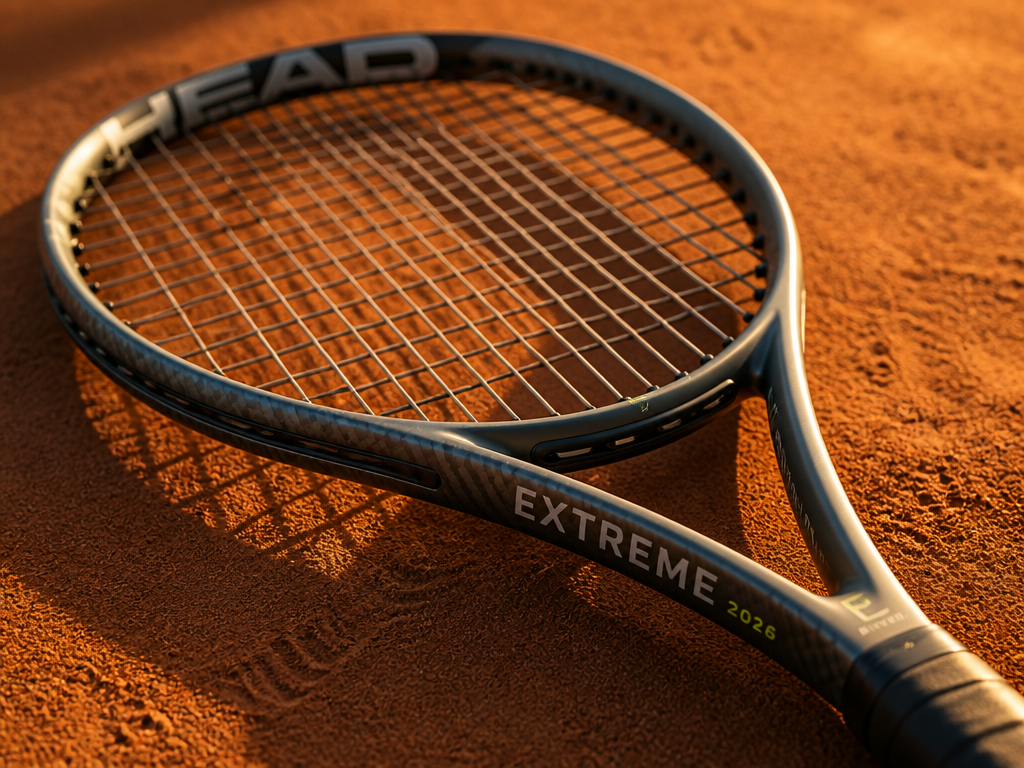
HEAD Extreme 2026 Review – The Year Feel Came Back
The 2024 HEAD Extreme was better technology than the 2026 HEAD Extreme. And the 2026 is the better racquet. That sounds like contradiction. It's not.

The 2024 HEAD Extreme was better technology than the 2026 HEAD Extreme. And the 2026 is the better racquet.
That sounds like contradiction. It's not. It's the difference between what looks impressive on a spec sheet and what actually happens when you hit a ball that arrives slightly low, with more spin than you expected, off a bad bounce on a public hard court at seven in the evening with the light going.
I've spent three weeks with the new Extreme lineup across three different string setups and one extended weekend session with a partner who hits heavy enough to expose a racquet's upper hoop. Henrik and I both tested. We both had the same reaction after the first ten minutes: this feels like a tennis racquet again.
Here's why.
What HEAD Actually Changed
The headline is Hy-Bor — a boron-carbon fibre weave borrowed from the Prestige line, placed at 2 and 10 o'clock in the hoop. That sounds like the story. It's not the full story.
The real change is that HEAD pulled back the Auxetic 2.0 dampening in the throat. The 2024 Extreme used Auxetic throughout the frame to kill vibration. It succeeded. Too well. The sensation at contact was what we called "disconnected" in our notes — a polite word for "I don't know where on the stringbed I hit that ball, because every contact feels identical."
The 2026 uses Auxetic 2.0 only in the handle. The layup above it is more direct, more traditional. The Hy-Bor adds stiffness in the upper hoop where the 2024 flexed unpredictably on off-centre hits. The result is a racquet that vibrates more — and tells you more.
That is the trade-off the 2024 avoided. HEAD chose to restore feedback. They were right to.
The One-Handed Backhand Test
If you hit a one-handed backhand, the 2024 Extreme was a difficult sell. The stability at the top of the hoop — the spot where you contact a shoulder-high slice or a defensive drive — dropped off noticeably when the ball was heavy. The frame twisted. The ball left the stringbed with a dull, thudding sound and no clear sense of direction.
The 2026 handles that zone differently. The Hy-Bor reinforcement stiffens precisely the area that needs to resist torsion. On a one-handed drive, the racquet holds its face longer through contact. The ball leaves with a clean, higher-pitched response — not metallic, not pingy, but readable. You know you've hit it well a fraction of a second before you see the result.
That extra half-beat of certainty is worth more than any spin-rate number a lab can measure. It's what lets you adjust your next shot.
The limitation is unchanged: the Extreme is still a 100-square-inch frame with a 16/19 pattern and a beam that measures 26/23/25 millimetres. It will never feel as connected through the hitting zone as a Prestige or an Ultra. But for a modern spin frame, the 2026 has closed what felt like a two-generation gap.
Model by Model
The MP – The safe bet
Stiffness rating unstrung: 65 RA. The most comfortable of the line. It gives you everything the 2024 MP should have given you — predictable launch angle, good spin access, no hotspots in the upper stringbed — but now with enough feel to read incoming spin. Best for the all-court player who hits with moderate pace and wants one frame to do everything.
Honest negative: On dead centre hits, there is still a slight hollow quality in the throat. The Auxetic deletion didn't fully solve it; it just moved the problem up an octave.

The Pro – The demanding option
18/20 pattern, 315 gram unstrung, swingweight in the low 330s. The control version. Henrik noted that the stringbed felt denser than the RA suggests — tighter launch angle, less free spin, more precision on flat drives. If you generate your own pace, this is the frame that lets you direct it.
Honest negative: The 2026 Pro is less forgiving than the 2024 version, which already asked a lot of the player. Mishits below the centre line rattle the handle in a way that some testers will call "feedback" and others will call "uncomfortable."
The MP L – The empty frame
Light, head-light, low swingweight. A platform for customisation. Out of the box it plays like a practice racquet — manoeuvrable, muted, short on plow-through. Weight it up and it changes character entirely. Without the weight, it doesn't deserve a second look.
The MP XL – The standout
Extended length (27.5 inches), 320 gram unstrung, swingweight that tests around 340 with strings. This is the one that made me check my bag and wonder when I was last this tempted by a frame outside my usual spec.
The extra half-inch in the Extreme design is a natural fit. The beam and stiffness handle the increased leverage without buckling. The serve is noticeably heavier — not just faster, but heavier — and the one-handed backhand slice opens up angles that feel like cheating.
Honest negative: The challenge is not the racquet. The challenge is transitioning back. After three sets with the XL, your standard-length frame will feel short. If you play tournaments with changing conditions, that adjustment window is a real cost.
Who This Is For
You, if you demoed the 2024 Extreme, put it down, and said "I just can't feel the ball."
You, if you're on a one-handed backhand and still using an older frame because nothing modern has felt stable enough in the upper hoop.
You, if you're a gear enthusiast who reads layup changes the way other people read box scores and you want to understand what Hy-Bor actually does — not on a chart, but on a backhand slice from a heavy ball.
Who This Isn't For
You, if the 2024 Extreme felt perfect to you. Keep it. You win.
You, if you prioritise maximum vibration dampening above all else. The 2026 gives you more information through the handle. Some players don't want that information.
You, if you're looking for a control frame. The Extreme is still a spin racquet. The feel improvement is real, but the DNA hasn't changed.
A Question the Science Hasn't Answered
Restoring feel to a modern spin frame means returning some vibration to the handle. That vibration — in the 100–200 Hz range, the frequencies the human hand detects best — is the information a player uses to adjust between shots.
But here's the unsettled question: does restoring that feedback necessarily reduce the forgiveness envelope? The 2026 is stiffer in the upper hoop. That gives stability. It also means that on a dead-centre hit, the frame transfers more shock to the arm than the 2024 did. Is that a survivable trade-off for a player hitting three times a week over a two-year period? The material science on boron-carbon fatigue is not yet written for recreational workloads.
HEAD made a choice. I think it was the right one. But the data on the long-term cost won't arrive for a few more seasons.
Carry that onto the court, and you'll test the 2026 with the right kind of attention.