Adinkra Symbols on a Ghanaian Tomb: How a Funeral Unfolds
In Ntonso, a town on the Kwabre road north of Kumasi, a man dips a carved calabash stamp into a pot of black dye and sets it down on cotton.

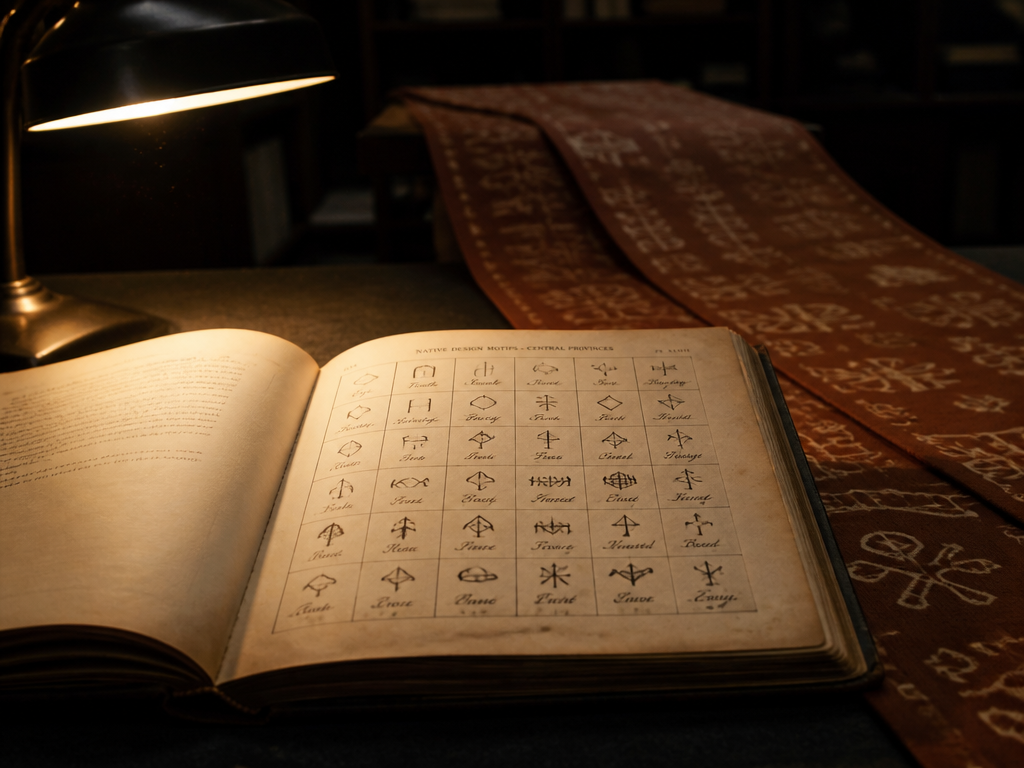
In Ntonso, a town on the Kwabre road north of Kumasi, a man dips a carved calabash stamp into a pot of black dye and sets it down on cotton. He lifts it, shifts his hand the width of a thumb, sets it down again. The dye is adinkra aduru, boiled from the bark of the badie tree with iron slag until it runs thick and holds its edge. The cloth under his hand is not for a wedding or a durbar. It is for a funeral, and it has been for roughly two hundred years.
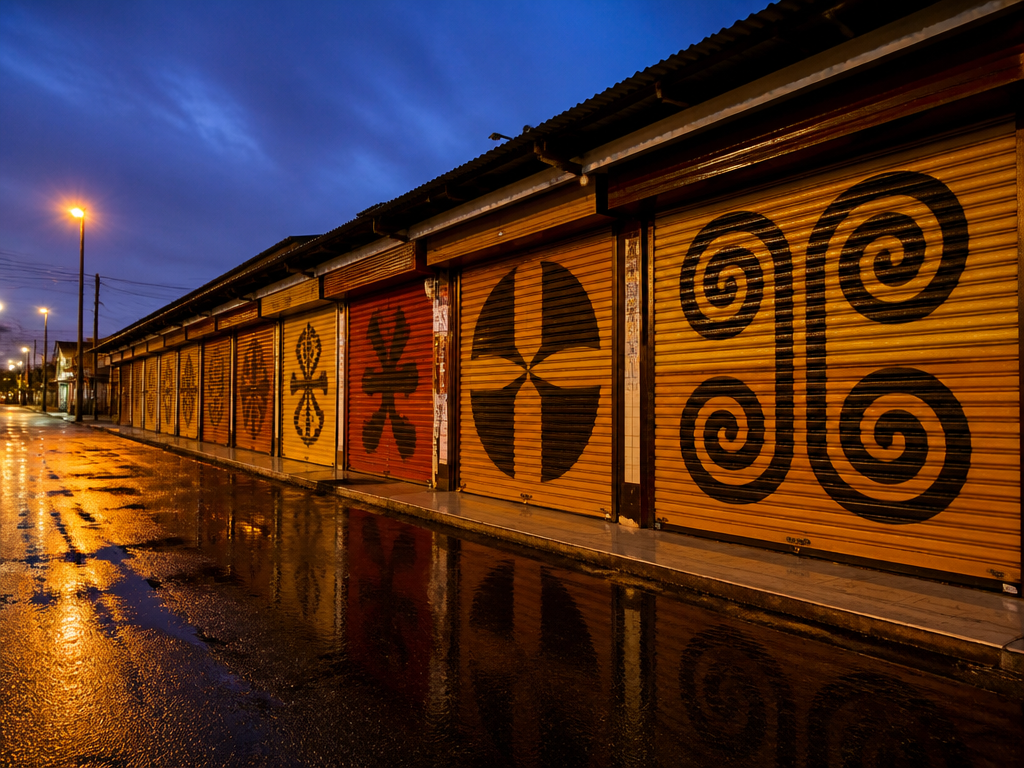
Some hours south, at Gomoa Mpota in the Central Region, the same marks have been set into concrete. The burial house being finished for Apostle Kwadwo Safo Kantanka — inventor, industrialist, founder of the Kristo Asafo Mission — carries Adinkra symbols across its walls and gateposts, and footage of it has travelled fast through Ghanaian social media. A great many people have asked what the marks mean, and whether putting them on a building is a new idea.
It is not. The relationship between the stamped cloth at Ntonso and the poured wall at Gomoa Mpota is not borrowing and not revival: it is the same grammar in a harder material. Adinkra was mourning cloth before it was anything else, and a family that presses those marks into a tomb is doing in concrete what it has long done in dye.
What follows is the sequence a Ghanaian burial actually runs in — the message, the waiting, the one week, the wake, the burial, the thanksgiving, the final rites — and where in that order a structure like the one at Gomoa Mpota belongs. It belongs at the end. That placement is most of the meaning.
First, the message goes out
Among the Akan — the Asante, Fante, Bono, Akyem and others whose language covers much of southern Ghana — a death is not announced by whoever happened to be in the room. Word goes first to the abusuapanyin, the head of the matrilineage, and the abusua takes the death from there. Descent among the Akan runs through the mother, and it is the mother's family that owns the funeral: they decide the date, they hold the purse, they answer to the in-laws.
Then the family chooses who tells whom. A messenger is sent to the deceased's spouse's people, to the hometown, to the elderly aunt who should not hear it from a phone screen. Where a death is sudden, the messenger may soften the first delivery and let the full news arrive with company in the room. The condolence a Ghanaian offers on arrival — damirifa due — is short because it is meant to be repeated hundreds of times over the coming months.
One early decision shapes everything after it: where the burial will be. In most Akan families the answer is the hometown, whatever city the person actually lived and died in. A man who spent forty years in Accra or Toronto goes home. That single fact is why the next stage exists.
Then everybody waits
The gap between a death in Ghana and the burial that follows it is commonly six weeks. It can be three months. It is not unusual for it to be longer.
To a reader outside the country this looks like delay. Inside it, the gap is the work. The body is kept at a mortuary while the family gathers what a proper funeral requires: relatives flying in from London, Hamburg and New Jersey; a contribution list circulated among cousins; a printer booked; cloth chosen and bought in quantity; a canopy company, a band, a caterer, a chief's permission where the family land is involved.
Refrigeration made this possible, and it is worth being plain that this is recent. Before mortuaries were common, the sequence was compressed into days, and much of what now takes two months took a week. The elaborate Ghanaian funeral of the present — with its printed brochures and its Saturday crowds — is a living form that has grown into the space cold storage opened up. It is not an ancient custom preserved in amber, and treating it as one misses what is interesting about it.
The one week
About eight days after the death, the family holds the nnawɔtwe da — the one week. In practice it is often nudged to a weekend so that people can travel.
Mourners come in dark cloth: kuntunkuni, a heavy brown-black; brisi, darker still. The closest relatives may wear kobene, a deep red reserved for those most directly bereaved, so that a stranger walking into the compound can read who has lost whom without asking. Adinkra cloth in its funerary form belongs here too — dark ground, stamped rows, worn for exactly this.
The one week is not a rehearsal for the funeral. It is the family's formal notice to the town that a death has occurred, an occasion to receive early condolences, and the moment the burial date is announced. From here, the machinery starts.
The printing and the buying
Within days, the deceased's face is on lampposts. The Ghanaian funeral poster is its own visual form: a photograph, a border, an age, and a phrase across the top — Call to Glory, Celebration of Life, Gone Too Soon. Beside it comes the brochure, which will be handed out on the day and which functions as a small biography: schools attended, workplaces, children named in order, the tributes set in columns.
Cloth is bought in bulk so that each group appears in uniform: the deceased's children in one design, the church women's fellowship in another, the old-boys' association in a third. Across a Saturday crowd of eight hundred people, the cloth does the introductions.

This is where the marks first appear in most funerals — stamped on the mourning cloth, printed along the border of the brochure. Long before anyone pours concrete, the symbols are already doing their job.
Friday night: the wake
The wake-keeping runs from evening into the small hours. The body is dressed and laid in state, sometimes in kente, sometimes in adinkra cloth, on a bed made up in white, in a room banked with fabric and flowers. The immediate family sits in a line to one side, in dark cloth, receiving.
Mourners file past the bed, then along the line of the family, hand by hand. A band plays, or a keyboard player does, and the volume is not apologetic. Somewhere near the entrance a table is set up with a ledger, and every donation is written down against a name.
That ledger deserves a sentence of its own. Ghanaian funeral giving is not charity; it is accounting across generations. What you give at this funeral is recorded, and when a death comes to your own family, the book is consulted and the obligation returns to you. The wake is the point at which a community's mutual debts are formally updated.
Saturday: the burial
Morning brings the service. For a Christian family — and most Ghanaian families now bury from a church — there is a full liturgy, tributes read by children and grandchildren, a sermon, and a hearse. For a mission church like Kristo Asafo, the service is the church's own.
Then the procession moves to the ground: a public cemetery, a church plot, or family land at the hometown. Where the family holds land, the grave is often close to the house, which is the older pattern and the one that makes a permanent structure a natural later step.
Sunday: the thanksgiving
The next morning the same crowd reassembles, and the colour changes. Dark cloth gives way to white and to lighter prints. The thanksgiving service is shorter and lighter in mood, closer to a reunion, and the family stands to be thanked in turn.
The switch from black to white is the clearest signal in the whole sequence: the acute period is closed. What remains is long.
Forty days, and a year
The Akan calendar runs in a cycle of forty-two days, the adaduanan, though the rite that lands at the end of it is usually spoken of in English as the forty days. Family return, prayers are said, and a further account is given.
A year later comes the anniversary, and in many families it is the anniversary that carries the weight the burial could not — by then the shock has gone and what is being marked is a place in the family's memory. Only after these have passed does the last stage begin, because only then does the family know what it can afford and what it wants to say.
Last of all, the building
The permanent structure comes last. That is the point I would ask a reader to hold on to when looking at the burial house at Gomoa Mpota: it is not the funeral, and it is not a substitute for the funeral. It is the final term in a sequence that started with a messenger walking to an aunt's house.
Symbols on walls are not new here either. The Asante traditional buildings still standing at Besease and nearby, protected as a UNESCO World Heritage site, carry bold relief motifs worked into mud plaster — spirals, interlace, the same visual vocabulary that the stamps carry. Adinkra symbols in architecture is an old Akan habit meeting new materials, and cement takes a mould as willingly as a calabash takes a knife.
The marks a burial house tends to carry are the ones that face death directly, and each one is a proverb compressed:
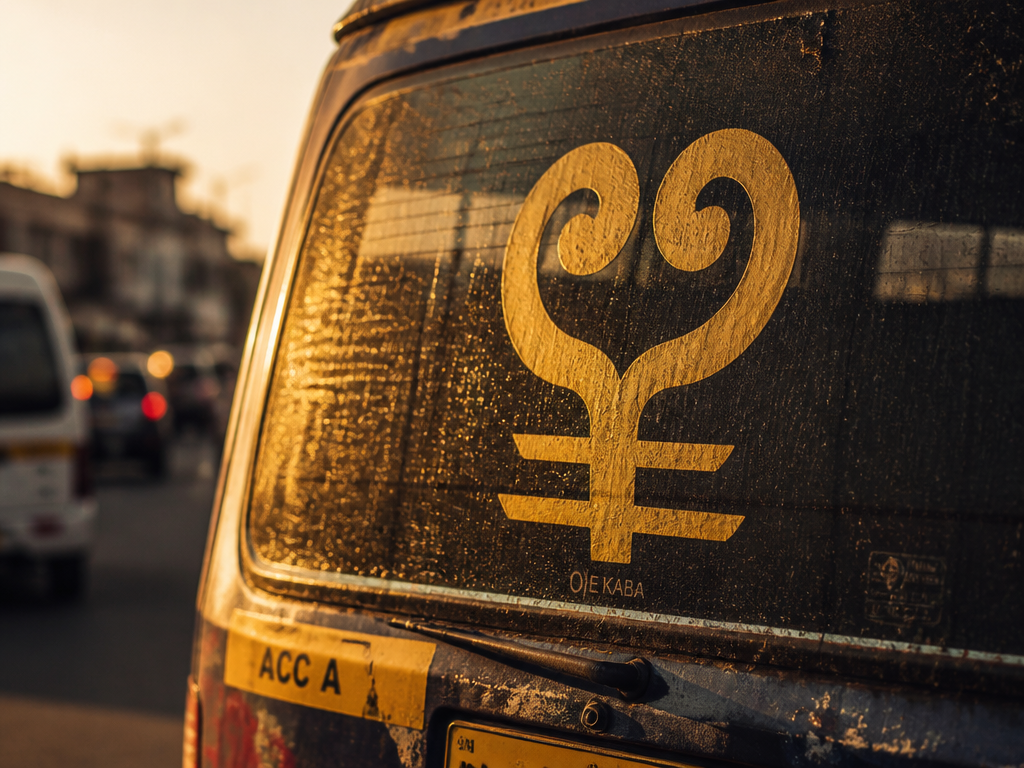
- Gye Nyame — "except for God". The most widely used of all the marks, and a statement about the limit of human power.
- Nyame Nwu Na Mawu — "God does not die, therefore I cannot die". A claim about the soul's continuation, and the most explicitly funerary symbol in the set.
- Owuo Atwedeɛ — the ladder of death, from the saying that no single person climbs it. Death is not one family's misfortune but the common road.
- Sankofa — the bird turning its head to take an egg from its own back, from the Akan proverb that there is no shame in going back for what you forgot.
- Nkyinkyim — the twisting line, for a life that changed direction and kept going.
On a mission founder's tomb, that selection reads less like ornament and more like a summary argument: God outlasts us, everyone climbs the ladder, and the road was not straight.
Side by side: four Ghanaian sequences
Ghana is not one funeral custom, and the Akan pattern above is the most visible rather than the only one. Four of the country's larger traditions, laid against the same four questions:

| People and region | When burial happens | What mourners wear | What marks the place afterwards |
|---|---|---|---|
| Akan (Asante, Fante, Bono; Ashanti, Central, Eastern, Bono regions) | Weeks to months after death; body kept at a mortuary while the family gathers | Kuntunkuni and brisi in dark brown-black; kobene red for closest kin; stamped cloth throughout | A grave at the hometown or on family land, often built up later into a permanent structure |
| Ga (Greater Accra) | Similar delay; the coffin itself is commissioned during the wait | Dark cloth, with white common at the thanksgiving | The famous carved coffins — abebuu adekai, "proverb boxes" — made in Teshie and Nungua in the form of a fish, a hen, a shoe, a cocoa pod, saying what the person was |
| Ewe (Volta Region) | Weeks to months; wake-keeping is central | Dark cloth; group cloth by association is strongly marked | A grave at the family house is common; Agbadza drumming carries the dead as a traveller being sent on |
| Dagbamba (Dagbon; Northern Region, around Yendi and Tamale) | Burial within a day, following Islamic practice — the first step differs completely | Plain white shroud for the dead; restrained dress for mourners | The grave is simple; the elaborate final funeral rites come separately, months or years later, with the lunsi drummers reciting the family's ancestry |
The Dagbamba row is the one that most repays attention. Look only at the moment of burial and the northern and southern customs appear to have nothing in common. Look at the whole sequence and the shape rematerialises: a fast committal, then a long wait, then a large public rite where the person's descent is recited in front of the town. Both traditions separate the disposal of a body from the honouring of a life. They simply put the pause in different places.
Where the symbols came from
The marks are usually traced to the Gyaman, an Akan state in what is now the Bono region and across the Ivorian border. The best-known account holds that a Gyaman king, Nana Kwadwo Adinkra, was defeated by the Asante under Osei Bonsu early in the nineteenth century, and that his patterned cloth was carried back to Kumasi and took his name.
That account is contested, and it is fairer to a reader to say so than to smooth it over. A stamped cloth collected in Kumasi in 1817 and now held in the British Museum is regularly cited against the story, since it predates the campaign that supposedly introduced the practice. A second line of argument reads the name not from a king at all but from the Twi root for a message or a farewell — which would make adinkra, literally, the goodbye cloth, named for its purpose rather than for a defeated man. Both readings have serious support. Neither has settled it, and a piece that picked one for tidiness would be inventing a certainty that does not exist.
Where the connection ends
Several things get blurred in the enthusiasm, and they are worth keeping apart.
The symbols are not an alphabet. They do not spell words, and a row of them is not a sentence to be decoded left to right. Each carries a proverb or a concept; a wall of them is a gathering of statements, not a text. Nsibidi, the sign system of the Cross River peoples of southeastern Nigeria and Cameroon, is a genuinely different thing with a different history, and the two are frequently merged online. They should not be.
A decorated tomb is not a shrine. Nothing at Gomoa Mpota is a place of worship, and honouring a dead person is not the same act as venerating a deity. Ancestor veneration is a real and serious element in many Ghanaian traditions, but a Christian mission building a Christian burial house in Akan visual language is doing something else — which is precisely the ordinary condition of Ghanaian religious life, where Akan form and Christian confession sit together without either party finding it a contradiction.
One prominent family's structure is not a national standard. Most Ghanaian graves are modest. The public conversation about funeral spending in Ghana is long-running and led from inside: chiefs and church leaders have urged restraint for years, and families routinely go into debt for a Saturday. Admiring one building's craft does not settle that argument, and it should not be made to.
The meanings are not fixed dictionary entries. Carvers, families and cloth-makers read individual marks with variation, and the commercial versions now sold on mugs and phone cases have multiplied the glosses further. Versions differ, and the ones that matter are the ones a particular family gives.
Names and terms
- Adinkra — the Akan system of stamped symbols, and the dark cloth they are printed on; associated above all with funerals.
- Adinkra aduru — the black dye, made from badie bark boiled down with iron slag.
- Abusua — the Akan matrilineage, which owns and runs a funeral; the abusuapanyin is its head.
- Nnawɔtwe da — the one-week observance, roughly eight days after a death.
- Adaduanan — the forty-two-day Akan calendar cycle, and the rite held at its close.
- Kuntunkuni, brisi, kobene — mourning cloths: dark brown-black, near-black, and the red worn by closest kin.
- Abebuu adekai — "proverb boxes", the figurative coffins of the Ga of Greater Accra.
- Lunsi — the Dagbamba drummers of Dagbon, who hold and recite lineage.
The saying behind one of those marks is the line worth carrying out of all this. Owuo atwedeɛ baako mforo: no one climbs the ladder of death by themselves — meaning not that anyone is spared it, but that everyone is on it, which is why the whole town turns out on a Saturday.
My own working habit, writing these pieces, is narrow and I have come to trust it: if a symbol reaches me without a people and a place attached, it does not go in. Three marks I had meant to include here are not here, because everything I could find about them traced back to the same unattributed list, copied and recopied, with no town and nobody's grandmother in it. The ones that stayed came with an address.