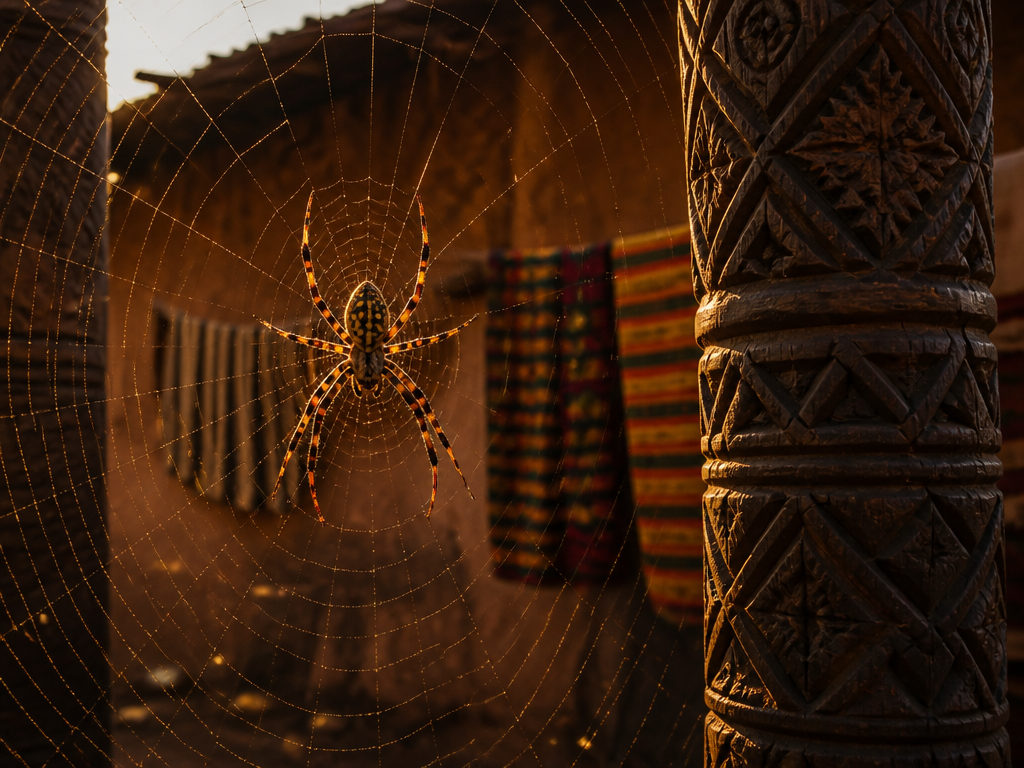
Who Is Nyame? The Akan Sky God Who Owns the Stories
The supreme sky god of the Akan — so present he is approached through lesser powers, so trusted that the adinkra symbol Gye Nyame, "except for God", marks cloth, walls, and skin across Ghana.

The stories, in brief
-
Story 1
It was Nyame who owned all stories until Anansi paid his impossible price — the frame that opens the anansesem tradition.
-
Story 2
In Akan teaching, Nyame is not worshipped through images; the proverb-symbol Gye Nyame carries the theology instead.
On the rear window of a trotro in Accra, in gold leaf on a coffin lid in Kumasi, on a pendant at the end of a chain in Brooklyn — the same shape keeps turning up. Two curled arms, one upright stem. It is an adinkra symbol, one of the stamped designs the Akan print onto cloth, and its name is Gye Nyame. Most people wearing it know it points at God. Fewer know that it is half a sentence. It means except for God — and the god the sentence refuses to finish without is Nyame, the sky god of the Akan of Ghana and Côte d'Ivoire.
The god you reach through someone else
The Akan are not one people but a family of them: Asante, Fante, Akuapem, Akyem and Bono in Ghana, Baoulé and Anyi across the border in Côte d'Ivoire. They share closely related languages — Twi and Fante among them — along with a common body of proverb, law and story. At the top of that world is the sky, and the sky is a person: creator of everything, and the one who misses nothing.
He is also, in ordinary practice, rarely addressed head-on. Requests travel through the abosom, the lesser deities, many of them attached to particular rivers and lakes, and through the nsamanfo, the ancestors who remain members of the family after death. Nineteenth-century missionaries read this arrangement as neglect — a high god too remote to bother with. The Akan analogy is closer to a chief's court. You do not walk up to an Asantehene and begin talking. You speak through the okyeame, the linguist who stands at his side and carries speech in both directions, sharpening it as it goes. Protocol is not distance. It is respect made into procedure.
The night Anansi bought the stories
Before there were stories on earth, there were none. That is the premise of anansesem — "spider stories", the Akan name for the whole genre — and the reason for it is a purchase.
In one widely told Asante version, Anansi the spider spins a thread up to the sky and asks to buy the stories, all of them. The sky god is amused. Towns have come offering gold and been refused; here is a spider with nothing in his hands. So he names a price no one could meet: Onini the python, Osebo the leopard, Mmoboro the hornets, and Mmoatia, the small forest being nobody can lay a hand on. Tellings differ on the list — some add Anansi's own mother to the bill, some drop one of the four — but the shape holds. Four impossible things, brought alive.
Anansi fights none of them. He talks. He tells the python that his wife has been insisting Onini is shorter than a certain palm branch, and would he mind stretching out beside it so the argument can be settled — then ties him to it while he lies there being measured. He digs a pit on the leopard's path, and when Osebo falls in, arrives as a rescuer. He carves out a calabash, pours water over himself and over the hornets, warns them the rain has come, and offers the gourd as shelter; when they are inside he stoppers it. For Mmoatia he sets out a wooden doll smeared with sticky gum and a bowl of mashed yam. The forest being eats, thanks the doll, gets no reply, strikes it for rudeness, and sticks fast.
Then he carries all four up the thread. The sky god calls his court together — a debt this size should be witnessed — and hands the stories over. From that day they are not his. They are Anansi's, and they are called by his name.
It is a strange thing for a supreme being to sell. The stories about the world end up belonging to the smallest and least respectable creature in it, transferred in public, by contract. And in many tellings the storyteller opens a session with a disclaimer — we do not really mean it — a formula that hands the audience permission not to believe a word. Ownership of the stories was never ownership of the truth. The Akan separated those two things at the top of the tradition, in its first scene.
Three names, one god
Readers meet this figure under several names and often assume a pantheon. Set the three most common ones side by side and something else appears.
| Name | What it emphasizes | Where you hear it | What changes when you use it |
|---|---|---|---|
| Onyame | the being itself — God as simple fact, sky-wide and prior to everything | everyday Twi speech, proverbs, ordinary conversation | nothing formal; it is the plain word |
| Onyankopon | uniqueness — usually glossed as "the great one who alone is great" | libation, prayer, preaching, the Twi Bible | the register lifts; this is the name for addressing |
| Anansi Kokuroko | the work — "the great spider", God as the one who spun the whole web | proverb, praise-naming, older recorded texts | attention shifts from who he is to what he made |

Three names, three angles, one god. What the set has in common is that each describes a function — being, singularity, craft — and none describes a face. That is not an accident of vocabulary. It is the theology. A god known by what he does cannot be settled into a likeness, and the Akan never tried. There are no statues of him, no painted image, no shrine holding his portrait. What carries the doctrine instead is a symbol and a saying.
The sky, the pot, and a sentence with no ending
His domains are the sky, creation, and knowing. The sky is not his emblem so much as his address, and Akan speech treats it that way: the thing above everyone, visible from every village at once, impossible to own.
The Gye Nyame stamp compresses a full proverb, which in its usual rendering runs: this great panorama of creation dates from time immemorial; no one lives who saw its beginning, and no one will live to see its end, except God. Two curled arms and a stem — and inside them, an argument about the limits of human witness. Some Akan compounds also keep a nyame dua, a forked post holding a pot that catches rainwater, standing where household prayer is made. It is a place, not a portrait; nothing about it is meant to look like anyone.
In living practice
At funerals, festivals and outdoorings across Akan Ghana today, an elder pours libation, and the order of address is itself a map of the cosmos: God first, then Asase Yaa — the earth, spoken to as a person — then the ancestors, then the matter at hand. Adinkra cloth is still stamped and still worn, mostly at funerals, and Gye Nyame is among the designs people reach for most.
The name also went where the Akan went inside their own country. When Twi-speaking Christians pray, the word in their mouths for God is Onyame or Onyankopon; the Twi Bible uses it, and so do Twi-speaking Muslims in ordinary speech. Missionary translators did not replace the Akan name for God — they borrowed it, because the concept it named was already there and already supreme. That borrowing is one of the quieter facts about religion in Ghana, and it is why the name never became archaic.
The symbol that travelled without its sentence
Gye Nyame has gone further than almost any other African religious symbol: pendants, tattoos, graduation stoles, phone cases, company logos, from Kumasi to London to Atlanta. Put two of its lives beside each other. On a stamped funeral cloth in an Akan town, it sits in a grid with other adinkra, each carrying its own proverb, and the wearer's family can finish every one of them. On a chain in a diaspora city, it is usually alone, and usually read as faith, or simply as Africa.
Nothing was stolen in that crossing; a symbol that travels is a symbol doing its job. But something was compressed. The design moved from a proverb people could complete to a mark people could recognise — and the specific claim inside it, about who witnessed the beginning of the world, stayed behind in the language it was made in.
Getting the name right
Anansi Kokuroko is not the trickster. The praise-name borrows the spider's image — the weaver, the one who spins a structure out of himself — to describe the creator. The Anansi who cheats a leopard into a pit is a character in the stories. The Great Spider is the one who sold them.
Onyame and Onyankopon are not two gods. They are two ways of naming the same one, and Akan speakers move between them the way anyone moves between a name and a title.
He is not an absentee. In one Akan telling, the sky once lay close to the ground until an old woman pounding fufu kept striking it with her pestle, and it withdrew upward to be out of reach. Comparative writers have taken that story as proof of a retired god who stopped caring. Akan practice says otherwise: every libation in the country begins with his name, and the first word of the sentence is not usually reserved for someone thought to have left.
"Idol worship" was never a coherent charge here. There was no idol. There is a symbol, a proverb, and a pot of rainwater on a forked post.
Names and terms
- Akan — a family of related peoples in Ghana and Côte d'Ivoire, including the Asante, Fante, Akuapem, Bono, Baoulé and Anyi.
- Twi — the Akan language most widely spoken in Ghana; the source of most of the words here.
- Onyankopon — the formal name of God in Akan prayer and scripture.
- Anansi Kokuroko — "the great spider", a praise-name for the creator, not for the trickster.
- Gye Nyame — the adinkra symbol meaning "except for God", drawn from a proverb about the beginning and end of creation.
- adinkra — the stamped Akan symbols, each carrying a proverb, printed most often on funeral cloth.
- anansesem — "spider stories", the Akan storytelling tradition Anansi bought.
- abosom — lesser deities, many tied to particular rivers or lakes, through whom requests are usually made.
- okyeame — the spokesperson who stands beside a chief and carries speech in both directions.
No one saw the beginning. No one will see the end. Gye Nyame.
The Gye Nyame symbol travels worldwide on cloth and jewellery, often worn without the theology it compresses.