Who Is Oshun? The Yoruba Orisha of Rivers and Sweetness
The orisha of the Osun river and everything that makes life sweet — whose sacred grove at Osogbo still draws a festival every year, and whose name now travels through pop music.

The stories, in brief
-
Story 1
In one telling, the male orishas tried to arrange the world without Oshun; nothing worked until she was given her place — a story Yoruba tradition uses to teach the indispensability of women.
-
Story 2
The Osun-Osogbo sacred grove in Nigeria, her river shrine, is a UNESCO World Heritage site and hosts her annual festival.
The most famous thing about Oshun is the least useful thing about her.
Say the name in a room and someone will hand you the short version: goddess of love, goddess of beauty, the one with the mirror and the gold. None of that is false. Among the Yoruba of southwestern Nigeria and Benin, Ọ̀ṣun (roughly AW-shun; the ṣ is sounded like sh) is an orisha — one of the divine forces that stand between the distant creator and the daily work of being alive — and love, beauty, and fertility sit squarely among the things she governs. But that summary is the doorway. It is not the house.
The house has a river running through it. The Osun river moves through what is now Osun State in southwestern Nigeria, past the town of Osogbo, and it is not a metaphor: it is drinking water, washing water, water people have lived beside for centuries. Fresh water, honey, brass, the colour yellow. Hold those four things in mind and the rest of this piece is an argument about what they add up to.
A name that arrives without its address
Many readers meet the name sideways. It surfaces in contemporary Black music — Beyoncé's Lemonade, with its yellow dress and its water, sent a great many people to a search engine at once, and the name has kept turning up in songs since. It surfaces in a Cuban grandmother's household, where she is Ochún. It surfaces in Brazil, where she is Oxum and where whole neighbourhoods know her drum rhythms. It surfaces in a novel, a tattoo, a museum label.
What rarely travels with the name is the address: a people, a language, a river, a town, a set of obligations that are still being kept. That is what follows.
The meeting that did not work
Here is the story most often told about her, and it is not a love story.
In one Yoruba telling, the orishas were sent down to put the world in order — to shape the land, settle the waters, make the earth fit to live on. They arrived and set to work, and the work was men's work: the orishas who came were male, and they did not include her in the council. They dug and built and arranged. Nothing held. Rain would not fall where it was asked to fall. Seeds went into the ground and stayed there. Whatever they made in the morning had come undone by evening.
So they went back up to report the failure, and the question they were asked was simple: was she with you? She was not. They had left out the one who was sent with them.
They returned, and this time she was given her place. The rain came. The seeds took. The world worked.
Versions differ on the details — who speaks, how many attempts, exactly what fails first — and different lineages and tellers order the events their own way. What does not vary is the point, and Yoruba tradition uses the story plainly: leave women out of the arrangement of the world and the arrangement will not hold. It is a story about a broken meeting, told by a tradition that takes meetings seriously.
Read that story once and "goddess of love" starts to feel thin.
Fresh water, honey, brass, yellow
Her emblems are not ornaments. Each one carries an argument.
Fresh water. Not the sea. The river — the water you can actually drink, bathe a newborn in, cook with. Other orishas hold other waters; hers is the one a town is built beside. Fresh water is the condition of ordinary life continuing, which makes her domain less a mood than an infrastructure.
Honey. Sweetness in Yoruba thought is not merely pleasant. Sweetness is what makes a thing acceptable — what allows a hard proposal to be swallowed, a quarrel to be settled, two parties to leave a room agreeing. Honey is the emblem of persuasion.
Brass and gold. Brass does not rust. It stays bright, it is cool to the touch, it holds value, and it is worked by specialists. Brass bangles and fans are among the objects most associated with her, and the metal's refusal to corrode is doing quiet work in the symbolism: some things do not degrade.
Yellow. The colour of honey, of brass, of the light on moving water. It is the colour worn by those who honour her, and at her festival the town carries it.
The peacock. Being looked at, in this reading, is a kind of authority rather than a vanity. The bird that displays is the bird that is deferred to.
And then the domain that ties the others together: diplomacy. She is the one who can be sent when force will not work. Beauty, honey, brass, cool water — these are the instruments of someone whose method is agreement rather than conquest. Yoruba tradition does not treat that as the soft option. In the story above, it is the missing ingredient without which nothing else functions.
The grove at Osogbo
On the edge of Osogbo stands a forest along the riverbank — the Osun-Osogbo Sacred Grove, one of the last stretches of primary high forest in southern Nigeria and, since 2005, a UNESCO World Heritage site. It is not a preserved ruin. It is an active shrine landscape, with sculptures, sanctuaries and paths still in use.

Much of what visitors see today was rebuilt from the 1950s onward, when the Austrian-born artist Susanne Wenger settled in Osogbo, was initiated into the tradition, and worked with Yoruba artists — the New Sacred Art movement — to restore shrines that had fallen into neglect. Their massive, organic cement and iron sculptures are now inseparable from the grove's character, which makes it an unusual thing: a sacred site whose modern art history is part of its sacredness.
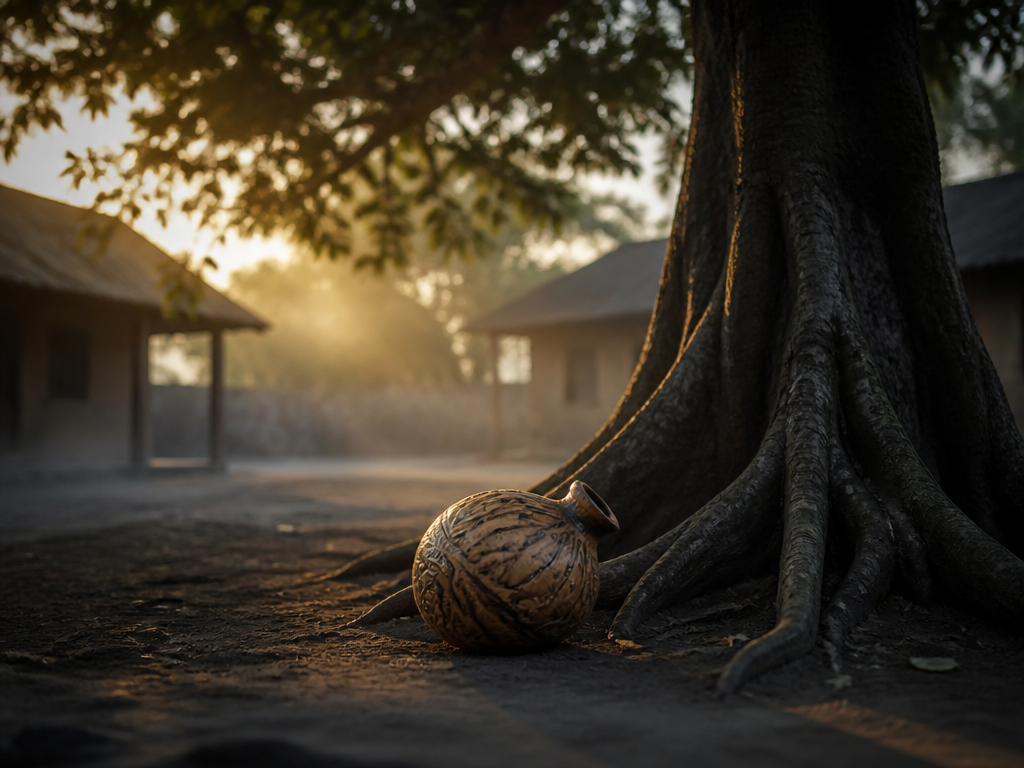
Every August the town holds the Osun-Osogbo festival, roughly two weeks of processions ending at the river. At its centre is the Arugbá, a votary maid who carries a covered calabash on her head from the palace to the water while the crowd accompanies her. The Ataoja, Osogbo's traditional ruler, has his own role in the sequence. Devotees come from across Nigeria; many more come from Cuba, Brazil, Trinidad and the United States, tracing a line back. Plenty who attend are Muslim or Christian — in Yoruba towns these belongings overlap far more comfortably than outsiders expect, and the festival is a civic occasion as well as a religious one.
The grove is also, in the most literal sense, a river conservation area. Protecting her has meant protecting a watershed.
What changed on the other shore
When Yoruba people were carried across the Atlantic in the slave trade, the orishas went with them, and were kept alive under conditions designed to erase them. Some names shifted with the language; some practices were folded behind Catholic saints so they could be practised in the open at all.
| Region | Name | What changes |
|---|---|---|
| Southwestern Nigeria and Benin | Ọ̀ṣun | The river, the grove, and the annual festival at Osogbo are physically present; practice is tied to a specific landscape |
| Cuba | Ochún | Spelling follows Spanish; long associated with Our Lady of Charity, Cuba's patroness, within Lucumí practice |
| Brazil | Oxum | Spelling follows Portuguese; honoured in Candomblé houses, associated with Marian figures that vary by house |
What survives the crossing is striking: the river, the yellow, the brass, the sweetness. What changes is the landscape. Without the Osun river, devotion attaches to other rivers, other waterfalls, other shores — and the tradition proves portable in a way its enemies did not intend.
Getting the name right
She is not the Yoruba Aphrodite. The comparison is a shortcut that costs more than it saves. An orisha is not a specialist in a pantheon of specialists; an orisha is also a lineage, an inheritance, a set of obligations, and a presence in a family's history. Greek gods have no living congregations. She does.
The spellings are not different figures. Ọ̀ṣun is the Yoruba orthography, with the subdot marking the sh sound. Osun is the same name without diacritics — which is why the river, the Nigerian state, and the shrine town all appear spelled that way on maps. Oshun is the common English rendering. Ochún and Oxum are the same name written for Spanish and Portuguese ears.
This is not "voodoo" in the Hollywood sense. That word, as films use it, is a distortion of Haitian Vodou — a related but distinct tradition drawing heavily on Fon and Ewe practice from present-day Benin and Togo. Yoruba orisha tradition is its own thing, with its own language, texts and lineages.
Nor is it "idol worship", the missionary-era label still floating around. The brass fan and the calabash are not the object of devotion any more than a crucifix is; they are instruments and signs. The label described what observers saw rather than what practitioners understood, and it stuck because it was useful to the people using it.
One more, worth saying plainly: she is not a service. A great deal of what circulates online frames her as something to be petitioned for outcomes. Her practice belongs to initiates, priests and families who carry it, and explaining what it means is a different act from handing out a procedure.
Names and terms
- Orisha — a divine force in Yoruba tradition, standing between Olodumare, the remote creator, and human life.
- Olodumare — the supreme creator in Yoruba belief, approached through the orishas rather than directly.
- Osogbo — a town in Osun State, southwestern Nigeria, built beside the river and home to the sacred grove.
- Arugbá — the votary maid who carries the covered calabash to the river during the annual festival.
- Ataoja — the traditional ruler of Osogbo, with a defined role in the festival.
- Lucumí — the Yoruba-derived tradition and liturgical language of Cuba, often called Santería.
- Candomblé — the Afro-Brazilian religion in which the orishas are honoured as orixás.
Back to the claim
The most famous thing about her is the least useful thing about her — until you know what the tradition means by sweet. Sweetness here is not decoration. It is the honey that makes an agreement go down, the cool water a town cannot live without, the metal that will not corrode, the voice in the council without which the world would not hold together. Love, in this reading, is not the soft edge of the pantheon. It is load-bearing.
Every August the calabash goes down to the water at Osogbo, and the river is still there to receive it.
Honoured as Ochún in Cuba and Oxum in Brazil; invoked by name in contemporary Black music from Beyoncé's "Lemonade" onward.