Àbíkú and Ọgbanje: Reading African Folklore in Contemporary Storytelling
The advice always arrives at the same moment. You have just finished The Famished Road, or Freshwater, or the chapter of Things Fall Apart where a stone comes out of the ground, and someone tells you…

The advice always arrives at the same moment. You have just finished The Famished Road, or Freshwater, or the chapter of Things Fall Apart where a stone comes out of the ground, and someone tells you to go and read the folklore first. Look up àbíkú. Look up ọgbanje. Then the novel will open like a lock. It is the standard guidance for reading African folklore in contemporary storytelling, and it is offered kindly — in seminars, in reading groups, in the margins of every study guide.
It is roughly right. It is also wrong in a way worth taking seriously.
Here is the relationship in one sentence. Àbíkú (ah-BEE-koo) in Yoruba tradition and ọgbanje (aw-GBAN-jeh, where gb is a single sound) in Igbo tradition are two neighbouring peoples' names for a child who dies young and is born again to the same mother — related ideas from adjacent traditions in what is now southern Nigeria, not one idea wearing two labels.
Where the advice holds
Start with the case for it, because it is strong.
In Chinua Achebe's Things Fall Apart, Ekwefi has borne ten children and buried nine. Her surviving daughter, Ezinma, is understood to be ọgbanje. Read cold, the scenes around Ezinma look like atmosphere — a grieving mother, a village anxiety. Read with the concept in hand, they look like procedure: a family working a known problem with known methods.
In Ben Okri's The Famished Road, the narrator Azaro is a spirit-child who has broken his pact and chosen to stay in the world. The novel's road, its hunger, its political violence in a country coming apart on the edge of independence — all of it is organised around a child who was supposed to leave and did not. Without àbíkú, the book reads as dream logic. With it, the dream has a legal structure.
And there is a lineage in print, not only in fiction. Wole Soyinka and J. P. Clark each published a poem titled "Abiku" in the 1960s, two Nigerian poets circling the same figure from different angles within a few years of each other. Contemporary novelists did not discover this material. They inherited a conversation already under way.
So yes: look it up. The advice earns its place.
Side by side
The trouble starts when "look it up" turns into looking up one thing.
| Àbíkú | Ọgbanje | |
|---|---|---|
| People and region | Yoruba; southwestern Nigeria and parts of Benin | Igbo; southeastern Nigeria |
| What the name says | From bí, to be born, and kú, to die — one born to die | Often rendered as one who comes and goes; usage varies by area |
| The other allegiance | The ẹgbẹ́ òrún, companions in the spirit world who hold the child to a promise to come back to them | A tie often described through the iyi-uwa, a token buried in the world that binds the child to its spirit kin |
| What families do | Naming and, in some accounts, marking the body: Málọmọ́, "do not go again"; Kòkúmọ́, "this one will not die again" | A diviner is called to find and destroy the iyi-uwa, cutting the tie |
| Where readers meet it | Okri's Azaro; the Soyinka and Clark poems | Achebe's Ezinma; Akwaeke Emezi's Ada |
The columns rhyme. They are not the same column.
The retelling: Ezinma's stone
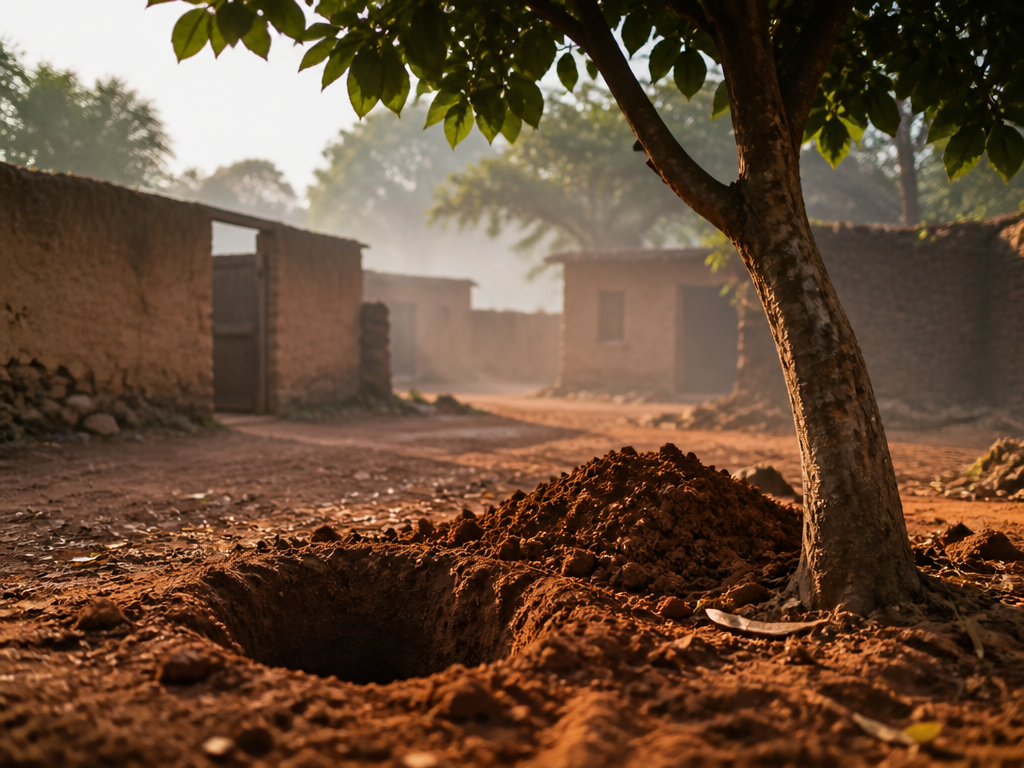
In Achebe's telling, the medicine man Okagbue comes to Okonkwo's compound and asks Ezinma, who is nine or ten, where she buried her iyi-uwa. She leads a small crowd out past the orange tree, then further, then further still, enjoying the procession. She stops at a spot. Okagbue digs. The pit goes deep enough that a man can stand in it. The crowd's patience thins. Then he lifts out a rag, and inside the rag is a smooth pebble.
Ezinma is asked whether it is hers. She says yes. The stone is destroyed, and the tie with it. Ekwefi's daughter, in the logic of the story, is now free to stay.
What that scene is doing is not decoration. It is a family closing a case.
Where the advice breaks down
The English gloss does the flattening
Search either term and you will land quickly on "spirit child," and then, on the worse days of the internet, on "changeling." The first is a serviceable shorthand; the second imports a European folktale wholesale and gets almost nothing right. Both do the same quiet damage: they merge two peoples' concepts into one English heading, and once merged, the heading starts to feel like the real thing and the Yoruba and Igbo terms start to feel like local colour. It is the wrong way round.
Some writers are not speaking in metaphor
This is where the lock-and-key model fails hardest. Freshwater is narrated in the plural by the ọgbanje who share Ada's body, and Emezi has said in interviews that they do not intend the book's ọgbanje as a figure of speech — that it is a description of a self, in Igbo terms, rather than a symbol standing in for something a psychiatrist would name. A reader who arrives with the folklore filed as "metaphor for trauma" has decoded a book that was not in code.
The tradition is not the fixed part
The advice assumes a stable myth and a variable novel. In practice it is closer to the reverse. Oral tradition differs by region, by lineage, by teller; what a family in one Igbo town says about ọgbanje is not a national position, and Yoruba accounts of the ẹgbẹ́ òrún vary in the same way. The novel is the fixed text. The tradition is the living, arguing, plural thing. Treating a two-paragraph encyclopedia entry as the authority, and the novelist as the one taking liberties, gets the hierarchy backwards.
There is a fourth move worth naming, because educated readers make it most: the reduction. Physicians have long pointed out that sickle cell disease is one thread running through the pattern of repeated infant deaths in this part of West Africa. That is a real observation. It explains something about the pattern, and nothing at all about what the concept means — what it lets a mother say, what obligation it places on a household, what it argues about where a person was before they arrived.
Where the connection ends
Two peoples, two languages, two cosmologies that do not map onto each other point for point.
Àbíkú sits inside a Yoruba account of the world in which a person comes from òrún with prior companions and prior commitments; the pull is a promise made elsewhere. Ọgbanje sits inside an Igbo account with its own architecture — chi, the iyi-uwa, the covenant — and the remedy is correspondingly concrete: find the object, destroy the object. There is no exact Yoruba equivalent of the iyi-uwa, and no exact Igbo equivalent of the ẹgbẹ́ òrún. The naming practice that answers àbíkú — Málọmọ́, Kòkúmọ́, Bánjókó, "sit down and stay with me" — is a Yoruba answer to a Yoruba problem.
Scholars disagree about how much weight the resemblance should carry, and it is worth saying so plainly rather than manufacturing a consensus. One position reads the two as regional expressions of a widely shared West African idea about children who return. Another argues that grouping them is a habit inherited from colonial-era comparative ethnography, which was always more interested in continent-wide categories than in what the Yoruba and the Igbo each actually say. Both positions have serious people in them. Neither is settled.
The default conclusion here is the honest one: related, and distinct.
Names and terms
- Àbíkú — Yoruba term for a child understood to be born, die young, and return to the same mother.
- Ẹgbẹ́ òrún — in Yoruba thought, a person's companions in the spirit world; for the àbíkú, the ones calling the child back.
- Ọgbanje — Igbo term for a spirit that cycles through repeated births and deaths in one family.
- Iyi-uwa — in Igbo accounts, a buried token linking the ọgbanje to its spirit kin; destroying it is said to break the cycle.
- Chi — in Igbo thought, a person's individual spiritual counterpart or portion.
- Málọmọ́ — a Yoruba name meaning roughly "do not go again," given to a child a family hopes will stay.
A more honest version of the rule
Not: look up the folklore and the book will unlock. Rather: find out which people the word belongs to, what they say about it, and how much variation sits inside that. Then read the book to see what this particular writer is doing with it — retelling, arguing, or making a claim they mean literally. Folklore in contemporary African fiction is not a cipher with one solution. It is a language the writer is speaking, and the useful question is not what the word decodes to but who is saying it and why.
When I reread Okri last year I stopped keeping a glossary. What I keep now is a two-column page: on the left, what the text says the word means; on the right, who in the text is saying it — the mother, the diviner, the child, the narrator who is also the spirit. The right-hand column is always longer, and it is always the interesting one. At the top of the page I have written Málọmọ́, do not go again, because it reminds me that the word belonged to a Yoruba mother at a naming ceremony long before it belonged to a novel.