The Mbombo Creation Myth: How the Kuba World Was Made
In Kuba telling, the creator Mbombo stood alone in darkness and water — and brought up the sun, the moon, the stars, and the living world in nine heavings.

The stories, in brief
-
Story 1
Alone in a world of water and dark, Mbombo vomited first the sun, then the moon and stars, then nine named creatures from whom the rest of life descends.
-
Story 2
The story is tied to Kuba kingship and telling rights — who may recite origins, and when, is part of the tradition itself.
The strangest thing about the Mbombo creation myth is not the vomiting.
That is the part everyone repeats. A creator alone in darkness and water, in pain, brings up the sun; the water steams back and dry land appears; then the moon and the stars; then nine creatures, and from those nine, everything else that lives. It is a vivid image, and the internet has filed it under curiosities — the world that got thrown up. The genuinely unusual thing about this Kuba origin story is quieter, and you need the kingdom to see it. The story belongs to someone. There are people who may recite it, occasions when it is recited, and a throne it explains.
Who Mbombo is
Mbombo (mm-BOM-bo) is the creator in the tradition of the Kuba, a federation of peoples in the central Congo basin of the Democratic Republic of the Congo, in the Kasai region between the Kasai and Sankuru rivers. "Kuba" is a name that came from neighbours; the kingdom gathers around eighteen peoples, with the Bushoong (boo-SHONG) at its centre, and it is ruled by a nyim (nyeem), a king, from a capital at Nsheng.
If you know anything about the Kuba already, it is probably the art. Kuba raffia cloth — dense geometric panels, no two repeats quite alike — sits in museum cases and, in reproduction, on a great many cushions. So do the royal portrait figures called ndop, and the masks worn at funerals and initiations. The kingdom that produced all that also produced a creation account, and the two are made of the same material: pattern held by an institution.
Mbombo is also called Bumba. That is the spelling most English readers meet, because the retelling that traveled — "Bumba was alone in the dark" — passed through mid-twentieth-century anthologies of world creation stories and got smoothed on the way for a general readership. Same figure, different route.
His domains are creation, the sky, and kingship. Hold on to that third one.
The nine heavings
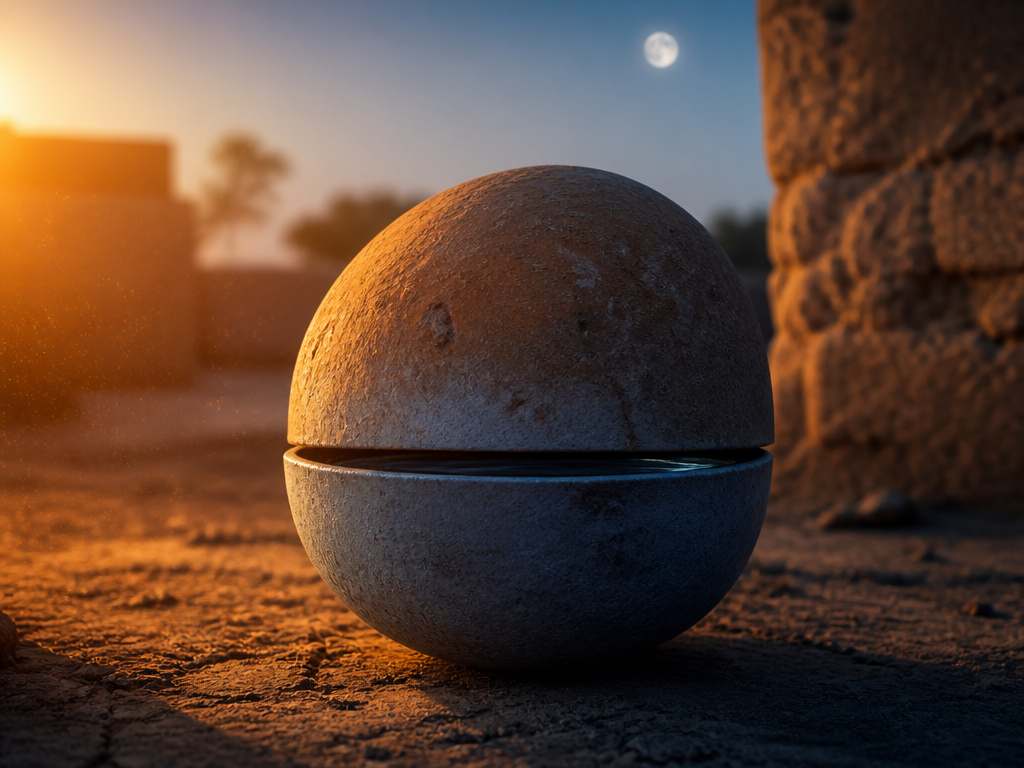
In Kuba telling, before there was anything to see, there was water everywhere, and over the water a darkness, and in the darkness Mbombo, alone, and white, and very large.
He was in pain. His stomach churned, and he heaved, and out of him came the sun. The sun's heat dried part of the water away, and where the water drew back, land appeared — sandbanks first, then hills. There was now a world with an edge to it, and light on it, and still Mbombo was in pain. He heaved again, and out came the moon and the stars, and the world had a night that was not the old darkness but a night with lamps in it.
Then came the third heaving, and this one brought living things: nine creatures, named, from whom the rest of life descends. The leopard. The crested eagle. The crocodile. The fish. The tortoise. A white heron. A beetle. A goat. Versions differ on the list and on the order, and some tellings hold one of the nine back as trouble — a lightning creature who burns what it touches and is driven up into the sky to live there, which is why people had to be shown how to draw fire out of trees instead.
The last movement is the one that makes the story a system rather than an anecdote. Each of the nine brings forth its own kind. The heron makes the birds; the crocodile makes the snakes and the iguana; the goat makes every horned animal; the fish makes the fishes; the beetle makes the insects. The world is not assembled piece by piece. It is descended, from a short list, in a line you could in principle trace back.
And notice what does not happen. Nobody fights. There is no sea monster to be cut in half, no rival to be defeated, no word spoken from a distance over a void. The water is not an enemy; it is simply what was there. The world comes out of the creator's own body, at cost to him, the way anything comes out of a body. Whatever else it is, that is a serious position about where existence comes from: not manufacture, not conquest — expulsion, and relief.
Whiteness, water, and the dark
The three images the story is built from are doing work.
Whiteness is Mbombo's own colour, and across much of the Congo basin white — white clay in particular — carries associations with the ancestors and with the world on the other side of this one. A white creator is not a European creator; he is a creator marked as belonging to elsewhere.
Water is the given condition, not a problem. It is there before anything, and it is never destroyed, only pushed back far enough for land to show. In a region organised by rivers, that is a plain description of how land works.
The primordial dark is likewise not evil. It is the state before distinction, and what the sun introduces is not goodness but difference — this from that, day from night, shore from river.
Who is allowed to tell it
Here is where the opening claim gets paid.
At the Kuba court, history is an office. Origins are not general property to be recited by anyone at any time; the right to tell them sits with the king's court and with titled office-holders, and the occasion is part of the telling. This is well documented — the historian Jan Vansina spent much of his career on Kuba oral tradition precisely because the Kuba maintained it as a formal, custodial practice rather than as loose folklore.
That is why kingship is one of Mbombo's domains. The account of how the world came to be is continuous with the account of how the kingdom came to be, and it runs through Woot (wote), the founding ancestor from whom the royal line traces itself. A story that explains why the nyim sits where he sits is not decoration. It is closer to a constitution. You would expect a constitution to have rules about who may read it aloud.
Which means the version in the anthology — and, honestly, the version above — is a text that has left the room it belonged to. Not stolen, necessarily. But loose.
In living practice
The Kuba kingdom did not end. There is still a nyim, still a court at Nsheng, still titled office, still cloth and masks made and used at funerals and initiations rather than only sold. Most Kuba today are Christian, and have been for generations; the royal institution and the church occupy the same towns without either cancelling the other.
Mbombo himself is not the centre of daily religious life, and that is not a decline story. Across much of Central Africa the creator is understood as distant — the one who made it, not the one you take a problem to. Ancestors and nearer spirits are the ordinary address. A reader looking for shrines and offerings to Mbombo is looking for a shape the tradition never had.
And when Kuba things crossed the Atlantic, it was not the pantheon that crossed. Yoruba orisha travelled with people, into Cuba and Brazil and Haiti, and are worshipped there now. The Kuba crossing went differently: what left was the design. Kuba cloth entered European collections, then modernist painting, then interiors and fashion. The pattern is everywhere and the kingdom that made it is a footnote. That asymmetry — the art fully welcome, the thought behind it not — is worth naming.
Getting the name right
Mbombo and Bumba are not two gods. They are one figure reached by two spellings, one closer to Kuba usage and one carried by the English anthology tradition.
"Weirdest creation myths" is the wrong shelf. The vomiting reads as comic only if you have decided in advance that a body is an undignified place for a world to come from. Plenty of traditions, including ones with far better press, begin with blood, dust, dismemberment, or a wound.
He is not interchangeable with other creators. Nzambi among the Kongo, Chukwu among the Igbo, Olodumare among the Yoruba, Mulungu in parts of East Africa — different peoples, different languages, different systems of thought, sometimes thousands of kilometres apart. Collapsing them into one "African creator god" is the same move as collapsing Zeus, Odin, and Yahweh, and nobody does that by accident.
The printed English text carries the marks of its era. It was written down under Belgian colonial rule, by outsiders, for outsiders, and some of its details sit oddly against the rest. Hold the tidy anthology paragraph a little more loosely than you hold the shape of the story.
And "myth" here means what a people tells about origins — not a synonym for something false.
Names and terms
- Mbombo — the creator in Kuba tradition; also the sky, also the ground of kingship.
- Bumba — the same figure under the spelling most common in English anthologies.
- Kuba — a federation of peoples in the Kasai region of DR Congo, known outside the region chiefly for its textiles and masks.
- Bushoong — the group at the centre of the kingdom, from whom the king comes.
- nyim — the Kuba king.
- Nsheng — the royal capital, also written Mushenge.
- Woot — the founding ancestor of the Kuba, the link between creation and the royal line.
- ndop — a carved royal portrait figure, each associated with a particular king.
One last thing
The image I keep from this story is not the heaving. It is the moment just after: water pulling back off new land, and sandbanks showing, in a world that had been all one thing a minute earlier.
A note on how I actually work, since it is the whole argument of this piece in miniature. I listed eight of the nine creatures above and did not force the ninth, and I did not name the descent of every kind. Not for effect. The full list varies between retellings, and the chain of English versions I can check is thinner than it looks — the same paragraph, recopied. Where a detail exists only in that chain and not in the record of the court, it goes in with a sentence saying so, or it does not go in. A story with an owner should be quoted like one.