Children of Blood and Bone Film Trailer: The Òrìṣà Behind Orïsha
A girl with white hair stands in shallow water, and the water answers her. That image carries the first film trailer for Children of Blood and Bone, Paramount's adaptation of Tomi Adeyemi's 2018…

A girl with white hair stands in shallow water, and the water answers her.
That image carries the first film trailer for Children of Blood and Bone, Paramount's adaptation of Tomi Adeyemi's 2018 novel, and it is doing enormous work in very little time. In the book, white hair marks a maji, a person born to divine power in the kingdom of Orïsha. Orïsha is invented. The word underneath it is not. Òrìṣà (roughly aw-REE-shah) is a Yoruba word for the deities of a religion that people in southwestern Nigeria, in the Republic of Benin, in Havana, in Salvador da Bahia and in Brooklyn practise today, this morning, with no reference to any film at all.
Both of those things are true at once, and the distance between them is where most of the confusion about this adaptation lives. It is worth walking that distance in order: what came first, what was built on it, and what a two-minute reel does at the end of the chain.
Is Children of Blood and Bone based on a real religion?
Partly, and the distinction matters. The novel is fantasy — its kingdom, its royal family, its ten maji clans and its plot are Adeyemi's invention. But the vocabulary she built with is Yoruba, and the deity names she borrowed belong to a religion with living practitioners, ordained specialists and an unbroken presence on two sides of the Atlantic. Nothing in the film is a depiction of worship. A good deal in the film is named after worship.
First: the òrìṣà, and the people who keep them
Among the Yoruba of southwestern Nigeria and neighbouring Benin, the òrìṣà are not a pantheon in the Greek sense — not a cast of characters on a mountain. They are better understood as forces of the world with personalities and histories: presences that stand between people and Olódùmarè, the supreme being, who is not approached casually or directly.
Each has a domain and a temperament. Ọya is the wind that arrives before a storm, associated with change, the marketplace and the boundary of death. Ṣàngó (SHAN-go) is thunder and lightning, and in many tellings a king of Òyó before he became an òrìṣà. Yemọja is associated with rivers and motherhood, and in the Americas with the sea. Ọ̀ṣun is the river of that name in Nigeria, and is associated with sweetness, wealth and children. Versions differ by town, by lineage and by teller, and any Yoruba priest will tell you that the account in the next town over is not identical to theirs.
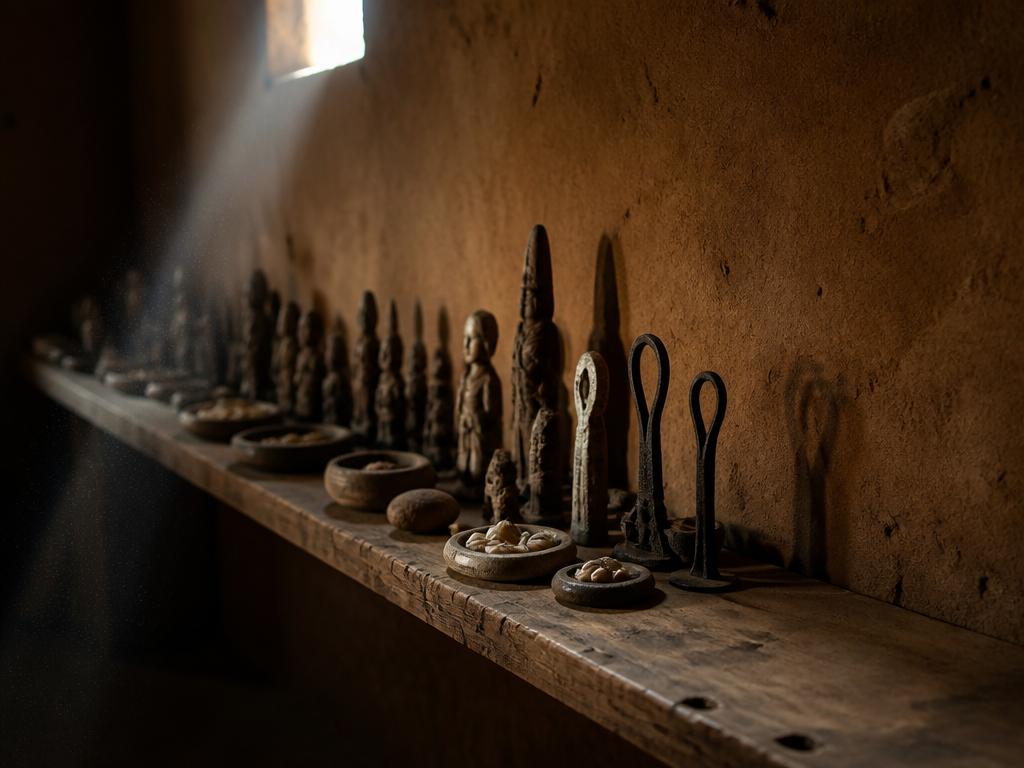
Holding it together is Ifá, a divination system read by a babaláwo or ìyánífá — a trained diviner who casts palm nuts or a divining chain and interprets the figure that results against a vast memorized body of verse. That verse corpus is the religion's library. Learning it takes years.
Two standing errors are worth clearing here, calmly. Missionary-era writing called this "idol worship"; it is not, any more than a crucifix is the object of Christian devotion. And Èṣù, the òrìṣà who opens and closes the road between people and the divine and who is fond of testing them, was translated into Yoruba-language bibles as the word for Satan. That single editorial choice, made in the nineteenth century, still shapes how Nigerians argue about their own grandparents' religion.
Next: what Adeyemi built on top
In 2018, Tomi Adeyemi — a Nigerian American writer — published a young-adult fantasy that took those names and grew a world around them. In Orïsha, magic ran through ten maji clans until King Saran ordered a purge that killed the elders and cut the connection. Zélie Adebola, the white-haired girl, is a Reaper, the clan associated with death and spirit and standing under Ọya. The story is her attempt to bring magic back.
Adeyemi has been direct about her engine: she has said she wrote the book while watching Black people killed by police in the United States, and that the maji's silver-white hair and their persecution are about that, not about Nigeria. The Yoruba layer gives the world its texture and its names. The plot is a story about state violence.
This is ordinary and legitimate authorial work. It is also worth saying plainly what it is, because a reader coming from the film will meet Ọya first as the patron of a fantasy clan and may never learn that Ọya has devotees who can tell you what her colours are and what her market day means.
Then: the studio, the director, and a cast announcement built for scale
Paramount optioned the book in a competitive sale before it was even published, and the project eventually landed with Gina Prince-Bythewood directing — a filmmaker who had just demonstrated, with The Woman King, that a large-scale African-set action film could be made with real craft.
The cast announcement that followed reads like a statement of ambition: Amandla Stenberg as Zélie, Tosin Cole as her brother Tzain, Thuso Mbedu as the princess Amari, Damson Idris as Prince Inan, Idris Elba as King Saran, and Viola Davis as Mama Agba, with Regina King, Cynthia Erivo and Lashana Lynch also attached. It is a roster assembled to signal that this is not a modest film, and to reassure an audience that the material is in serious hands.
That signalling is itself part of the mechanism. A cast of this weight raises the budget, the budget raises the required audience, and the required audience determines how much unfamiliar material the finished film can afford to carry.
Then: two minutes, and what they can hold
Which brings us to the reel. A trailer's job is to make a world legible to someone who has never heard of it, in about the length of a pop song. It does that with shorthand: a throne, a raised hand, a wall of water, a voice saying the stakes out loud.
Shorthand is not dishonest. It is just lossy, and what gets lost first is exactly the part this site cares about — the specificity. A system in which a diviner spends a decade memorizing verse becomes, on screen, a glow at the fingertips. The difference between the Yoruba of Ọ̀yọ́ and the Lucumí of Matanzas, between an eighteenth-century practice and a twentieth-century one, cannot survive the cut. What arrives instead is the general shape of magic, which every fantasy franchise already shares.
So a viewer comes out of the first look knowing the word orïsha and knowing it means "powers in a fantasy kingdom." Whether they ever learn the second meaning depends on what they do next.
Last: the author steps back
The final link in the chain is the one that has drawn the most coverage. In a series of posts on TikTok, Adeyemi publicly distanced herself from the production, saying that the film as it stands does not reflect the involvement she wanted or expected, and asking that her name not be treated as an endorsement of it.
The specifics are between her and the studio. But the structural point is not gossip: the person who did the work of choosing what to borrow, what to invent and what to leave alone is the person no longer standing behind the result. Whatever judgement the film eventually earns, it will be made without the author in the room.
Names and terms
| Name | Where it comes from | What it means |
|---|---|---|
| Òrìṣà | Yoruba tradition, living | Divine forces approached through devotion, each with a domain and history |
| Olódùmarè | Yoruba tradition, living | The supreme being, not approached directly |
| Ifá | Yoruba tradition, living | A divination system read from a memorized verse corpus |
| Babaláwo / Ìyánífá | Yoruba tradition, living | A trained male / female diviner of Ifá |
| Ọya, Ṣàngó, Yemọja, Ọ̀ṣun, Èṣù | Yoruba tradition, living | Individual òrìṣà, with devotees today |
| Lucumí, Candomblé | Cuba, Brazil — living | Atlantic traditions descended from Yoruba practice under slavery |
| Orïsha (the kingdom), maji, Reaper, King Saran | Adeyemi's novel | Invented for the fiction |
The question nobody can answer yet
The hopeful case is that a blockbuster works like a doorway: a teenager sees the trailer, searches a name, and ends up reading about Ifá verse or standing in an Ọ̀ṣun festival crowd in Osogbo. The worried case is that the shorthand sticks — that òrìṣà comes to mean "elemental clan powers" to a generation the way voodoo came to mean something with pins in it.
Both have happened before, to other traditions, from films of comparable size. Nobody has yet shown convincingly which way it runs, or what determines it. So the honest thing to say about Children of Blood and Bone is not a verdict but a question: when a mass-market film borrows the vocabulary of a living religion, does it send people toward the tradition or does it stand in front of it — and who, apart from the people who practise it, would even notice the difference?