Children of Blood and Bone: African Fantasy Fiction and Real Yoruba Belief
Look at the poster long enough and you notice the dots. Orïsha, the kingdom in Tomi Adeyemi's novel, carries two of them over the i.

Look at the poster long enough and you notice the dots. Orïsha, the kingdom in Tomi Adeyemi's novel, carries two of them over the i. The word sitting underneath it, òrìṣà, was not invented for a book. It belongs to the Yoruba people of southwestern Nigeria, Benin and Togo, and to millions of their descendants in Cuba, Brazil, Trinidad and the United States, and it has been in use for a very long time. Which is the first honest thing anyone can tell you about this piece of African fantasy fiction: the spelling is a signal. Adeyemi changed one mark to show you where the borrowing stops and the invention starts.
If you came to this book from a trailer, you are in a good position, not a bad one. You do not need to have read a word of Yoruba scripture, and there is no entrance exam. What you probably do have is a question, and it is a better question than most people give themselves credit for.
The question, plainly
The question is: am I learning something true about a real religion, or am I reading a fantasy novel that borrowed some pretty names?
The answer is: both, in specific proportions, and the proportions are worth knowing.
Some of what you meet in Children of Blood and Bone is real, and older than any novel. Some of it is Adeyemi's, built for a story, and she has never claimed otherwise. And a third category sits between the two, where a real idea has been simplified enough to move at the speed of a chase scene. That middle category is where most of the confusion lives, so most of this piece is about it.
What follows assumes you have not read the book. There are light plot details ahead, nothing that spoils the ending.
What happens in the book, briefly
Children of Blood and Bone (2018) is the first novel in Adeyemi's Legacy of Orïsha trilogy, followed by Children of Virtue and Vengeance and Children of Anguish and Anarchy. It opens not with a battle but with a lesson: a girl named Zélie Adebola holding a staff in a reed hut while an elder called Mama Agba corrects her grip.
Eleven years before that lesson, in the event the book calls the Raid, King Saran had the kingdom's maji rounded up and killed. Magic went out of the world the same night. Zélie's mother died in it. Zélie survived because she was a child whose power had not yet woken, and children like her are called divîners — marked by white hair, allowed to live, taxed and beaten and watched.
The story starts moving when Amari, the king's own daughter, watches her father kill a young woman she loves, takes a scroll from the palace, and runs. The scroll turns out to wake magic in anyone with the lineage for it. Zélie's hands light up. What follows is a chase across the kingdom for three objects and a ceremony that can bring magic back for good, with Amari's brother Inan hunting them, and with Inan carrying a secret about himself that makes the hunt unbearable.
It is, structurally, a quest novel with a deadline. What makes it feel different is what it is furnished with.
Where the names come from
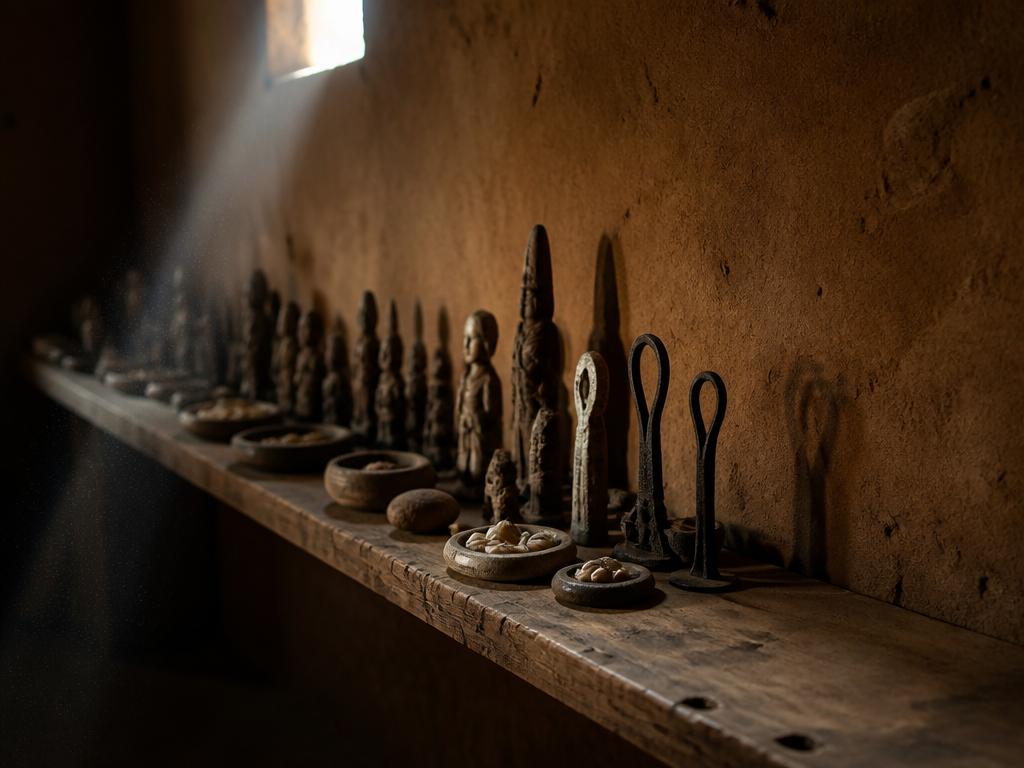
The Yoruba are one of the largest ethnic groups in West Africa, concentrated in southwestern Nigeria and extending into Benin and Togo, with Ilé-Ifẹ̀ remembered as the place where the world began. Their religious life centres on Olódùmarè, the supreme being, remote and not petitioned directly, and on the òrìṣà — a great number of divinities, each with a domain, a history, a colour, a set of songs, and in many cases a river or a town.
The òrìṣà are not gods in the Greek sense, and calling any of them "the African Zeus" gets you further from the truth, not closer. Several were once human. Others are forces that were never human. What they share is àṣẹ (roughly AH-sheh), the power to make a thing happen — the force that lets a word become an event.
The names in Adeyemi's clans are real ones. Ògún holds iron, tools, oaths and the work of blacksmiths and hunters, and today the drivers and mechanics of Lagos claim him too. Ṣàngó holds thunder and lightning and a particular kind of justice. Ọya holds the winds, storms, the Niger, and the edge where the living end. Ọ̀ṣun holds fresh water, and her river runs past Osogbo in Osun State, where the sacred grove is a UNESCO World Heritage Site and the annual festival still fills the town. Yemọja is a mother of waters, associated in Nigeria with the Ogun River, and in Brazil and Cuba with the ocean, which tells you something about what happens to a deity who crosses one.
Knowledge in this system is not guessed at. It is asked for, through Ifá, the divination practice attached to Ọ̀rúnmìlà, deity of wisdom. A babaláwo — the word means something close to "father of secrets" — casts a chain or palm nuts, reads which of 256 configurations has come up, and recites verses from the enormous body of memorised material attached to it. This is a living practice, performed this week, in Nigeria and in Havana and in Salvador and in Brooklyn. UNESCO inscribed the Ifá system on its intangible heritage list in 2008. It is not folklore in the past tense.

Adeyemi did not meet the òrìṣà in a library first. She has described encountering their images while she was in Salvador, in Bahia, Brazil, the city where Candomblé kept the names alive across the Atlantic, and going looking afterward. That origin matters to how the book reads. It came from the diaspora side of the water, from someone finding her way back along a rope that was already there.
Side by side
| The novel's Orïsha | Yoruba tradition | |
|---|---|---|
| People and place | A secondary world, though the map borrows real Nigerian city names — Lagos, Ibadan, Ilorin, Warri, Sokoto | The Yoruba of southwestern Nigeria, Benin and Togo, and diaspora communities in Cuba, Brazil, Trinidad and the US |
| Who the power belongs to | Ten maji clans, each with one elemental domain, each answering to one deity | Hundreds of òrìṣà; counts vary by account and none of them is ten. Domains overlap, and an òrìṣà's character shifts from town to town |
| How you come into it | Bloodline. You are born maji or you are not, and the mark is visible in your hair | Divination, initiation, lineage and calling, over years, inside a house of practice with elders in it |
| What the deities want | Largely offstage. The gods grant; the story is about the people | Reciprocity. Offerings, praise, conduct, obligation — a relationship with terms on both sides |
| What the power is for | Fighting, mostly, because it is that kind of book | Health, children, judgement, farming, safe travel, the ordinary weight of a life |
| How it travels | The scroll, the sunstone, the bone dagger, a ceremony with a deadline | Ships, memory, and cover — the names survived the Middle Passage inside Candomblé, Lucumí and Orisha worship, changing as they went |
The pattern in that table is the pattern in most good comparisons: related, and distinct. The novel took the register of a real system — divinity attached to element, power attached to lineage, ceremony attached to place — and built something that runs on it. What it did not do is transcribe.
One story the novel does not tell
Here is what "the stories they carry" means, and why a clan power is not the same thing as an òrìṣà.
In one telling among the Ọ̀yọ́ Yoruba, Ṣàngó was not first a god. He was the third Aláàfin, the king of Ọ̀yọ́, and he had a temper and a gift for calling down fire. He wanted to know how far the gift went. He went up to a hill above the town to test it, and the lightning he pulled came down on his own household instead of the field he aimed at, and killed people he loved.
What happened after that is where the tellings separate. In some accounts he left Ọ̀yọ́ in disgrace, walked into the bush at a place called Koso, and hanged himself from a tree. In others he ascended by a chain and was never a corpse at all. What is agreed is what his followers said afterward, when people came saying the king had hanged himself: Ọba kò so. The king did not hang.
That phrase became his praise name and the name of the shrine. Ṣàngó is not the fire clan. Ṣàngó is a king who overreached, killed his own house, and was claimed anyway — and whose people answered the shame with three words. You can build a Burner clan out of the lightning. You cannot build it out of the rest.
What the book invents, and why that is the point
The engine of Children of Blood and Bone is not Yoruba myth at all. It is the Raid, and everything that follows from it: a state that identifies a category of people by a visible mark, taxes them, licenses violence against them, and calls it order. The white hair is a target. The word divîner is a slur before it is a description.
That is Adeyemi's, and she says so. The author's note at the back of the book is four pages long and it is about the United States — about watching footage of Black Americans killed by police and writing a novel in which magic is taken from a people who are then blamed for the loss. The maji are not stand-ins for Yoruba practitioners. They are, by the author's own account, standing much closer to home.
This is worth knowing before you start, because it changes what you are reading. The book is not a documentary about a religion wearing fantasy clothes. It is a novel about state violence that chose Yoruba furniture because Yoruba furniture was the author's inheritance, and because West African belief is a foundation you can build a serious book on. The mythology is the ground, not the subject.

Where the connection ends
Five places a careful reader should not blur the line.
Ten clans is a novelist's number. Real òrìṣà counts vary wildly by account — you will hear four hundred, four hundred and one, more — and the point of the variation is that the system was never closed. Ten tidy elemental portfolios is good worldbuilding and bad theology.
Magic is not àṣẹ. In the book, power sits inside a person and comes out of their hands. Àṣẹ is not a battery. It is closer to efficacy — the quality that makes a word land, a medicine work, a judgement stick — and access to it runs through relationship, divination and obligation, not through blood alone.
Orïsha is not Yorubaland. The map uses Nigerian city names, but the kingdom, the monarchy, the Raid and the geography are all invented. Reading the novel does not give you a picture of Nigeria, historical or current.
Nothing vanished. The premise that magic died in one night is fiction. Yoruba religious practice was suppressed, criminalised in places, and pressured hard by both missionary Christianity and Islam, and it is still here — in Osogbo, in Bahia, in Havana, in diaspora houses across North America and Europe. Millions of people are living inside this tradition right now, alongside Yoruba Christians and Yoruba Muslims, sometimes in the same family.
Neither the book nor this article is a manual. The novel's ceremony, with its three objects and its solstice, is invented for the plot. Actual òrìṣà practice belongs to lineages and initiates, and what is done in a shrine is not something you learn from a paperback or a website. The meaning is public. The method is not.
One more correction while we are here, because it comes up whenever these names reach a mass audience: Èṣù, the messenger òrìṣà who opens and closes the way at the crossroads, is not the devil. That equation was made in the missionary era, cemented when nineteenth-century Bible translation into Yoruba used his name for Satan, and it has been doing damage ever since. Èṣù is the one who carries the message and enforces the terms. He is not evil, and no version of the tradition before that translation says otherwise.
Where readers disagree
There is a real conversation about this book among Yoruba readers and òrìṣà practitioners, and it does not resolve into one verdict.
One position: visibility is the win. A generation of readers now knows that Ọya and Ògún exist, that the names are Yoruba, that West Africa has a cosmology deep enough to hold a trilogy. That is not nothing, particularly for young Nigerians and diaspora kids who had Percy Jackson's Olympus and nothing that sounded like home.
The other position: compression has costs. Turn òrìṣà into clan classes and readers arrive at the real tradition expecting a character-select screen. The gap between a fictional Burner and the actual Ṣàngó — a king, a scandal, a phrase, a shrine at Koso — is exactly the gap that gets lost.
Both of these are held by thoughtful people, and often by the same person on different days. The novel does not have to be a betrayal or a textbook. It can be a good book that got a lot of readers to the doorway of something it is not.
Names and terms
- Òrìṣà — the Yoruba divinities, each with a domain, a history and its own body of songs and praise poetry.
- Orïsha — the fictional kingdom in Adeyemi's novel, spelled with a mark that keeps it distinct.
- Olódùmarè — the Yoruba supreme being, source of everything, approached through the òrìṣà rather than directly.
- Àṣẹ (AH-sheh) — the power that makes things happen; the force behind an effective word.
- Ifá — the Yoruba divination system, and the body of knowledge it carries.
- Babaláwo — an Ifá diviner; the title means roughly "father of secrets".
- Aláàfin — the title of the king of Ọ̀yọ́, the Yoruba empire Ṣàngó is remembered as having ruled.
- Candomblé, Lucumí, Orisha worship — living Yoruba-derived traditions in Brazil, Cuba and Trinidad; continuations, not copies.
- Divîner, maji, kosidán — Adeyemi's terms for the marked children, the magic-born, and everyone else. All three are the novel's.
One thing to try this week
Open the book at the back before you open it at the front. Adeyemi's author's note is four pages, it sits after the last chapter, and reading it first costs you nothing and reframes everything — you will meet Zélie already knowing what the white hair is doing there and where it came from. Most people find it after five hundred pages, when the reframing has nowhere left to go.
Then, if you want the other half, spend ten minutes with footage of the Osun-Osogbo festival, which happens every August by the river in Osun State, Nigeria. It will not look like a fantasy novel. That is the useful part.
Ọba kò so, the Ọ̀yọ́ say — the king did not hang. Names outlast the versions of themselves that reach a screen, and the ones in this book were already old when they got there.