Adinkra Symbols in Stone: How Ghana Buries Its Great Men
Drive west out of Accra along the coast road, past Kasoa and the roadside furniture stalls, and at Gomoa Mpota you come to a building that does not look like a tomb.

Drive west out of Accra along the coast road, past Kasoa and the roadside furniture stalls, and at Gomoa Mpota you come to a building that does not look like a tomb. It has a broad staircase, a deep porch, statues standing sentry, and a facade carved over with Adinkra symbols — the small stamped glyphs that Ghanaians know from mourning cloth, from church walls, from the back of a trotro. This is where Apostle Kwadwo Safo Kantanka, the industrialist and founder of the Kristo Asafo Mission, is to be laid. Photographs of it have travelled fast on Ghanaian social media, and the reaction has been mostly admiration, some of it quietly startled.
The startle is worth sitting with, because it comes from a mismatch. Many people, Ghanaians included, file Adinkra under pattern — the thing printed on a funeral cloth, the thing a hotel puts on its lobby wall. And they file the elaborate Ghanaian funeral under expense. Put the two together at monumental scale and it can read as excess.
It is better understood as grammar. Among the Akan of Ghana, a funeral is a public statement about who a person was and what the family owes them, and Adinkra is one of the languages that statement is written in. The building at Gomoa Mpota is not a decorated tomb. It is a sentence.
What follows is an attempt to separate three things that usually get mashed together: what most people assume about Ghanaian burial customs, what the record and the practice actually show, and what I have learned to look for when I attend one.
What most people assume
The standard outsider account of a Ghanaian funeral runs roughly like this. The funeral is enormous and expensive. It happens months, sometimes a year or more, after the death. There are billboards. There is a brass band or a DJ. There are matching cloths, a donation table, and a printed programme with the deceased's photograph on the cover in gold. Somebody will tell you, usually with a laugh and usually a Ghanaian, that Ghanaians spend more on burying a person than on housing them.
Underneath that account sit three assumptions, and each of them is slightly off.
The first is that the delay signals disorganisation or, less kindly, that the family is stalling for money. The second is that the scale is competitive display — funerals as a status auction. The third, the oldest and the most damaging, is inherited from the missionary period: that honouring the dead in this way is worship of the dead, and therefore a rival to the church. That third assumption is why nineteenth-century mission records so often described Akan funeral rites as idolatry, and why the word fetish attached itself to West African religious life and has never fully come off. It was a category error then and it remains one now.
There is a fourth assumption, specific to the design question. It is that Adinkra symbols are ornament — a visual style, like paisley, that can be applied to any surface for a local flavour. On that reading, carving them onto a mausoleum is a decorating choice.
What the evidence suggests
The funeral is a second, deliberate event
Among the Akan — the Asante, Fante, Akuapem, Akyem and related peoples of southern and central Ghana — burial and funeral are not the same event, and the gap between them is structural rather than accidental. The body is preserved. The family, the abusua, has to be convened, and an Akan family is a lineage, not a household: it runs through the mother's line and it now runs through Kumasi, Accra, Hamburg, Toronto and the Bronx. Land questions, succession questions and debts are settled before the rites. Cloth is commissioned. A date is set that lets the diaspora fly.
So the delay is not a failure of the system. It is the system. The interval is what makes a full ayie — the Akan funeral observance — possible at all.
The observances themselves are staged. There is the wake, the burial, and then the ayie proper, often on a Saturday, with the family seated in state to receive mourners. There is the one-week observance, nnawɔtwe, and in many families the fortieth-day rite, adaduanan, and a first-anniversary observance after that. Each is a checkpoint in a slow handover: the person stops being a living member of the household and becomes an ancestor, a nsamanfo, still part of the lineage and still addressed, but on the other side of a boundary.
That is the part the missionary label got wrong. Pouring libation and calling the names of the dead is closer in intent to a family reading out its own roll than to petitioning a god. Among the Akan the ancestors are not divine; they are senior relatives who have moved, and who remain answerable to and for the living. A Ghanaian Catholic can hold both frames at once, and millions do.
As for the expense — display is real, and Ghanaians debate it constantly and often sharply in their own newspapers and pulpits. But the donation table complicates the auction reading. Mourners contribute, the contributions are recorded by name, and the record is a ledger of obligation that runs in both directions across years. What looks like spending is also, in part, a mutual insurance scheme with very long memory.
Where Adinkra actually comes from
Adinkra is not a decorative alphabet invented for export. It is Asante, with a documented origin story and a contested one.

The most repeated account ties the cloth to Nana Kwadwo Adinkra, a ruler of the Gyaman state in what is now the Bono region and eastern Côte d'Ivoire, defeated by the Asante in the early nineteenth century. In one telling, the Asante took the cloth and its stamping technique as war spoil. In another, the association is looser and the name derives from adinkra, glossed in Twi as farewell or parting — the cloth of goodbye. Scholars have gone back and forth on this; the Gyaman account appears in colonial-era sources and in Asante oral tradition, but the etymology of the word and the age of the stamping technique are not settled, and honest writing on the subject says so rather than picking the tidier story.
What is not in dispute is the method and the meaning. The stamps are cut from calabash. The dye, adinkra aduru, is boiled down from the bark and roots of the badie tree with iron slag until it is thick and near-black. The cloth is pegged out, gridded into panels with a comb, and stamped by hand — work still done in Ntonso and neighbouring towns in the Asante region, where you can watch it and where the stampers will tell you which symbol is which.
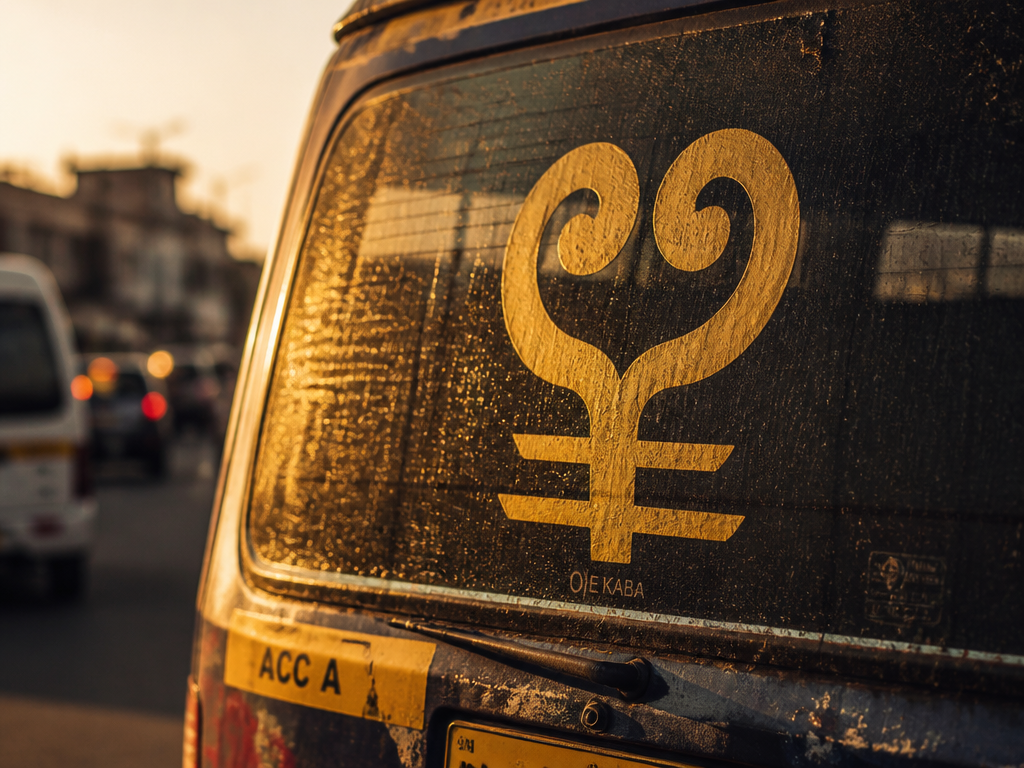
And each symbol carries a proverb. This is the point that gets lost when the glyphs go on a coffee mug. An Adinkra symbol is a compressed saying — the visual half of a spoken proverb, and the two travel together.
| Symbol | Twi name | The saying behind it | What it means |
|---|---|---|---|
| Two-headed crocodile with one stomach | Funtunfunefu Denkyemfunefu | They share one stomach, yet they fight over food | The waste of infighting in a family that shares a fate |
| A backward-looking bird | Sankofa | Se wo were fi na wosankofa a yenkyi — it is no shame to go back for what you forgot | Retrieve what is worth keeping from the past |
| Interlocking chain links | Nkonsonkonson | We are linked in both life and death | The chain of the lineage, living and ancestral |
| A jagged, zigzag line | Nkyinkyim | The path of life is not straight | Endurance, adaptation, a life that turned |
| A ladder | Owuo Atwedeɛ | Owuo atwedeɛ, obaakofoɔ mforo — death's ladder is climbed by everyone, not one person alone | Mortality as the universal condition |
| A knot | Nyansapɔ | The wise knot, which only the wise can untie | Wisdom, ingenuity, hard problems solved |
Read that list again with a funeral in mind. Nkonsonkonson is the lineage. Owuo Atwedeɛ is the plain fact of death. Sankofa is the instruction the whole delayed, staged, expensive observance carries out. These are not general-purpose good-vibes symbols. A meaningful share of the Adinkra corpus is funerary in its native setting, which is precisely why the cloth appears at ayie — russet and black kuntunkuni and birisi for the bereaved, white for a person who died old and full of years, because that death is a completion rather than a rupture.
Why the symbols moved from cloth to concrete
The migration from textile to building is a twentieth- and twenty-first-century development, and it is worth naming as such rather than pretending the ancestors built like this. Asante architecture has its own long tradition of moulded relief — the surviving traditional buildings at Asante shrine sites carry bold curvilinear motifs in mud plaster, and UNESCO listed them for exactly that reason. But the specific move of stamping Adinkra glyphs onto public concrete belongs to the era of independence and after: the National Theatre, university crests, church facades, chieftaincy buildings, the tiled forecourts of family houses.
And the funerary architecture has its own trajectory. Ghana already has a famous idiom of designed death: the figurative coffins of the Ga around Accra and Teshie, carved as fish, eagles, cocoa pods, Bibles, aeroplanes — a craft that dates to the mid-twentieth century, is attributed in most accounts to Ata Owoo and Kane Kwei, and now sits in museum collections abroad while still being made for actual funerals at home. The principle there is simple and it is the same principle: the container should say what the person was.
A burial house carved with Adinkra symbols is that principle at architectural scale. For a man whose public identity was built on the argument that Ghanaian ingenuity needed no foreign template — Apostle Safo built cars, machines and a manufacturing outfit under the Kantanka name and staked a career on made-in-Ghana — the choice of an indigenous visual language for his resting place is legible. It is an argument continued by other means.
Scholars and critics do disagree about what this trend represents. Some read monumental family mausolea as continuous with older Akan practice, where the graves of chiefs and elders were tended, spatially significant and ritually addressed. Others read the concrete-and-tile mausoleum, with its porch and its statues, as something newer — shaped by remittance money, by Pentecostal prosperity aesthetics, and by competition between families that older custom would not have permitted. Both readings have evidence. The honest position is that this is a living form still being argued about by the people who use it.
What I actually watch for
After enough funerals you stop taking in the whole scene and start reading specific things. Here is my own list, offered as one attendee's practice rather than as instruction, because none of this is mine to prescribe.

The cloth, first. Colour tells you the family's reading of the death before anyone speaks. Deep russet-brown and black say grief and a life cut short of its span. White or white-and-black says the person went old, complete, with grandchildren — a funeral that will have laughter in it. Getting this wrong at the gate is the fastest way to misread the entire day.
Then the drums. Fontomfrom and atumpan are talking drums; they render Twi speech in tone. When they sound at a chief's or an elder's funeral, they are not background — they are reciting appellations, the praise-names of a lineage. I do not follow all of it. I watch who in the room straightens when a particular phrase comes.
Then the seating. Who sits with the abusua, who sits with the church, who is placed to receive. An Akan funeral is a map of a lineage drawn in plastic chairs, and the map is accurate.
Then the poster and the programme. The obituary poster is its own Ghanaian genre — the photograph, the honorifics, the phrase Call to Glory or Nante yie, go well. Read the list of surviving relatives and you have the family's own public account of itself.
Then the donation table, which is where the ledger lives, and where you can see the reciprocity that the word extravagance misses entirely.
And last, on the newer mausolea, the symbols themselves. I read them the way you would read an inscription, because that is what they are. A Nkonsonkonson chain over a doorway is a claim about lineage. Gye Nyame, the most reproduced glyph in the country — except for God, the supremacy of the divine — is a theological statement and, on a Christian family's tomb, a deliberate bridge between two frames. Nkyinkyim on a facade says the life inside it had turns in it. When I look at a building like the one at Gomoa Mpota, the question I am asking is not whether it is impressive. It is which sentences the family chose to carve, and in what order.
Where the connection ends
Having argued that funeral custom and Adinkra design are one grammar, I should be equally clear about where the seams are.
Adinkra on a tomb is not Adinkra on cloth. The stamped cloth is made by hand, for a specific mourning, by stampers in a specific set of Asante towns, and it is worn. A carved facade is permanent, public and architectural. The vocabulary carried over; the practice did not. Ntonso stamping is a craft with a living lineage, and a moulded concrete relief, however handsome, is not that.
The Akan funeral is not the Ghanaian funeral. Ghana has more than eighty languages and no single burial custom. The ayie described here is Akan. The Ga of Accra bury quickly relative to Akan practice and gave the world the figurative coffin. Ewe funerals in the Volta Region carry their own drumming repertoires and their own rites. Among the Dagomba, Mamprusi and other peoples of the north, and across the Muslim communities of Tamale, Wa and Accra's zongos, burial follows Islamic requirement — same day where possible, no elaboration of the grave — and the idea of a year-long interval before the rites does not apply. Writing 'Ghanaian burial customs' as one thing is a convenience of headline space, this one included.
Honouring ancestors is not deifying them. The nsamanfo are addressed as elders, not petitioned as gods. Blurring that is the missionary-era error repeating itself in gentler clothes.
And the Christian funeral and the traditional one have not merged into a single thing. They run alongside each other, sometimes in the same weekend, occasionally in tension — plenty of Ghanaian churches have preached against aspects of ayie, and plenty of families have gone ahead anyway. What looks from outside like seamless syncretism is, up close, an ongoing negotiation conducted by specific families about specific relatives.
Names and terms
- Adinkra (ah-DEEN-krah) — Asante stamped symbols, each attached to a proverb; also the cloth they are printed on.
- Ayie (ah-YEE-eh) — the Akan funeral observance, distinct from the burial itself.
- Abusua (ah-BOO-swah) — the Akan matrilineal family or lineage, traced through the mother.
- Nsamanfo (n-sah-MAN-foh) — the ancestors; deceased members of the lineage who remain part of it.
- Adaduanan — the fortieth-day observance after a death.
- Kuntunkuni / birisi — dark mourning cloths, russet-brown and near-black, worn by the bereaved.
- Fontomfrom / atumpan — Akan drums that reproduce the tones of Twi speech, used to recite praise-names.
- Gye Nyame (jeh N-yah-meh) — 'except for God'; the most widely reproduced Adinkra glyph in Ghana.
- Ntonso — the town in the Asante region where Adinkra cloth stamping is still practised.
- Gyaman (JAH-man) — the state, in present-day Bono and eastern Côte d'Ivoire, whose ruler Kwadwo Adinkra is named in the most-repeated origin account.
The last word
The myth is that a Ghanaian funeral is a costly spectacle running months late, and that the glyphs on its cloth and its concrete are handsome local decoration.
The more accurate version is that the delay is what lets a scattered lineage assemble, the cost is a ledger of obligation that runs both ways, and the glyphs are proverbs — so that a building like the one at Gomoa Mpota is not decorated at all, but written on.
As the ladder says: Owuo atwedeɛ, obaakofoɔ mforo. Death's ladder is climbed by everyone — no one climbs it alone.