Yoruba Indigenous Religion in Church, Mosque, and Diaspora
The drummers come before dawn. In Ramadan, on streets in Ìbàdàn and Lagos, small bands of young men walk the neighbourhood at four in the morning, waking households for the meal before the fast.

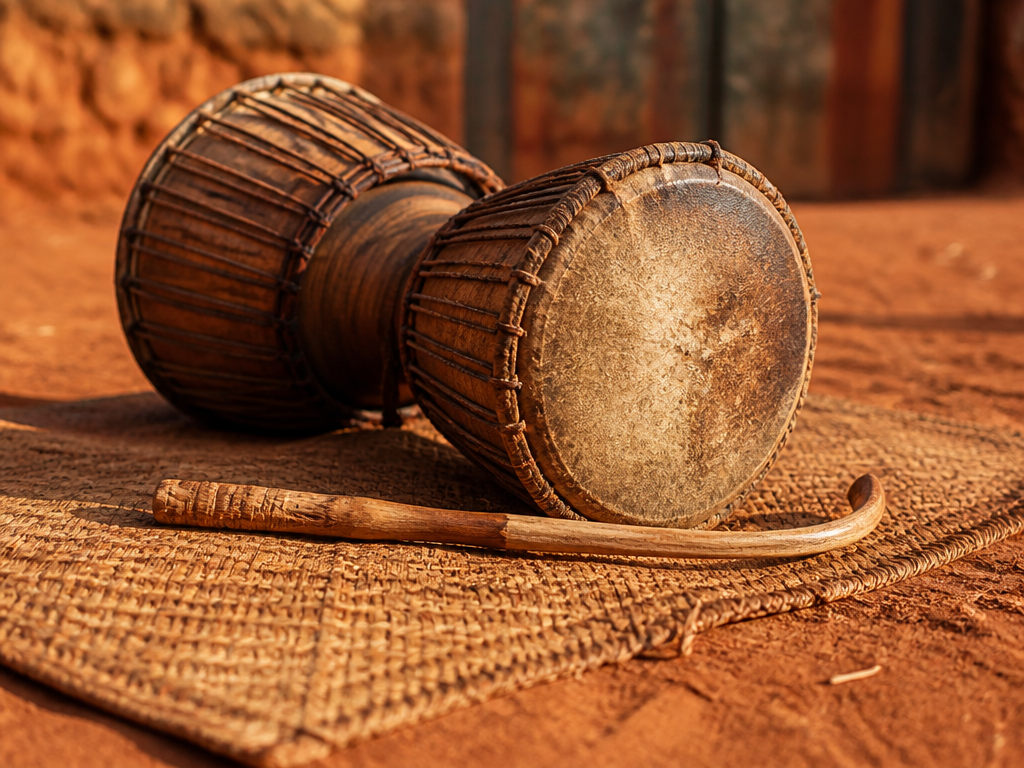
The drummers come before dawn. In Ramadan, on streets in Ìbàdàn and Lagos, small bands of young men walk the neighbourhood at four in the morning, waking households for the meal before the fast. They call it ajísáàrì. What they carry is the dùndún, the hourglass drum squeezed under the arm to bend its pitch toward speech, and what they sing over it is praise poetry — a household's name unspooled into verse. The devotion is Muslim. The drum, the meter, and the praising itself come out of Yoruba indigenous religion.
If you have met Ọ̀ṣun on an album cover, or Ṣàngó in a song title, or a friend's grandmother crossing herself in a white-garment church while the talking drums answer the choir, you have met this pattern without being handed the key to it. Here is the key, in one sentence: the relationship between Yoruba tradition and the two world religions that now claim almost every Yoruba person is not a leftover and not a coincidence, but a single religious grammar carried into new vessels by people who did the carrying on purpose.
This piece is built around one number, because the number is where the misunderstanding starts.
The number: fewer than two in a hundred
When the Pew Research Center surveyed nineteen sub-Saharan countries for its 2010 study Tolerance and Tension: Islam and Christianity in Sub-Saharan Africa, Nigeria came back split almost evenly down the middle — roughly half Christian, roughly half Muslim. Adherents of African traditional religion registered at under two percent. In some breakdowns of that data, the figure sits below one.
Across the Atlantic the number is smaller still. Brazil's 2010 national census counted Candomblé and Umbanda together at around three-tenths of one percent of the population — fewer than 600,000 people in a country of roughly 190 million, and in the state of Bahia, the historic Yoruba heartland of the Americas, still a small minority of respondents.
Those figures are real. They are also the single most misread pair of numbers in the study of Yoruba religion, and almost every popular claim about the tradition being "nearly extinct" or "reduced to folklore" traces back to them.
What the question actually measured
A survey question about religion in Nigeria or Brazil is a single-answer question. What is your religion? Pick one. The instrument is built for a world where a person belongs to one faith the way they hold one passport.
That design does two things at once. It measures identity accurately — a Nigerian Baptist who answers "Christian" is telling the plain truth, and it would be condescending to read them otherwise. And it forces a choice that the underlying religious culture never required. Yoruba practice historically had no membership roll and no conversion ceremony. A household might keep Ọya, consult a babaláwo, and honour its egúngún without any of that constituting an exclusive affiliation you would announce to a stranger with a clipboard.
The political history sharpens the point. Nigeria has not asked a religion question in its national census since 1963; the topic was dropped from the 1991 and 2006 counts precisely because the answers carry so much weight in the allocation of power that the count itself becomes a contest. What we have instead are sample surveys, conducted in a country where "Christian" and "Muslim" are the socially legible answers, where the alternative has spent a century being described from pulpits as something to be repented of, and where the English words offered as the third option — "traditional", "animist" — were coined by outsiders and carry a sting.
So the two-percent figure measures something specific and narrow: how Nigerians answer a forced-choice affiliation question in the present climate. That is worth knowing. It is not the same as knowing what people believe or do.
What the number does not measure
It does not measure the name of God. Yoruba Christians pray to Ọlọ́run and Ẹlẹ́dàá; Yoruba Muslims pray to Ọlọ́run and Ẹlẹ́dàá. Both words predate both faiths, and both come loaded — Ọlọ́run is the owner of the sky, Ẹlẹ́dàá the one who moulds. Samuel Àjàyí Crowther's Yoruba scriptures put those names on the page in the nineteenth century, and Yoruba translations of Islamic devotional material did the same. Two of the world's largest religions address the divine in West Africa using vocabulary formed by an older cosmology.
It does not measure oríkì, the praise-poetry form that names a person by naming their lineage and their town. Oríkì is how Yoruba tradition addressed a deity, a king, and a newborn. It is also, structurally, how a Pentecostal worship leader in Lagos stacks the attributes of God one on top of another until the room is standing, and how the ajísáàrì singer greets a household at four in the morning.

It does not measure the drums — gángan, dùndún, sákárà, bẹ̀mbẹ́ — or the fact that fújì, one of the great Nigerian Muslim popular musics, grew directly out of that Ramadan dawn-waking practice in the hands of performers such as Sikiru Ayinde Barrister.
It does not measure attendance at the Ọ̀ṣun-Òṣogbo festival, where hundreds of thousands walk to the sacred grove on the river each August — a UNESCO World Heritage site since 2005 — many of them people who would tick "Christian" or "Muslim" on a form without hesitation.
And here is the tell within the data itself. When Pew's researchers stopped asking about identity and started asking about practice — whether offerings to ancestors or spirits can protect a person, whether the respondent has consulted a traditional healer, whether sacred objects hold power — the answers stopped being fractions of a percent and became large minorities of self-identified Christians and Muslims. Same people. Same survey. Different question.
Side by side: three vessels, one grammar
The carrying happened in at least three directions, and comparing them is more useful than treating any one as the story.
| Aládùrà churches | Yoruba Muslim practice | Lucumí and Candomblé | |
|---|---|---|---|
| People and place | Yoruba Christians in south-western Nigeria and the West African diaspora | Yoruba Muslims in Ọ̀yọ́, Ìbàdàn, Ìlọrin, Lagos and beyond | Descendants of enslaved Yoruba, Fon and Kongo peoples in Cuba and in Bahia, Brazil |
| How it arrived | Founded by Yoruba Christians from the 1920s and 1930s — the Cherubim and Seraphim, the Church of the Lord (Aladura), Christ Apostolic Church — not by missionaries | Islam entered Yorubaland overland from the north across centuries, absorbed gradually rather than imposed | Carried in the holds of slave ships in the eighteenth and nineteenth centuries, then rebuilt under Catholic surveillance |
| What Yoruba practice carried in | Drumming and dance in worship, night vigils, prophecy and dream interpretation, healing through prayer, praise-stacking in the oríkì manner | Drum ensembles, praise singing, the Yoruba names for God, the naming ceremony's shape, oath-taking language | Òrìṣà by name, the divination corpus, initiation lineages, drum liturgy, food and colour associations |
| What changed | Theology is Christian and explicit about it; the òrìṣà are not addressed | Theology is Islamic and explicit about it; the òrìṣà are not addressed | Catholic saints entered the system, and in Cuba the tradition took a Spanish-inflected liturgical language |
Two things in that table deserve emphasis, because they are usually collapsed.
In West Africa, the deities did not travel; the forms did. An Aládùrà congregation is not worshipping Ṣàngó under another name. What crossed over was the sensory and structural repertoire — how you address power, how you praise, how a community handles affliction, what a vigil is for — inside an unambiguously Christian or Muslim theology.
In the Americas, the deities did travel, and the saints came to them. Ṣàngó and Santa Bárbara, Ọ̀ṣun and the Virgin of Charity, Yemọja and a Lady of the sea: these are correspondences worked out by enslaved and free Black communities under conditions where the alternative was suppression. That is a different phenomenon from what happened in Ìbàdàn, and using one word — syncretism — for both is where most of the confusion lives.
Names and terms
- Òrìṣà (oh-REE-shah) — the deities and powers of Yoruba tradition, each with a domain, a history, and a body of praise poetry.
- Olódùmarè / Ọlọ́run / Ẹlẹ́dàá — the supreme creator, distant from daily affairs; the second name means roughly "owner of the sky".
- Ifá — the divination system built on 256 configurations, each opening onto a body of memorised verse. UNESCO listed it as intangible cultural heritage in 2005.
- Babaláwo (bah-bah-LAH-woh) — "father of secrets", the trained diviner who reads Ifá.
- Orí — the inner head; a person's destiny and the part of them that must be honoured for a life to go well.
- Ìwà — character, in the moral sense; the central Yoruba ethical term.
- Egúngún — the masked ancestral presence that returns to speak with the living during festival.
- Ìṣẹ̀ṣe (ee-SHEH-sheh) — the term Yoruba practitioners increasingly use for their own tradition, in place of borrowed English labels.
- Aládùrà — "owners of prayer", the family of Yoruba-founded churches begun in the 1920s.
- Lucumí — the Yoruba-derived tradition and liturgical language of Cuba, often called Santería by outsiders.

The devil that was not there
One detail shows how much a translation choice can do. When Crowther and his colleagues rendered the Bible into Yoruba from the 1840s onward, they needed a word for Satan. They chose Èṣù.
Èṣù is not that. In Yoruba tradition he is the messenger and the keeper of the crossroads, the one who carries offerings upward and carries consequence back down, the tester who exposes what a person actually is rather than what they claim. He is the reason a proverb can turn on you. He is unpredictable, and being unpredictable is his function within a system that takes moral ambiguity seriously — but he is not the adversary of God, because in Yoruba cosmology there is no cosmic war for a devil to command.
That single equation, repeated in sermons for a century and a half, is why a Yoruba child today may hear Èṣù's name in church every Sunday and never learn what it meant first. Scholars of Yoruba religion have been correcting it in print for decades. It is a translation error with a long tail, not a revelation about the tradition.
Where scholars disagree
They disagree seriously, and it would be dishonest to smooth it over.
The older argument was about whether anything survived the Middle Passage at all. Melville Herskovits, in The Myth of the Negro Past (1941), argued that African religious forms persisted in the Americas in recognisable shape. E. Franklin Frazier argued the opposite — that slavery was so total a rupture that what looks African is mostly reinvention. Most researchers now sit closer to Herskovits, but Frazier's caution about romanticising continuity has not gone away.
The newer argument is about the saints. The mid-century reading, associated with the French sociologist Roger Bastide, treated the saint-òrìṣà pairings largely as a compartment — a public Catholic face over a private African core, kept separate in the practitioner's mind. Later scholars pushed back hard. J. Lorand Matory, in Black Atlantic Religion (2005), argued that Candomblé's Yoruba character was not merely preserved but actively constructed through nineteenth- and twentieth-century traffic between Lagos and Bahia — merchants, returnees and priests crossing the ocean in both directions, deliberately shaping what the tradition would be. Andrew Apter has argued that òrìṣà ritual is itself an interpretive practice, one that absorbs and critiques new material rather than merely hiding under it.
The difference matters for how you read a Cuban altar. Under the older view, the saint is camouflage. Under the newer one, the practitioners were doing theology — deciding what fit, what did not, and what a new figure meant — which is what religious communities everywhere do when traditions meet.
Where the connection ends
A good comparison earns its differences, and these are the ones not to blur.
Aládùrà Christians are Christians. The drums and the vigils do not make a congregation secretly traditionalist, and telling them otherwise is a slight, not an insight. They would tell you the same, and they are the authority on their own faith.
Yoruba Muslim practice is Islamic practice. A dùndún accompanying devotional song is a local form, in the same way that Arabic maqām or Indonesian gamelan-inflected recitation are local forms. Islam has always taken on the sound of the places it reaches.
Diaspora traditions are not degraded copies. Lucumí and Candomblé are complete religions with their own initiations, lineages, authorities and two centuries of accumulated interpretation. They are continuations, not remnants, and a Havana priest is not a lapsed version of an Ọ̀yọ́ one.
Ìṣẹ̀ṣe practitioners exist right now. The most important limit on the two-percent figure is that the two percent are people. There are babaláwo taking clients, compounds keeping their egúngún, families whose Ọ̀ṣun observance never lapsed. Reading them as a metaphor for cultural memory — as the ghost inside everyone else's church — erases them a second time.
A Yoruba proverb says ìwà l'ẹwà: character is beauty. It is quoted by Christians, Muslims and traditionalists alike, in Lagos and in Bahia, usually without anyone pausing to ask which religion it belongs to. That is roughly the right instinct.
The myth is that Yoruba tradition was replaced by Christianity and Islam and now survives only as folklore in a rounding-error minority. The more accurate version is that under two percent of Yoruba people carry the tradition as their declared faith, while a great many more carry its language, music, ethics and structure inside the two religions they name on a form — and that this is not a failure of the tradition, but the shape of its persistence.