Yoruba Indigenous Religion in Church, Mosque, and Song
Somewhere in the middle of a praise-and-worship set — Ìbàdàn, Brixton, Houston, it hardly matters — the keyboard drops out and a talking drum takes over.

Somewhere in the middle of a praise-and-worship set — Ìbàdàn, Brixton, Houston, it hardly matters — the keyboard drops out and a talking drum takes over. The gángan bends its pitch up and down like a voice, and the congregation knows exactly what to do with that. If you have ever watched that happen and wondered whether you were looking at Yoruba indigenous religion in a Sunday suit, you have already asked the question this piece exists to answer.
It is a fair question, and it gets asked more sharply every year, because the vocabulary keeps surfacing. Àṣẹ at the end of a poem read in Brooklyn. Ọ̀ṣun read into a yellow dress and a flood of river water in a pop video. Ifá in an interview, Ògún in a lyric, Ṣàngó on a T-shirt in a city where nobody can tell you which town Ṣàngó ruled. A reader raised Christian or Muslim in a Yoruba family — or a generation or three away from one — ends up holding two things at once: a formal religion, and a set of words from somewhere older that nobody quite sat down and explained.
Here is the short answer before the long one. Yoruba indigenous religion, Yoruba Christianity and Yoruba Islam are not one faith wearing three outfits. They share a language, a set of inherited artistic and social forms, and a set of urgent questions about misfortune and protection — and in the Americas, and only there, they went through a long period of deliberate overlay that Yorubaland itself never needed. Related, and distinct. The interest is all in the places where the answer turns into it depends, and there are several.
What we are actually comparing
Four things. It helps to name them before setting them beside one another.
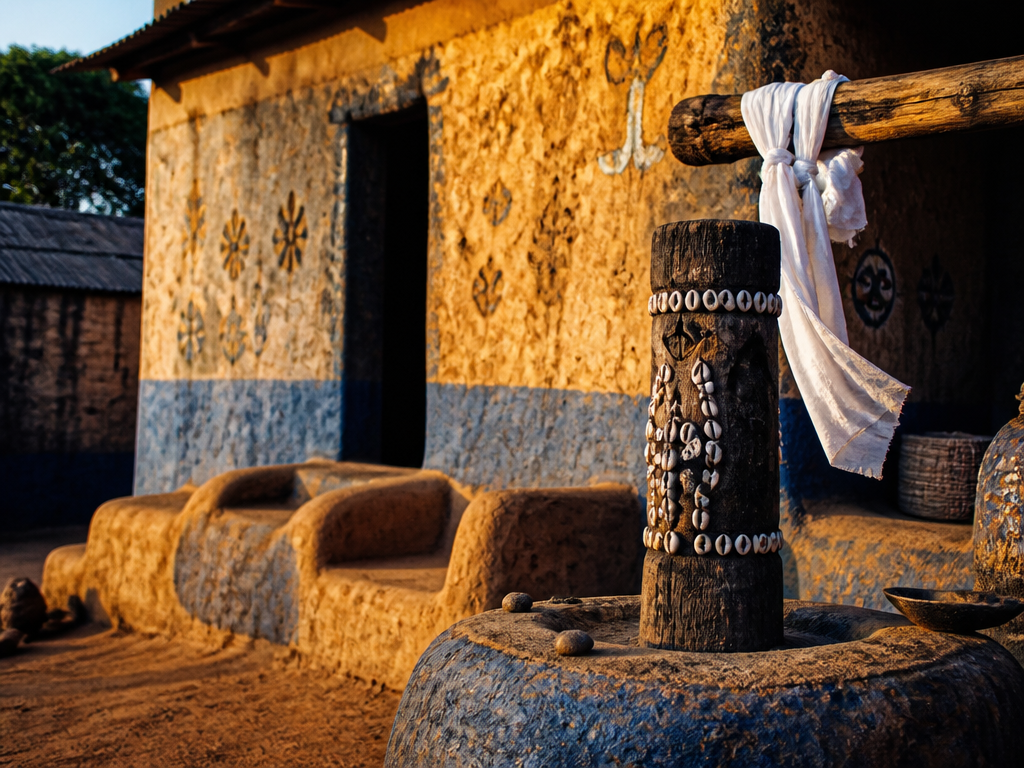
Ìṣẹ̀ṣe is what practitioners in Nigeria increasingly call the older tradition; the word points to the inherited way of doing things, the source-practice. At its top sits Olódùmarè, also called Olórun, the supreme being — remote by design, with no shrine and no priesthood of his own. Beneath and around is the working world of the òrìṣà, several hundred of them, each with a priesthood, a drum, a colour, a food and a territory. There are the ancestors, addressed at funerals and through the egúngún masquerade. And there is Ifá, the divination system through which the whole arrangement is consulted, argued with and remembered. Holding it together is àṣẹ, the force that makes a word spoken correctly become a thing that happens.
The detail that quietly wrecks most versions of the comparison is that ìṣẹ̀ṣe was never a membership. It attaches to lineage, town, river and craft. Ògún, the òrìṣà of iron, belongs to hunters and blacksmiths, and now to drivers and mechanics who keep his day. Ọ̀ṣun is a particular river running past a particular city, Òṣogbo, and the agreement made there between a people and the water. Nobody joined. You inherited an obligation and took up others as life required them. Put the question "which religion are you" to a household in Abẹ́òkúta in 1830 and it would have landed about as usefully as asking which language their cooking was in.
Yoruba Islam is the oldest of the newcomers. It came down the trade routes from the north and was established among the Ọ̀yọ́ by the seventeenth and eighteenth centuries, long before any missionary. Yoruba speakers call a Muslim Ìmàle, and the city of Ilọrin, at the northern edge of Yorubaland, has been a centre of Islamic scholarship in Yoruba for two centuries.
Yoruba Christianity arrives in the 1840s, and it arrives partly in Yoruba hands: alongside the missions came the Sàró, Yoruba people freed from slave ships and settled in Sierra Leone, who returned home literate and Anglican, and the Agùdà, returnees from Brazil and Cuba, many of them Catholic.
The òrìṣà houses of the Americas — Lucumí in Cuba, the Kétu houses of Candomblé in Brazil, Orisha worship in Trinidad — are the tradition carried across the Atlantic in the memory of enslaved people, concentrated in the last and most Yoruba-heavy decades of the trade.
All four are Yoruba religions now. Nobody has been Anglican in Abẹ́òkúta for six generations by accident.
Names and terms
- Òrìṣà (oh-REE-shah) — a divinity. There are hundreds; each has their own priesthood, drum, food and territory.
- Olódùmarè — the supreme being, deliberately distant; the òrìṣà handle daily business.
- Àṣẹ (AH-sheh) — the power that makes a thing come to pass.
- Ifá — the divination system, and the vast body of verse held in its 256 chapters, called odù.
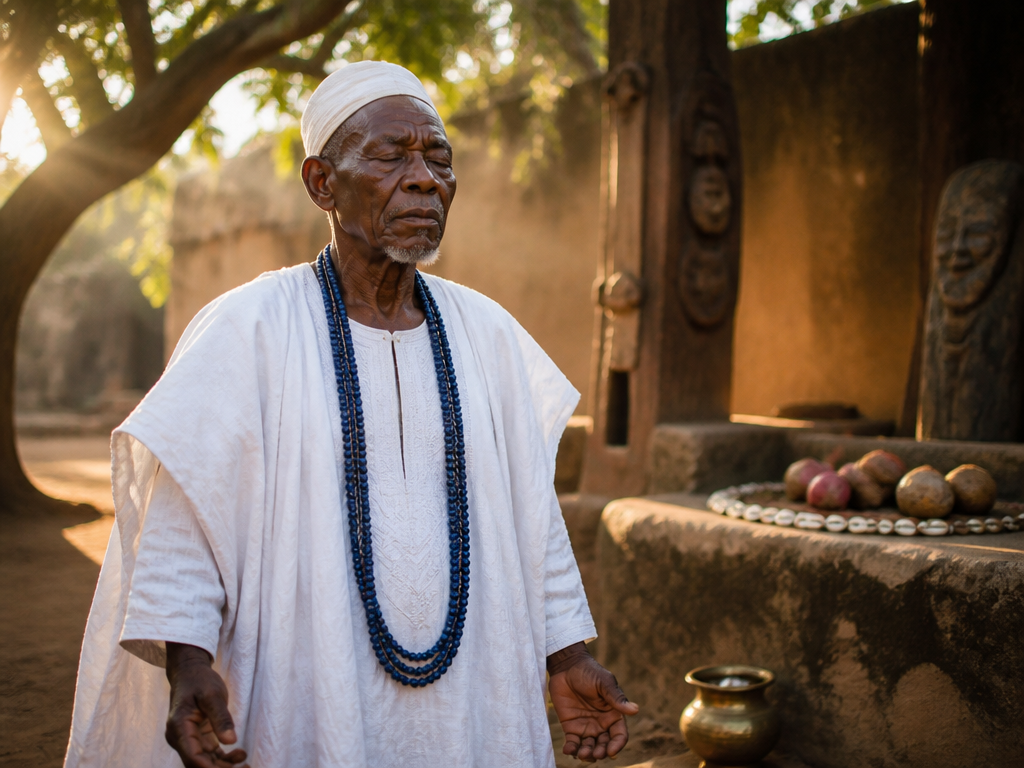
- Babaláwo — "father of secrets", an Ifá diviner, trained over years the way a lawyer is trained.
- Ìṣẹ̀ṣe (ee-SHEH-sheh) — the tradition itself; the name its practitioners now prefer.
- Oríkì — praise poetry that names a person, a lineage or an òrìṣà by their attributes.
- Aládùrà — "owners of prayer", the Yoruba-founded prophetic churches of the twentieth century.
- Ìmàle — a Yoruba Muslim, and the Yoruba word for Islam.
- Lucumí, Candomblé, Orisha — the Cuban, Brazilian and Trinidadian continuations, each a living tradition in its own right.
Side by side

| People and region | What it is | What carried over from òrìṣà practice | Where you hear it | |
|---|---|---|---|---|
| Ìṣẹ̀ṣe | Yoruba of southwestern Nigeria, Benin, Togo | The inherited tradition: Olódùmarè, the òrìṣà, ancestors, Ifá | Everything; this is the source | Ọ̀ṣun-Òṣogbo festival, Ifá consultation, egúngún, ìjálá chant |
| Aládùrà and mainline churches | Same towns, same families, from the 1840s | Christianity, Yoruba-founded from 1918 onward | Drums, oríkì-shaped praise, prophecy and dreams, the diagnosis of affliction | Yoruba gospel, all-night vigils, white-garment congregations |
| Yoruba Islam | Ọ̀yọ́, Ilọrin, Lagos and outward, from the 17th century | Islam practised in Yoruba, with its own scholarly line | Praise-chant form, drum ensembles, festival calendar habits | Wéré, ṣakara, àpàlà, and fújì downstream of them |
| Lucumí, Candomblé, Orisha | Cuba, Brazil, Trinidad, and their own diasporas | Continuations of òrìṣà worship in the Americas | The òrìṣà themselves, by name, with their drums and songs | Batá drumming, Bahian festival, Havana ceremony |
Read the third column across and something odd shows up. In Yorubaland, most families gave up the òrìṣà names and kept the forms. In the Americas, enslaved people kept the names and accepted borrowed forms. Two opposite strategies, roughly the same span of time, both producing something that survived. Neither is a lesser version of the other, and neither is a copy.
The evidence you can check for yourself
You do not have to take any of this on authority. It shows up in three places: the words, the sound, and the shape.
The words. When Samuel Àjàyí Crowther and his colleagues translated the Bible into Yoruba in the middle of the nineteenth century, there was no neutral religious vocabulary waiting for them. Every word they needed — God, prayer, sacrifice, spirit, heaven, place of worship — already existed, and already belonged to òrìṣà practice: Ọlọ́run, àdúrà, ẹbọ, ẹ̀mí, ọ̀run, ojúbọ. So a Yoruba Christian at prayer this morning addressed Ọlọ́run, which is the same name a babaláwo uses. A Yoruba Muslim will move between Allāhu and Ọlọ́hun inside a single sentence without any sense of strain. This is not a hidden survival. It is a translation history, and its consequence is plain: two world faiths are conducted, in Yorubaland, in the theological vocabulary of the older one.
The sound. The hourglass pressure drums — the dùndún family, the gángan under the arm — were built to imitate the tones of Yoruba speech, which is how a drum can be said to talk. They came into church, along with the sẹ̀kẹ̀rẹ̀ gourd rattle and call-and-response leading. More telling than the instruments is the poetic shape they carry. Yoruba praise does not open with a request. It opens with oríkì: you name the one you are addressing by their attributes, at length, piling epithet on epithet until the naming is itself the offering. An ìjálá chanter does that to Ògún. A gospel singer in Ìbàdàn does it to God. The petition, if it comes, comes late.
On the Muslim side, the same instinct produced whole genres. Wéré, also called ajísáàrì, is music sung through the streets to wake households for the pre-dawn meal in Ramadan; Sikiru Ayinde Barrister carried it forward into fújì, and before that ṣakara and àpàlà had come out of Yoruba Muslim neighbourhoods. None of that is smuggled òrìṣà worship. It is Yoruba artistic form, chosen deliberately by intelligent people for content they had decided to keep.
The shape. Prostration in greeting — the full ìdọ̀bálẹ̀, the kneeling ìkúnlẹ̀ — did not stop at the church door. Harvest and new-yam timing survives as thanksgiving. And the deepest continuity is a question rather than a practice. In the older framework, misfortune has an address: illness, childlessness, a business collapsing, a run of accidents are not simply bad luck, and divination exists to find out what is behind it and what may be done. That question did not go away when the address changed. It is exactly what a prophet in a white-garment church is consulted about, and what an alfa is asked in a courtyard in Ilọrin. The answers are new. The urgency is inherited.
Èṣù is not the devil
One piece of the record needs correcting, and it is worth doing calmly, because the error is now a century and a half old and travels under respectable cover.
Èṣù is the òrìṣà of the crossroads and of movement: the messenger who carries offerings and language between the human world and the òrìṣà, the one who tests people, who makes an outcome swing, without whom nothing gets delivered. He is unpredictable and he is essential, and in Ifá practice he is greeted first, because nothing works otherwise.
The nineteenth-century Yoruba Bible used the name Èṣù to translate Satan. It was a translator's decision, not a discovery, and it did what such decisions do: it hardened. Generations of Yoruba Christians have grown up hearing the name of a functioning divinity used as the name of evil itself, and diaspora readers meet the same equation second-hand in horror films that make Èṣù's Caribbean counterparts into something to be afraid of. The scholarly consensus, and the position of practitioners, is straightforward. A figure of ambiguity and testing is not a figure of absolute evil. That equation came in with the printing press.
The Atlantic inversion
Across the water, the arrangement ran the other way, and it is the sharpest comparison this subject offers.
In Cuba and Brazil, enslaved Yoruba people were required to be Catholic. What they kept was the òrìṣà themselves, under their own names — Ṣàngó, Ọ̀ṣun, Yemọja, Ògún, Ọbàtálá — with their drums, their songs and their initiations, and what they laid over the top was a layer of Catholic saints. The pairings differ by island, by city and by house, which is itself instructive: this was never a single codified system handed down, but a set of local arrangements made by people managing surveillance.

And here the traditions genuinely part company. Nigerian Yoruba Christianity kept the forms and gave up the names; Cuban and Brazilian practice kept the names and took on the forms. From the 1970s, some Candomblé houses in Brazil began stripping the Catholic layer back out, on the argument that it had done its work and was no longer needed. In the United States, Òyótúnjí African Village was founded in South Carolina in 1970 as an explicitly Yoruba religious settlement. These are not communities recovering something lost. They are communities editing something they have been holding the whole time.
Which is why the flattest thing you can say about Lucumí or Candomblé is that they are diluted African religion. They are Yoruba tradition as continued by the people who had the hardest job continuing it, and in some respects — the drum repertoire, the initiation grades — they have preserved detail that has thinned at home.
Where scholars disagree
Three live arguments, and it would be dishonest to smooth any of them over.
Ifá and Islamic geomancy. Ifá works from sixteen basic figures, combined into 256 odù. The Arab divinatory science of ʿilm al-raml, sand-writing, also works from sixteen figures, as does Malagasy sikidy. William Bascom, whose 1969 study is still the standard English description of Ifá, treated the resemblance as a historical question worth pressing, given centuries of trans-Saharan traffic. Wande Abimbola and others have argued for indigenous development, pointing out that the mathematical structure is one several cultures could reach independently, and that Ifá's enormous corpus of memorised verse — the actual substance of the practice — has no counterpart in geomancy at all. A third position holds that the borrowing is real but the direction is unrecoverable at this distance. Nobody has closed this.
Are the Aládùrà churches continuity or invention? One reading says they are òrìṣà religion in Christian clothing: prophecy, holy water, spiritual diagnosis, drums, the whole apparatus. The anthropologist J.D.Y. Peel, who studied these churches closely, argued something more subtle and more convincing — that they are genuinely Christian movements which succeeded because they took seriously the same problems òrìṣà practice had always addressed, rather than dismissing them. Continuity of concern, not continuity of content. That distinction does a lot of work.
Were the saint-pairings camouflage or theology? The older reading is camouflage: a mask worn under a hostile church. Later scholarship, and many practitioners, hold that people saw real correspondences and meant them. Both are probably true in different houses and different decades, which is an unsatisfying answer only if you needed a single one.
Where the connection ends
Some differences should not be blurred, however warmly one feels about the overlaps.
Òrìṣà are not saints, and the pairing was never an equation. A saint is a dead human being venerated as an intercessor. An òrìṣà is a divinity with a territory, a priesthood, a drum and a set of obligations running in both directions. The Catholic frame cannot hold that, which is precisely why some houses have set it aside.
A babaláwo is not a pastor with different props. Ifá training runs for years and is chiefly memorisation of verse. It is closer in kind to legal training than to pastoral ministry, and it is not something a talented speaker can improvise into.
Àṣẹ is not the Yoruba amen. Yoruba Christians say àmín. Àṣẹ is a concept about the efficacy of speech — the reason a word said properly by the right person does something. Its migration into diaspora English as a general affirmation is a real and interesting story, and a separate one.
Attending is not converting. The Ọ̀ṣun-Òṣogbo festival each August draws Christians and Muslims in large numbers to the sacred grove, a UNESCO World Heritage site whose sculptures were restored in the twentieth century by the Austrian artist Susanne Wenger, who took the name Àdùnní Olóriṣà and lived there until her death. Being present for the Arugbá's procession to the river is participation in a city's life. It settles nothing about anyone's creed.
Ìṣẹ̀ṣe is not a survival. This is the one that matters most. Practitioners today are not remnants and not folklore; they are contemporaries who never left, they run temples and lineages, and they argue publicly for their standing. Ìṣẹ̀ṣe Day on 20 August has been observed as a state holiday in Ọ̀ṣun and has drawn loud objection elsewhere in Nigeria. Writing about the tradition only as an ingredient in other people's worship is a way of leaving those people out of their own story.
So — is it the same religion?
No. And you can now say precisely why, which is worth more than the yes or the no.
If the question is about vocabulary, form and aesthetic — the drum, the praise-shape, the name of God, the sense that a misfortune has a cause — the continuity is deep and it is not in dispute. If the question is about doctrine and allegiance, the break is real: Yoruba Christians and Muslims are Christians and Muslims, and treating their faith as an unconscious hangover from something else insults their intelligence. And if the question is about how any of this feels from inside a family, it depends on the family. Plenty of households have a Muslim uncle, an Anglican grandmother and a cousin who consults Ifá, and manage to bury their dead together without anybody's theology having to win.
That last arrangement is the part that most surprises readers who arrive through the music. The exclusive question — pick one, name it, defend it — is itself an import. What was here before was a practice you were born into and added to.
Ìṣẹ̀ṣe Làgbà, practitioners say: the tradition is the elder.
The tradition did not survive by hiding. It survived by being the language the new faiths had to borrow.