Tomi Adeyemi, Orïsha, and What the Film News Leaves Out
Children of Blood and Bone is not a story from Yoruba religion. It was never trying to be, and its author has been clearer about that than most of her coverage has.

Children of Blood and Bone is not a story from Yoruba religion. It was never trying to be, and its author has been clearer about that than most of her coverage has.
That is worth putting at the top, because the film news around Paramount's adaptation has no slot for it. Trailer coverage runs on a template: the studio teases footage, the official synopsis gets quoted, the cast stacks up, the crew credits close it out. Nowhere in that template is there a line for here is what this word means in the place it came from. So a reader watches ninety seconds of a kingdom called Orïsha, hears about maji and divîners, sees magic being hunted by a king, and reasonably concludes they have just been shown a window onto something real people believe.
What they have been shown is a novel. A very successful one, written by an American author who read widely, travelled to research it, and then built her own world out of the material she gathered. The distance between those two things is the entire subject here. It is not a complaint about Tomi Adeyemi. It is a distinction that makes both halves better: the fantasy gets to be a fantasy, and the tradition gets described accurately, in the present tense, as something people across southwestern Nigeria, Benin, Cuba, Brazil and Trinidad have never stopped doing.
The rest of this is spent earning that first sentence.
What the film news covers, and what it leaves out
Entertainment coverage of a big adaptation is a genre with fixed furniture. There is the lede about the studio dropping footage. There is the official description, reproduced nearly verbatim because it is the only sanctioned plot summary anyone has. There is the roster — X stars as Y, joined by Z — which does most of the work of persuading you the film is real. There are the crew credits. If the piece has an editorial thought in it, the thought arrives in the final sentence, and it is usually a complication rather than an opinion.
This is not a failure of journalism so much as a description of what a 300-word announcement piece is for. The problem is what happens when the property being announced is built from a vocabulary that belongs to a living tradition. The template passes those words through untranslated. Orïsha, maji, divîner all arrive on the page with the same weight as Hogwarts or Panem — proper nouns you are expected to absorb without asking where they came from.
One of those three words came from somewhere. Òrìṣà is not invented. It is the Yoruba word for the divine beings who stand between people and the creator — figures with names, histories, festivals, and priesthoods that are operating this year, in Nigeria and across the Atlantic. The other two words, maji and divîner, are Adeyemi's. She made them for her book, and the little accents she hung on them are a signal, if you are looking for one.
The result is a strange kind of borrowed authority. The fictional kingdom sounds researched because one of its words is real, and the real word gets quietly reclassified as fantasy furniture because it is standing next to two invented ones. Neither the novel nor the film asked for that swap. The coverage does it by accident, one trailer roundup at a time.
Is Children of Blood and Bone based on Yoruba religion?
No — it is inspired by West African mythology and culture, and Yoruba tradition is the largest single source, but the book's world, magic system, gods and politics are Tomi Adeyemi's invention. Orïsha in the novel is a kingdom. Òrìṣà in Yoruba tradition are divine beings, not a place. The novel's magic is inherited at birth and sorted into ten clans; Yoruba practice is organised around lineage, divination, initiation and relationship, and is not a power set. Some deity names in the book will be familiar to anyone who knows the tradition. The system they sit inside is not.
That answer holds in both directions, which is why it is useful rather than pedantic. Nothing in the novel is a claim about how anyone worships. Nothing in the trailer is a depiction of a real ceremony. If you go looking for Yoruba religion in the film, you will find a fantasy epic wearing a few of its names. If you go looking for the fantasy epic in Yoruba religion, you will find several thousand years of a different project entirely.
The two dots over the i
Orïsha, in the novel, carries a diaeresis — those two dots. Yoruba writing uses tone marks and a dot under certain letters: òrìṣà, with the accents indicating pitch and the mark under the s giving it a sh sound. The two spellings are not variants of each other. One is an orthography; the other is a design choice.
Same with divîner and its circumflex, a mark Yoruba does not use. Fantasy has done this forever — the slightly-wrong accent is shorthand for this place is not your place. Adeyemi is doing what Tolkien did with Elvish and Frank Herbert did with Arabic: taking real linguistic material, bending it, and letting the bend do the world-building.

It is a small thing that tells you something reliable. Where the book's spelling matches the tradition's spelling, you are usually looking at a name that came from outside the book. Where it wobbles, you are looking at the author's own architecture. The trailers keep the wobble. Almost nobody covering them mentions that it is there on purpose.
Who the òrìṣà actually are, in plain language
Among the Yoruba of southwestern Nigeria and parts of Benin and Togo, the universe has a creator, Olódùmarè (oh-loh-doo-MAH-ray), who is not approached directly. Between people and that creator stand the òrìṣà (oh-REE-shah) — divine beings, each with a domain, a character, a history, and a body of praise poetry. They are not a pantheon in the Greek sense, ranked and tidy. They are more like an enormous extended relationship: some are honoured continent-wide, some belong to a single town or river, some to one family line.
A few names a reader may have met without knowing where they came from:
Ṣàngó (SHAN-go), associated with thunder, lightning, and a king of the old Ọ̀yọ́ empire. Ọya (OH-yah), of wind, storm and abrupt change, tied to the Niger River. Ọ̀ṣun (OH-shoon), of fresh water, tied to the Osun river in Nigeria, whose sacred grove at Òṣogbo is a UNESCO World Heritage Site and whose festival fills that town every August. Ògún (oh-GOON), of iron, tools, roads and the work done with them. Yemọja (yeh-MO-jah), associated with waters and motherhood, who crossed the Atlantic and became Yemanjá in Brazil.
The system's spine is Ifá, a divination practice in which a trained diviner — a babaláwo, literally father of secrets — consults a vast memorised corpus of verses to read a client's situation. Ifá is not fortune-telling and it is not a spell. It is closer to consultation: a structured way of asking what a circumstance is and what obligation it carries. UNESCO lists it as intangible cultural heritage. It is practised now, this week, by people with phones.
And it did not stay in one place. Enslaved Yoruba people carried these traditions across the Atlantic, where they survived under pressure and took new shapes: Candomblé in Bahia, Brazil; Lucumí, often called Santería, in Cuba; the Orisha tradition of Trinidad. Those are living religions with congregations, calendars, and clergy — not folklore, and not a chapter that closed.
Where the novel borrows, and where it turns off
The borrowing is real and it is mostly at the level of names and atmosphere. Adeyemi's Orïsha has deities, several of whom carry names a reader might recognise; her ten maji clans are each attached to one of them, and each clan controls a slice of the world — death, fire, water, iron, mind, sight. Her heroine Zélie is a Reaper, which means her magic touches death, which means her clan answers to Oya. There is a creator figure the book calls Sky Mother, who is Adeyemi's.
Here is the turn. In the novel, magic is a birthright with a visible tell — white hair — that makes its bearers identifiable, hunted, and either powerful or powerless depending on whether the gods are reachable. It is a capacity. Take it away and a person is diminished; give it back and they can fight.
That is a superb engine for a fantasy trilogy and it is not how the tradition works. Yoruba practice is not a power distributed at birth to some people and denied to others. It is participation: lineage, apprenticeship, divination, initiation where initiation applies, obligation to a community and to the dead. A babaláwo spends years memorising verses. A devotee's relationship with a particular òrìṣà is a relationship, with duties running in both directions, not an ability that can be switched off by a king's decree. The word àṣẹ (AH-shay) is sometimes translated as power, which is where a lot of confusion starts; it is closer to the force that makes things come to pass — the quality that makes a word or an act effective. It is not a mana bar.
So the novel keeps a handful of names and replaces the architecture underneath them. That is what fantasy does. It is only a problem when nobody says it out loud.
The book was never really about magic
Adeyemi has said, repeatedly and in the book's own author's note, what she was writing about: state violence against Black people in America. She has described watching news footage of unarmed Black people killed by police and wanting to write something a reader would feel rather than argue with. The maji are hunted, marked, and legally disposable. Their magic is stolen. The story is about getting it back.
Once you know that, the departures stop looking careless and start looking structural. A story about a people who can be identified on sight and stripped of something inherent needs magic to be inherent. A relationship-based, initiation-based, community-based tradition does not give you that plot. Adeyemi needed the first, so she built the first.
This is the part that entertainment coverage almost never carries, and it is the part that answers the question readers are actually asking when they ask whether the book is authentic. The book is authentic to what it is about. What it is about is Los Angeles and Ferguson at least as much as Ọ̀yọ́.
Èṣù is not the devil, and the trailer has nothing to do with it
A related error will surface in the comments under every trailer, so it is worth handling calmly.

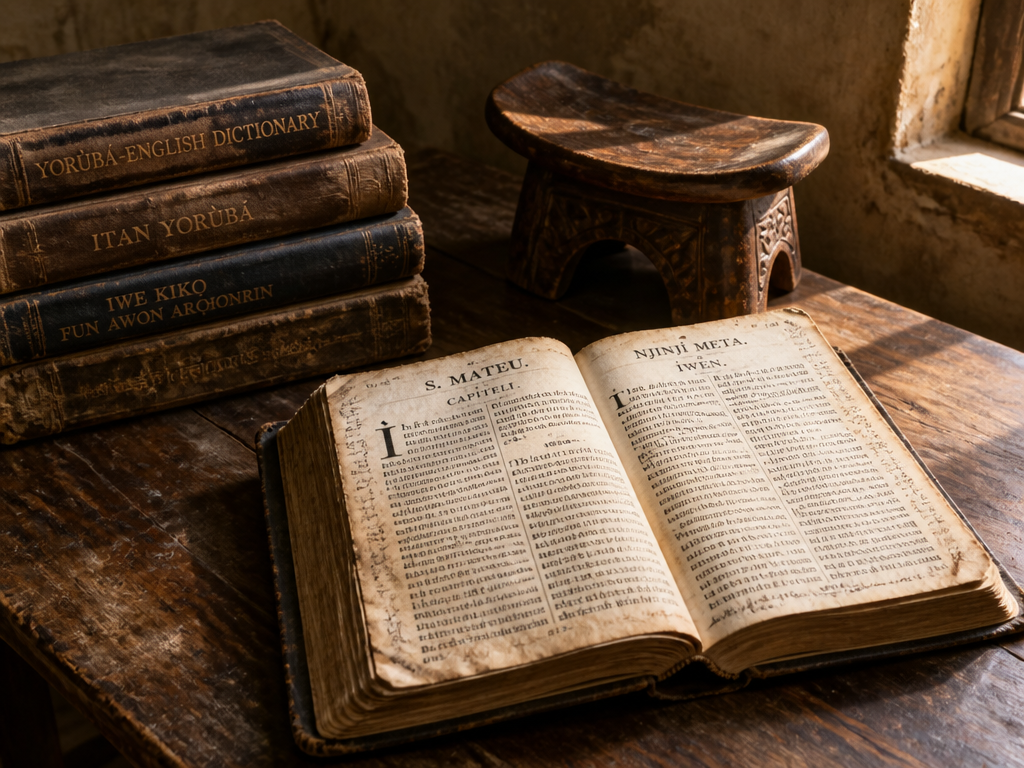
Èṣù (EH-shoo) is the òrìṣà of the crossroads: the one who carries messages between people and the divine, who tests, who opens or blocks the way. In the nineteenth century, when the Bible was translated into Yoruba, Èṣù was the word chosen for Satan. That single translation decision, repeated across generations of printed scripture and preaching, welded a messenger and a boundary-keeper onto a Christian adversary who has nothing to do with him. The association stuck so hard that it now travels back into English-language pop culture as fact.
It is a translation artefact, not a description. Èṣù is not evil, does not rule a hell, and is not opposed to a good deity. In the diaspora he appears as Eleguá in Cuba and Exu in Brazil, and the same mislabelling followed him there.
None of this is in the film. That is precisely the point: the film is not making a claim about Èṣù, and any reader who leaves the trailer thinking they have learned something about him has learned it from somewhere else.
Names and terms
From Yoruba tradition (real):
- Òrìṣà — divine beings between humanity and the creator, each with a domain and a following.
- Olódùmarè — the creator, not approached directly.
- Ifá — a divination practice with a memorised verse corpus, consulted for guidance.
- Babaláwo — a trained Ifá diviner; the word means father of secrets.
- Àṣẹ — the quality that makes a word or act effective; often loosely rendered as power.
- Candomblé / Lucumí / Orisha tradition — living Yoruba-descended religions in Brazil, Cuba and Trinidad.
From the novel (invented):
- Orïsha — the kingdom the story takes place in.
- Maji — people born with magic in that kingdom.
- Divîner — a maji whose magic has not woken.
- Sky Mother — the novel's creator figure.
- The ten clans — the book's magic classification; a fantasy system, not a religious structure.
The same deity, four coasts
One reason online arguments about spelling go nowhere: these names legitimately change shape depending on where the tradition landed. None of these is a corruption of the others.
| Yoruba (Nigeria) | Cuba (Lucumí) | Brazil (Candomblé) | Domain, in brief |
|---|---|---|---|
| Ṣàngó | Changó | Xangô | Thunder, lightning, justice |
| Ọ̀ṣun | Ochún | Oxum | Fresh water, rivers |
| Ọya | Oyá | Iansã | Wind, storm, sudden change |
| Ògún | Ogún | Ogum | Iron, tools, roads |
| Èṣù | Eleguá | Exu | Crossroads, messages, openings |
Versions differ on the details behind every one of these, by region, by lineage, and by who is telling it. That variation is normal in an oral tradition and it is not a sign that anybody has it wrong.
What Adeyemi's distance from the adaptation is, and isn't
In posts on TikTok that she later deleted, Adeyemi said she would no longer promote the adaptation of her work. She did not give a detailed reason, and no fuller public statement has followed. Marketing has continued on schedule; the trailer went out, the roster went out, the coverage ran the template.
That is the whole verifiable shape of it, and it is worth resisting the urge to fill in the rest. Authors part ways with adaptations for reasons ranging from creative disagreement to contract terms to exhaustion, and most of those reasons never become public. The one thing her distance does not automatically indicate is a dispute about cultural accuracy. Readers have assumed that, because it is the tension the story invites, but nothing on the record says so.
What it does mean, practically, is that the film now speaks for itself. When the trailer says Orïsha, there is no author on the promotional trail to explain what that word is doing.
What to watch for when the next trailer drops
Watch what the film does with hair, since the white hair of the maji is the book's central visual marker and the clearest sign the film is committed to the novel's own logic rather than to anything documentary.
Watch the ceremonies, if there are any. If the film stages something that looks like ritual, it is a designed sequence built for a fictional kingdom. Real Yoruba ceremony belongs to lineages and initiates and is not the sort of thing a production department reproduces.
And watch the language of the coverage rather than the coverage itself. Inspired by and based on do very different work, and in the film news around this adaptation they get used interchangeably.
There is a Yoruba saying, ìwà l'ẹwà — character is beauty. It is a fair description of what the tradition is actually preoccupied with: conduct, obligation, what you owe the living and the dead. That is a harder thing to put in a trailer than a hunted girl with a staff, which is exactly why the two projects were never the same project.
The myth is that Children of Blood and Bone opens a door onto Yoruba religion, and that watching the film will show you what a continent's people believe. The truer version is that it opens a door onto a novel about American police violence, built by an author who borrowed a few real names and invented everything holding them up — and the religion is still out there, in Òṣogbo and Havana and Bahia, going on without the cameras.