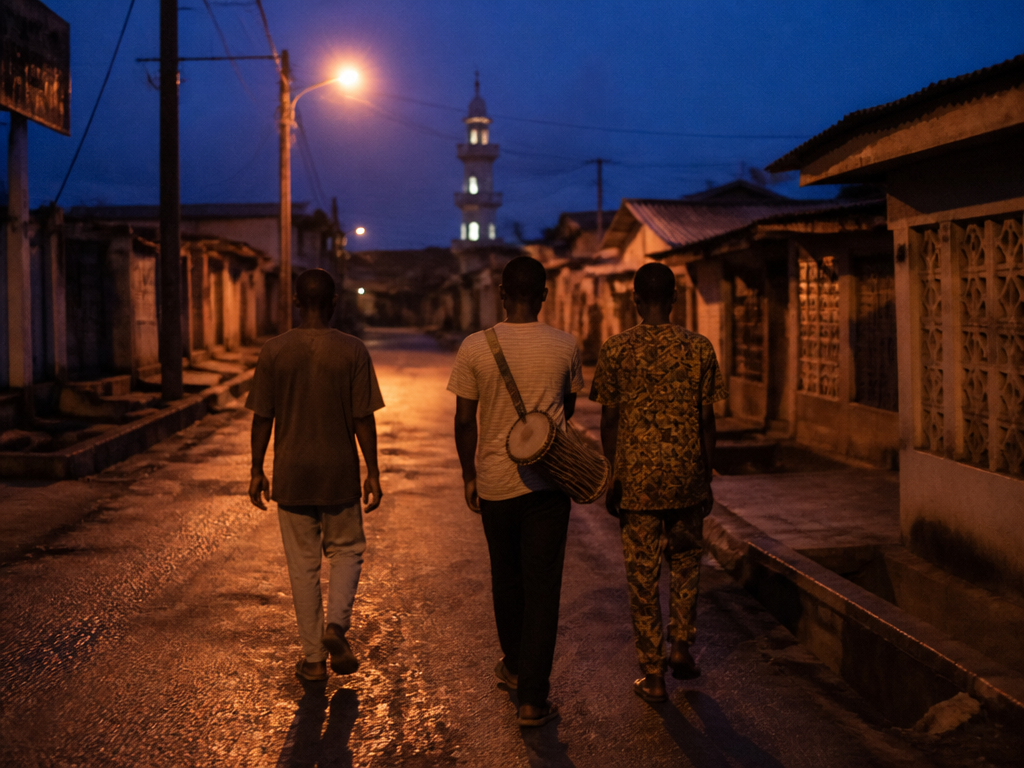
The Character Arc and Orisha: What Film Adaptation Changes
There is a question asked in every story meeting, every workshop, every notes call: what does she want, and who is she by the end? It sounds like common sense.

There is a question asked in every story meeting, every workshop, every notes call: what does she want, and who is she by the end? It sounds like common sense. It is a fairly young idea, and it travels badly. With a film adaptation of Tomi Adeyemi's Children of Blood and Bone headed for cinemas — a novel that builds its world out of Yoruba names and Yoruba powers — that question is about to be put to material that answers it in another language entirely.
Adeyemi's book is her own invention. She is a Nigerian-American novelist working with a tradition, not transcribing it. But the tradition she reaches for is real, and it is not finished: Yoruba religious practice continues today in Nigeria and Benin, and in Brazil, Cuba, Trinidad and the United States, where it travelled with enslaved people and kept going under other names. In that tradition, the thing English calls character does not behave the way a screenwriting manual expects.
What is a character development arc?
A character development arc is the change a story requires of its main character between the first page and the last: a flaw named early, pressed on in the middle, and either mended or fatal at the end. In commercial screenwriting it is treated as a requirement rather than an option — a protagonist who ends where she began is called flat, and flat is a note you have to fix. Novelists inherit the same expectation, usually from the same handful of books.
That requirement is worth looking at directly, because it is the single strongest force acting on any traditional story that gets adapted for the screen.
The belief has a paper trail
It starts, as these things do, with a misread. Aristotle's Poetics is the usual authority cited, but Aristotle ranked plot first and character second; tragedy, he wrote, is an imitation of an action. Character was what actions revealed, not the thing being renovated.
The modern shape arrives in 1946, when the Hungarian playwright Lajos Egri published The Art of Dramatic Writing and argued the reverse: character drives plot, and a character who does not grow has no business on a stage. Three years later Joseph Campbell published The Hero with a Thousand Faces, gathering myths from many peoples into one repeating pattern he called the monomyth — departure, ordeal, return.
The leap from library to industry was made by one person. In the mid-1980s a Disney story analyst named Christopher Vogler wrote a short internal memo summarising Campbell for working screenwriters. It circulated, then became a book, The Writer's Journey, in 1992. Around it sat Syd Field's Screenplay (1979), with its three acts and its plot points; then Robert McKee's Story (1997); then Blake Snyder's Save the Cat (2005), which put the change on a numbered beat sheet.
That is the whole lineage: a Hungarian playwright, a comparative mythologist, a studio memo, and three paperbacks. Within about twenty-five years it hardened from a way of seeing into a rule that development executives enforce.
The source is thinner than the belief
Here is the part worth knowing before the next adaptation arrives. Campbell's book does contain African material — a handful of tales, a Bushman story, fragments from East Africa. They are fragments, and they come almost entirely from nineteenth- and early twentieth-century colonial collections: material written down by missionaries and administrators, in translation, often without the teller's name, certainly without the audience, the season, the drumming, or the interruptions that make a performance mean what it means.
So the pattern was assembled from summaries. That is not a scandal — Campbell was doing comparison, and comparison always flattens. The trouble is what happened downstream, when a comparative lens was sold as a universal law, and the law was applied back onto the very traditions whose stories had been thinned to build it. Vogler himself has said his stages are flexible, that they can be reordered or dropped. Almost nobody quoting him passes that part along.
Three heroes, three kinds of movement
Take three African epics and watch what actually moves.
Among the Mande peoples of Mali and Guinea, the epic of Sunjata Keita is performed by jeliw — hereditary bards, often called griots in French. Sunjata is born unable to walk. In the best-known telling he rises, taking hold of an iron bar that bends under him, and goes on to found an empire. That looks like an arc, and it is a magnificent one, but the story does not treat it as self-improvement. His greatness was spoken over him before his birth. What changes is not Sunjata's interior; it is the arrival of a destiny into the world. Versions differ considerably from one jeli to another — the bar, the plant he pulls up, the words his mother says — and the tradition treats that variation as normal, not as error.

Among the Akan of Ghana, Anansi the spider (ah-NAN-see) does not develop at all. In one telling he buys the world's stories from Nyame, the sky god, by trapping creatures nobody could trap. In others he cheats his family, is caught, and is undignified again the following week. He is greedy at the start and greedy at the end. The learning happens in the room: the children listening watch consequence land on someone who never learns, which is a more durable lesson than watching a hero improve.
Among the Nyanga of the Democratic Republic of the Congo, the epic of Mwindo — recorded in 1956 from the performer Shé-kárisi Rureke — does contain something like transformation. Mwindo is born extraordinary, wins everything, overreaches, and is humbled by the beings of the sky. He comes home a chief who knows his limits. But the change is not psychological and private. It is public, and it is about what a ruler owes people.
| Tradition | Hero | What actually moves |
|---|---|---|
| Mande (Mali, Guinea) | Sunjata Keita | A foretold destiny arrives; the hero grows into it |
| Akan (Ghana) | Anansi | Nothing in him — consequence lands on the listener instead |
| Nyanga (DR Congo) | Mwindo | Pride broken and repaired, in public, as a lesson in rule |
Three traditions, three answers, none of them the beat sheet.
Ìwà: the word English turns into "character"
Yoruba thought has a word for character: ìwà (ee-WAH). It covers conduct, disposition, the grain of a person. And there is a proverb the Yoruba say plainly — ìwà l'ẹwà, character is beauty. So the concept exists, and it is central.
What sits underneath it is orí (oh-REE), the inner head: a person's destiny, in one account chosen by the person before birth and then forgotten. Ifá divination (ee-FAH), performed by a babaláwo, consults a vast body of verses called the odù to read where someone stands in relation to that destiny. This is living practice, not folklore; people go to a diviner this week.
Notice what the arc has to do to this. A screenplay wants a want, a flaw, and a corrected version of the person. Ifá is not asking what is wrong with you and how you might fix it by act three. It is asking what you already are, and how you might come into alignment with it. Those are different stories. One ends in repair; the other ends in recognition. A screen adaptation that only knows the first shape will quietly rewrite the second into it, and call the result faithful.
Why Èṣù is not a villain with a backstory
Èṣù (EH-shoo) stands at the crossroads. He carries messages between people and the orisha, opens and closes the way, and tests people — sometimes uncomfortably. When nineteenth-century missionaries translated the Bible into Yoruba, they used his name to render Satan. That single editorial decision is why Èṣù still turns up in films as a devil, and it is simply wrong: a messenger who enforces reciprocity is not an adversary of God.
The adaptation-era version of the same mistake is gentler and harder to see. It gives him a wound. It makes his mischief the symptom of an injury, so the audience can forgive him by the end. That is the arc doing its work — converting a principle of the universe into a person with a therapeutic problem. It flatters the format and loses the idea.
Names and terms
- Orisha — the deities and forces of Yoruba tradition, each with a domain and a character.
- Èṣù — messenger and keeper of the crossroads; not a devil.
- Orí — the inner head; a person's destiny.
- Ìwà — character, in the moral and personal sense.
- Ifá — the Yoruba divination system; odù, its body of verses; babaláwo, the diviner trained in them.
- Jeli (plural jeliw) — Mande hereditary bard and keeper of history.
- Anansesem — the Akan word for the Anansi stories; literally, spider words.
When I draft a piece for this site now, I write the tradition's own account of how a person becomes good before I write a single line about what any figure in it wants. It changed the work more than I expected: a profile of Ọya that had gone three drafts came apart entirely once I stopped looking for her reason and started describing what she is for. The file still opens with the same line at the top, where I can see it. Ìwà l'ẹwà. Character is beauty — the having of it, not the arc of it.