African Mythology in Fiction: How the Story Reaches the Page
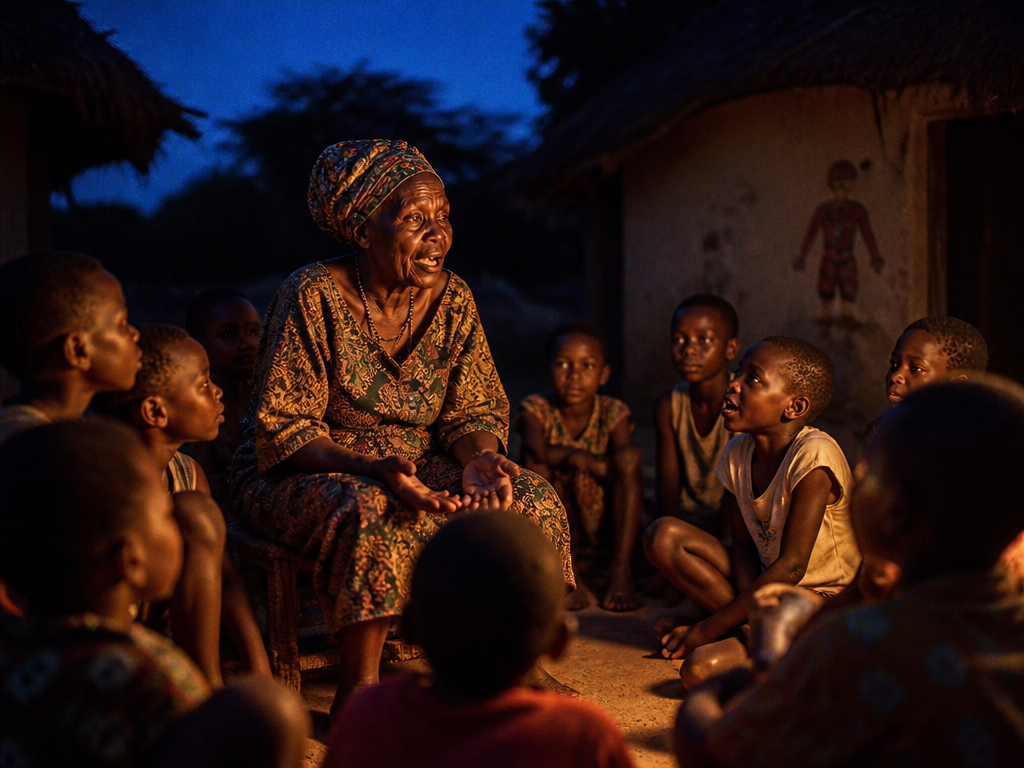
In a Yoruba household, a story does not start on its own. The teller calls out "Àlọ́ o" — roughly, a tale — and the room has to answer "Àlọ́" before anything happens.

In a Yoruba household, a story does not start on its own. The teller calls out "Àlọ́ o" — roughly, a tale — and the room has to answer "Àlọ́" before anything happens. If nobody answers, there is no story. Among Hausa tellers in northern Nigeria and Niger, a tatsuniya opens the same way in a different language: the teller offers the tale, and the listeners have to say, in effect, let it come, let us hear it.
That is the first thing to know about African mythology on the page. Before it was ever a page, it was an appointment between people who could see each other. Everything that happens to the story afterwards — the transcription, the printing, the reading on a train in Atlanta or Peckham — happens to something that began as an event, and each stage takes something and adds something. It is worth following that chain in order, because most arguments about whether a novel gets the tradition "right" are really arguments about one link in it.
Step one: the story is an occasion, and the variation is the design
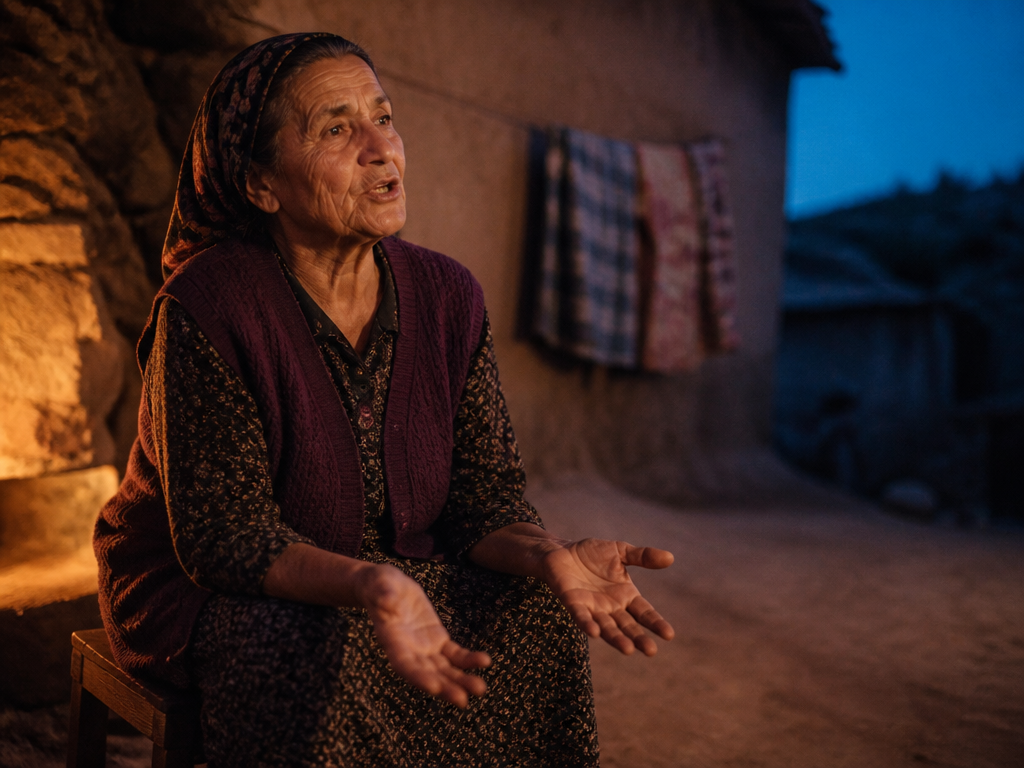
A telling has a teller, a night, a room, and a reason. Someone is being warned. A child is being teased. An elder is settling a point without naming anyone. The teller reads the room and adjusts — lengthens the funny part, drops the part that would embarrass the family sitting nearest the door.
So the same story exists in dozens of shapes, and this is not a corruption of an original. It is how the form works. When two versions of a tale disagree about which animal cheated first, the disagreement carries information: about the village, the lineage, the year. Flatten them into one authorised text and you have not cleaned up the story, you have deleted its address.
| People and place | What the telling is called | How it works |
|---|---|---|
| Yoruba (Nigeria, Benin) | àlọ́ | Teller calls; the room must answer before the tale may begin |
| Hausa (northern Nigeria, Niger) | tatsuniya | Teller offers the tale; listeners answer that it should come |
| Akan (Ghana, Côte d'Ivoire) | Anansesɛm, "Ananse stories" | Framed as spider-stories; a closing formula hands the tale back |
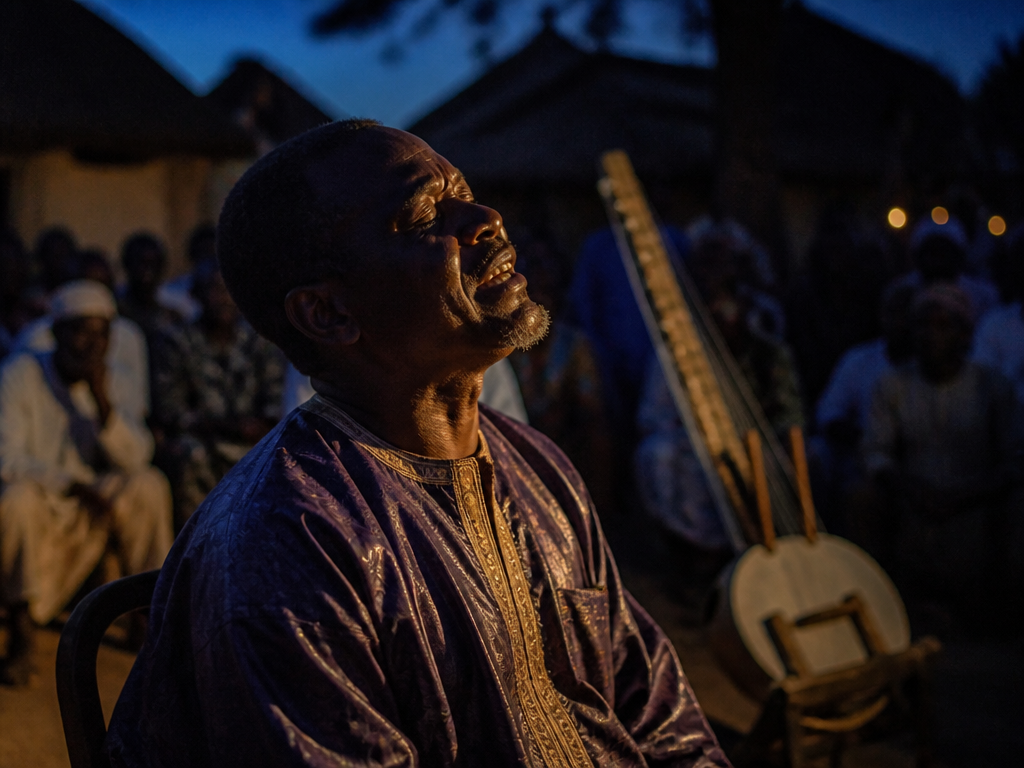
| Mande (Mali, Guinea, the Gambia) | the jeli's telling | A hereditary professional performs, often to kora, ngoni, or balafon |
Step two: someone writes it down
In 1960 the Guinean historian D.T. Niane published the epic of Sunjata Keita, founder of the Mali Empire, as a book. He had it from Mamadou Kouyaté, a jeli — a hereditary keeper of history, genealogy, and speech among the Mande. The book that most of the world now reads as the Sundiata epic is one performance, by one man, from one lineage, in one week.
What print keeps is real: the sequence, the names, the shape of the argument, and the fact that it now survives a drought, a war, and a funeral. What print cannot carry is the rest of the occasion — the audience answering back, the instrument under the words, the teller's decision to slow down because someone in the third row had just lost a brother. And print does one thing nobody intends: it promotes a single version to the status of the version, simply by being the one you can buy.
One correction while we are here. "Griot" is a French-era borrowing, and it has picked up a whiff of the wandering minstrel. The Mande words are jeli and jali, and the job is closer to state archivist and diplomat than to busker: a professional in a named family — Kouyaté, Diabaté, Kanté — carrying genealogies that settle real questions about land and succession.
Is African mythology the same as folklore?
No, and the line between the two words is mostly a European filing habit rather than anything in the material. In nineteenth-century scholarship, Greek and Norse sacred stories were catalogued as mythology, and everybody else's as folklore, legend, or worse. Same kind of story, different shelf, and the shelf carried a judgement.
There is also a live distinction that matters more. Some of this material is story: a creation account you can retell at a table and enjoy as narrative. Some of it is working knowledge for people alive right now. The odù of Ifá, the verse corpus a babaláwo or ìyánífá memorises, is not folklore to the person who consults them on a Tuesday about a family decision — it is a functioning body of thought about cause, consequence, and obligation. A novel that treats the second kind as though it were the first tends to feel thin to readers who know the difference, even when every name is spelled correctly.
Step three: the book gets framed for a stranger
Now the manuscript meets a publisher, and the questions start. Italicise the Igbo? Add a glossary? Have a character explain, mid-scene, what the masquerade is?
These are not neutral typographic choices. A glossary at the back is a courtesy — a reader can use it or ignore it. A definition dropped into the middle of a scene is something else: it tells you who the scene is for. When a character stops to explain her own grandmother's proverb, she is not talking to her cousin. She is talking over her cousin's shoulder to someone in another country.
The framing can also happen entirely outside the book. Amos Tutuola's The Palm-Wine Drinkard came out in London in 1952, built from Yoruba story-material in an English shaped by Yoruba syntax. British reviewers took it up as a marvel of untutored naturalness; a number of Nigerian critics were mortified, reading the same sentences as a Nigerian writer being praised for not writing standard English. One book, two framings, and the author controlled neither.
Writers have answered this in different ways. Chinua Achebe argued for an English "altered to carry the weight" of African experience, and wrote proverbs into Things Fall Apart that take their meaning from the scene around them rather than from a footnote. Ngũgĩ wa Thiong'o eventually stopped negotiating and left, writing in Gĩkũyũ and arguing the case in Decolonising the Mind. Both are answers to the same question: who is standing at the counter when this book is sold.
Step four: two readers open the same page
This is the step the whole chain has been building toward, and it is the one that decides whether a book feels authentic.
A sentence like the mask came out lands twice. To one reader it is an image, slightly eerie, requiring a note. To another it is a memory with a smell attached, and the note would be an insult. Ben Okri's The Famished Road opens with a narrator who is an abiku, a spirit-child who keeps returning; Akwaeke Emezi's Freshwater is built from the Igbo understanding of the ọgbanje. Neither book pauses to reassure you. Nnedi Okorafor and Tomi Adeyemi write worlds where Igbo and Yoruba frames are simply the physics, not the twist.
That is what readers usually mean when they say a book reflects them rather than explains them. It is not about accuracy of detail — a well-researched novel can be accurate and still feel like a tour. It is about where the camera stands.
Step five: the page goes back into the room
The chain does not end at the reader, which is the part most accounts leave out. Printed books re-enter oral circulation. A teenager in Kumasi or Kingston reads a novel that takes their grandmother's material seriously, and goes and asks the grandmother a question they had never thought to ask. Teachers set the book. Someone records the answer on a phone.
Amadou Hampâté Bâ of Mali put the stakes plainly at UNESCO in 1960: when an old man dies, a library burns. The Akan have a word for the response — sankofa, going back to fetch what was left behind. The loop from room to page and back is not nostalgia. It is how a tradition keeps a copy.
Names and terms
- Àlọ́ (AH-law) — a Yoruba tale, and the call that opens one.
- Tatsuniya — a Hausa folktale, told in a set exchange between teller and listeners.
- Anansesɛm — Akan "spider stories", the cycle around Ananse the trickster.
- Jeli / jali — a Mande hereditary specialist in history, genealogy, and speech; "griot" is the French-era word for the same role.
- Odù — the verse corpus of Ifá, memorised by its diviners and consulted in the present tense.
- Àbíkú (Yoruba) / ọgbanje (Igbo) — a child understood to be born, die young, and return to the same mother.
- Sankofa — an Akan symbol and proverb: it is not taboo to go back and fetch what you forgot.
Akan tellers have a formula for handing a story on at the end: this is my story; if it was sweet, or if it was not sweet, take some and let the rest come back to me. Tonight, use that as your test on whatever you are reading — when the first unfamiliar name arrives, notice whether the sentence stops to explain it to a stranger or keeps moving and trusts you to catch up, because the first is a tour and the second is a book that already thinks you live there.