Fatoumata Keïta
One of the storytelling voices behind African Belief — every piece below carries their name because it was researched, framed, and checked in their voice.
Pieces by Fatoumata
Children of Blood and Bone: What a Film Adaptation Can Carry
Ask a babaláwo how many òrìṣà (or-EE-shah) there are and you may get a number, then a correction, then a pause that means that is not really the question.
Children of Blood and Bone Film Adaptation: The Yoruba Craft Behind Orïsha
The first studio-released look behind the scenes on Children of Blood and Bone spends a surprising amount of its short running time on fabric.
The Negative Father Archetype in African Myth: Mwindo and Yennenga
Twelve days. That is how long it took a Nyanga bard named Shé-Kárisi Candi Rureke, in 1956, to get through the story of Mwindo — twelve days of chanting and narrating and acting out the parts, with an…
Enkai: Maasai God of Rain, Cattle, and the Two-Coloured Sky
The sentence arrives early in almost every guidebook, documentary voice-over and travel blog: Enkai gave the Maasai all the cattle on earth, so every cow in the world is really theirs.
Who Is Nyame? The Akan Sky God Who Owns the Stories
On the rear window of a trotro in Accra, in gold leaf on a coffin lid in Kumasi, on a pendant at the end of a chain in Brooklyn — the same shape keeps turning up. Two curled arms, one upright stem.
Electronic Music Production and the Orisha: Three Ways a Sacred Sound Ends Up in a Track
You have met the word already, probably without being told what it was. Orisha, or Orixá, or Òrìs̀à with the tone marks left in, sitting in an artist name, a track title, a label's catalogue.
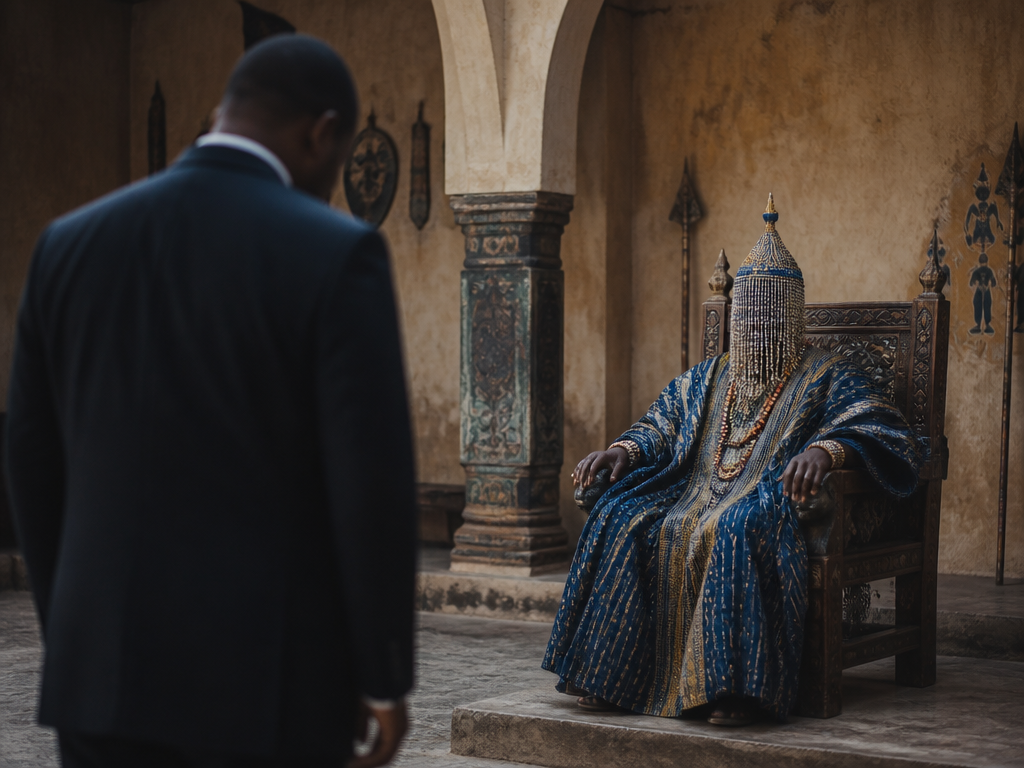
Oba, Emir, and Ballot Box: Traditional Authority in Contemporary Nigerian Politics
The convoy stops before the ballot does. In the months before a Nigerian general election, a candidate's motorcade turns off a highway in Ile-Ife, or Sokoto, or a town in Anambra State, and the…