Queen's Club and the Real Story of Grass-Court Tennis in 2025
The myth arrives in the opening paragraph of almost every preview piece written before a Queen's Club final week. Grass-court tennis, the reader is told, is a throwback.

The myth arrives in the opening paragraph of almost every preview piece written before a Queen's Club final week. Grass-court tennis, the reader is told, is a throwback. A reminder of a time when men in white trousers chased down serve-and-volley points on slick turf that rewarded a single bold rush to net. Tennis purists sigh over it. Casual fans mostly ignore it. The Queen's Club tournament, for decades, carried that baggage into every June — the sport's most elegant anachronism.
The problem with the myth is that it stopped being true about fifteen years ago, and the 2025 Queen's Club tournament just proved it again.
What the myth actually looks like
If you closed your eyes and pictured grass-court tennis — the old version, the one that sticks in the collective memory — you probably see a server charging forward behind a slice out wide, then cutting off a weak return with a half-volley at the service line. Points end in three or four shots. The grass is so fast that rallies are a luxury the surface does not permit. This is the Wimbledon of your grandfather's imagination, and it is also the Queen's Club that newspaper columnists have been romanticising for decades.
There is a reason the myth persists: it was once largely true. Before the 2000s, grass at Queen's played genuinely fast. The ball skidded low. Holding serve was the dependable outcome, and breaking serve required a perfect return or a net-cord. The tournament produced champions like Pete Sampras, Boris Becker, and John McEnroe — players whose grass-court games were built around the heavy serve and the forward rush. If you could volley, you could win at Queen's. If you could not, you went home early.
What actually happened at Queen's 2025
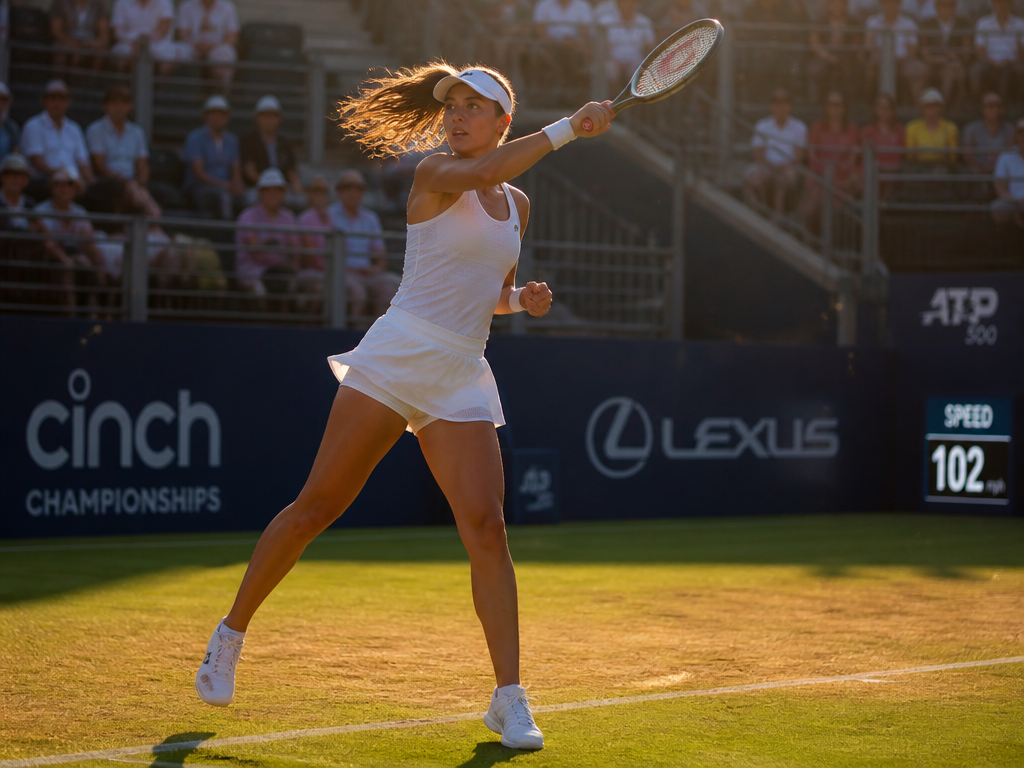
The 2025 edition of the Queen's Club championships — officially the Cinch Championships — offered a different picture. Watch the tape of any of the men's quarterfinal matches and you will see extended baseline exchanges, defensive lobs retrieved near the back fence, and passing shots struck from five metres behind the baseline. The serve remains important, because it is important on every surface, but it is no longer the entire story.
Emma Raducanu's participation in the women's event — a newer addition to the Queen's schedule — made the shift even plainer. Raducanu's game is built around flat groundstrokes and early-ball striking, not serve-and-volley. She won matches at Queen's by doing what she does on hard courts: stepping into the court, taking the ball on the rise, and redirecting pace. The grass did not force her to change. It accommodated her.
This is not an anomaly. The 2025 Queen's final between two players ranked inside the top twenty featured rallies of twelve, fifteen, even eighteen shots. The statisticians tracking the event noted that the average rally length on grass at Queen's has climbed steadily over the last decade. It now sits close to the average on slow hard courts. The surface did not suddenly become clay. But it stopped being the lightning-fast carpet of lore.
Why the surface changed
The shift is mechanical, not romantic. Three things happened.

First, the grass itself changed. The rye-grass sward used at Queen's — and at Wimbledon — is a denser, more durable blend than the grass used in the 1990s. It holds up better under repeated wear, which means the baseline areas stay truer for longer. A court that wears evenly plays slower than a court where the grass has been scuffed away to bare dirt. The old Queen's courts turned into a dirt-and-slick combination by the second day of play. Modern Queen's courts remain relatively consistent through a full week of tennis.
Second, the balls changed. The tennis ball used at Queen's is marginally heavier and slower than the balls used twenty years ago. The International Tennis Federation has standards for ball weight and bounce, and the approved balls now sit at the slower end of the permitted range. This was deliberate. The sport's governing bodies wanted to preserve rally play on grass, not eliminate it.
Third, and most significant, the rackets changed. Modern string technology — polyester strings in particular — allows players to generate spin that was impossible with the natural-gut stringing of the 1990s. Heavy topspin grabs the grass and slows the ball down after the bounce. A return that would have skidded through at ankle height in 1995 now bites into the surface and rises to waist height. The server's advantage collapses at precisely that moment. The returner can now take the ball above the net and drive it.
These three changes compound. Denser grass plus slower balls plus heavier spin equals a surface that plays medium-fast, not lightning-fast. The serve-and-volley player does not disappear — there will always be a place for the net rusher — but the advantage is no longer decisive enough to overcome a weak return game.
The honest takeaway
The myth of grass-court tennis as a quaint oddity is comfortable. It gives the casual sports news consumer a tidy hook: here is the old surface, the historic club, the throwback tournament. It makes for easy copy. But it sells the sport short.
What Queen's Club actually offers in 2025 is a surface that asks a slightly different question than hard courts or clay. The ball still skids a little more. The bounce is still lower. The timing window for groundstrokes is still narrower. But the player who wins at Queen's is not the one who can volley best. It is the one who can adjust fastest — who reads the lower bounce, who generates enough spin to control the ball on a surface that offers less friction, who trusts their baseline game on a court where the old instincts say to charge forward.
The 2025 tournament produced champions who had never won a grass-court title before. They did not reinvent their games. They brought the same athletic versatility that wins on hard courts and clay, and the grass did not punish them for it. That is the real story.
The final contrast
The myth: grass-court tennis is a relic that rewards a single style from a lost era.
The truth: grass-court tennis in 2025 rewards exactly what every other surface rewards — the player who sees the ball earlier, moves better, and wins the same rallies that decide matches everywhere else.
The surface is just the stage. The players stopped performing the old script years ago. It took Queen's Club 2025 to finally convince the rest of us to stop asking for it.